AI Tools for Small Businesses: Maximizing Efficiency in 2025

The latest AI tools for small businesses in 2025 offer transformative capabilities, enabling enhanced efficiency, automated processes, and informed decision-making across diverse operational areas.
Navigating the modern business landscape demands agility and innovation, especially for smaller enterprises. The emergence of AI tools small businesses can leverage is redefining how operations are managed, customer relationships are nurtured, and growth strategies are executed. This article delves into a comprehensive comparison of five leading AI platforms set to maximize efficiency for small businesses in 2025, offering insights into their unique strengths and applications.
Understanding the AI Revolution for Small Businesses
The integration of artificial intelligence into small business operations is no longer a futuristic concept; it is a present-day imperative. Small businesses, often constrained by limited resources, can find immense value in AI’s ability to automate repetitive tasks, analyze complex data, and personalize customer interactions, thereby leveling the playing field against larger competitors.
AI’s impact extends beyond mere automation. It empowers strategic decision-making by providing actionable insights derived from vast datasets that would be impossible for human analysis alone. This allows small business owners to identify market trends, optimize pricing, and tailor marketing efforts with unprecedented precision. The true power lies in its capacity to free up valuable human capital, redirecting employees to more creative and strategic endeavors.
Key Benefits of AI Adoption
- Enhanced Productivity: Automating routine tasks like data entry, scheduling, and email management.
- Improved Customer Experience: Providing instant support through chatbots and personalizing marketing messages.
- Data-Driven Insights: Analyzing sales data, customer behavior, and market trends to inform strategy.
- Cost Reduction: Minimizing operational expenses through optimized resource allocation and reduced manual labor.
Ultimately, embracing AI allows small businesses to operate with greater efficiency, make smarter decisions, and achieve sustainable growth in a competitive environment. The platforms discussed in this article represent the forefront of this technological shift, offering tailored solutions for various business needs.
Platform 1: HubSpot AI – Integrated CRM and Marketing Automation
HubSpot AI represents a powerful suite designed specifically for small businesses seeking an all-in-one solution for customer relationship management (CRM) and marketing automation. Its AI capabilities are deeply embedded across its various hubs, from sales and marketing to service and content management. This integration allows for seamless workflows and a unified view of customer interactions.
For small businesses, HubSpot AI offers a significant advantage by centralizing customer data and automating personalized communications. Its AI-powered content creation tools can generate blog post ideas, email copy, and social media captions, saving considerable time and resources for marketing teams. Furthermore, its predictive analytics help identify sales opportunities and potential customer churn, enabling proactive engagement.
AI Features for Growth
- Content Creation: AI-powered tools assist in drafting emails, blog posts, and social media content.
- Sales Forecasting: Predictive analytics to identify sales trends and potential leads.
- Customer Service Automation: Smart chatbots for instant support and ticket routing.
- Personalized Marketing: AI-driven recommendations for targeted campaigns and content.
HubSpot AI stands out due to its comprehensive nature, offering a cohesive platform where all customer-facing functions are enhanced by intelligent automation. This makes it an ideal choice for small businesses looking to scale their marketing and sales efforts efficiently without juggling multiple disparate tools.
Platform 2: Zoho CRM Plus – Comprehensive Business Management with AI
Zoho CRM Plus provides a robust ecosystem of business applications, with its AI assistant, Zia, at the core. This platform goes beyond traditional CRM, integrating sales, marketing, customer support, and project management into a single, cohesive interface. For small businesses, this consolidation means less time spent switching between applications and more time focusing on core objectives.
Zia, Zoho’s AI, offers intelligent assistance across all modules. It can predict sales outcomes, suggest optimal times to contact leads, automate routine tasks like data enrichment, and even analyze sentiment in customer communications. This predictive and analytical power helps small businesses make more informed decisions and improve overall operational efficiency.
The platform’s strength lies in its ability to adapt to diverse business needs, offering customizable solutions that can grow with the company. From automating lead scoring to personalizing customer interactions, Zoho CRM Plus empowers small businesses to manage their entire customer lifecycle with AI-driven intelligence.
Platform 3: Microsoft Copilot – AI for Everyday Productivity and Collaboration
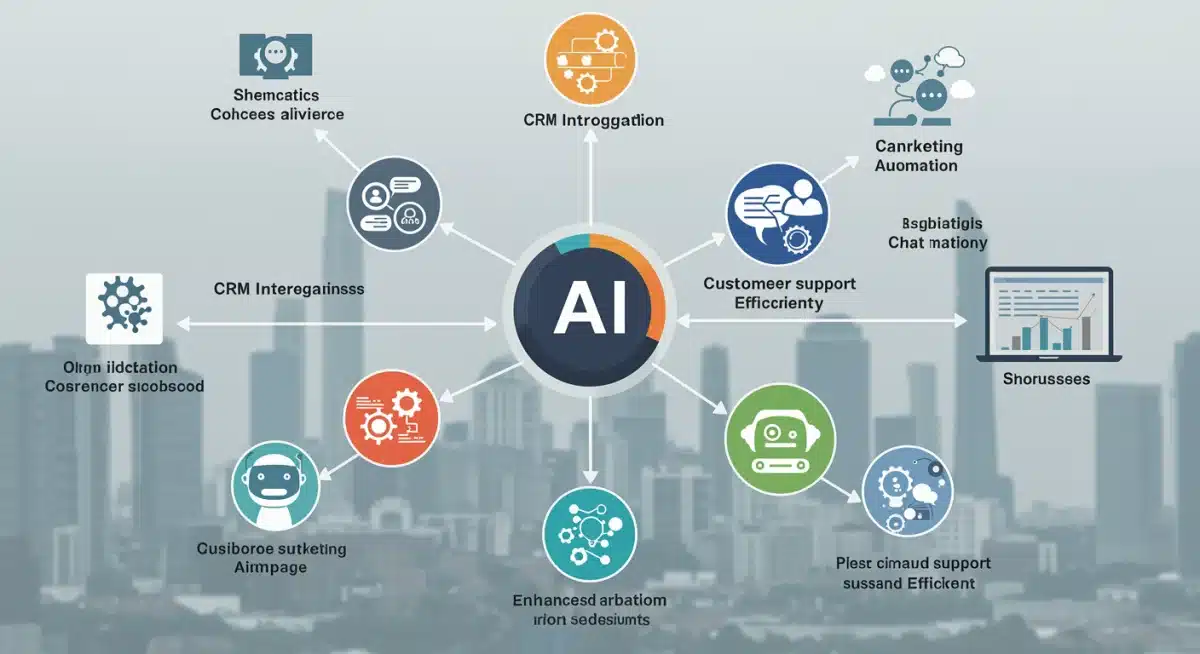
Microsoft Copilot is transforming how small businesses approach daily productivity and collaboration by integrating AI directly into the Microsoft 365 suite. This ubiquitous tool acts as an intelligent assistant across applications like Word, Excel, PowerPoint, Outlook, and Teams. For small businesses, this means enhanced efficiency in document creation, data analysis, email management, and meeting summarization.
Copilot empowers users to generate content, analyze data, and summarize information with simple natural language prompts. Imagine drafting a marketing report in Word, analyzing sales figures in Excel, or summarizing a lengthy email thread in Outlook, all with AI assistance. This significantly reduces the time spent on administrative tasks, allowing employees to focus on higher-value activities.
Its integration with Teams also facilitates more productive meetings, offering real-time transcription, action item identification, and meeting summaries. This makes collaboration smoother and ensures important decisions are captured and acted upon efficiently. For small businesses, Copilot democratizes access to advanced AI capabilities, making sophisticated tools accessible for everyday use.
Platform 4: Grammarly Business – AI-Powered Communication Enhancement
Effective communication is paramount for any small business, and Grammarly Business elevates this to an AI-powered art form. This platform goes beyond basic grammar and spell-checking, offering sophisticated suggestions for clarity, conciseness, tone, and style across all written communications. For small businesses, this means professional-grade emails, reports, marketing copy, and website content without needing a dedicated editor.
Grammarly Business helps teams maintain consistent brand voice and tone, ensuring all external communications reflect professionalism and clarity. Its AI algorithms analyze text in real-time, providing instant feedback and suggestions to improve readability and impact. This is particularly valuable for small teams where individuals often wear multiple hats, including content creation and customer correspondence.
Communication Advantages with Grammarly Business
- Clarity and Conciseness: AI suggestions to simplify complex sentences and remove jargon.
- Tone Detection: Identifies and suggests adjustments to ensure appropriate tone for the audience.
- Consistency: Helps maintain a uniform brand voice across all team members’ communications.
- Plagiarism Detection: Ensures originality in written content, crucial for marketing and PR.
By refining written communication, Grammarly Business helps small businesses build stronger relationships with clients, project a professional image, and avoid costly misunderstandings, ultimately contributing to improved efficiency and reputation.
Platform 5: Intercom – AI for Customer Engagement and Support
Intercom is a leading platform for customer engagement, and its AI capabilities are specifically designed to enhance customer support and communication for small businesses. It combines live chat, chatbots, and targeted messaging to create a seamless and personalized customer experience. For small businesses, this means handling customer inquiries more efficiently and proactively engaging with visitors on their websites.
The AI-powered chatbots, known as ‘bots,’ can answer common questions, qualify leads, and route complex queries to the appropriate human agent, thereby reducing response times and improving customer satisfaction. Intercom’s AI also analyzes customer interactions to provide insights into common pain points and areas for improvement, allowing businesses to refine their support strategies.
Furthermore, Intercom’s AI helps personalize outbound messaging, enabling small businesses to send targeted messages to customers based on their behavior and preferences. This proactive engagement can lead to higher conversion rates and increased customer loyalty. The platform’s focus on conversational AI makes it an invaluable asset for small businesses aiming to deliver exceptional customer service at scale.
Choosing the Right AI Tools for Your Small Business
Selecting the ideal AI tools for your small business requires careful consideration of your specific needs, budget, and growth objectives. Each platform discussed—HubSpot AI, Zoho CRM Plus, Microsoft Copilot, Grammarly Business, and Intercom—offers distinct advantages tailored to different aspects of business operations. The key is to identify the areas where AI can provide the most significant impact for your unique enterprise.
Begin by assessing your current bottlenecks. Are you struggling with lead generation and marketing automation? HubSpot AI might be your solution. Do you need an integrated system for managing various business functions with intelligent assistance? Zoho CRM Plus could be the answer. If daily productivity and collaboration are your primary concerns, Microsoft Copilot offers robust assistance within the familiar Microsoft 365 ecosystem. For enhancing communication quality, Grammarly Business is unparalleled, while Intercom excels in customer engagement and support.
Consider starting with a pilot program or a free trial to evaluate how a particular AI tool integrates with your existing workflows and delivers tangible benefits. Scalability is also a crucial factor; ensure the chosen platform can grow alongside your business without significant disruptions or prohibitive costs. Investing in the right AI tools today can pave the way for sustained efficiency and competitive advantage in 2025 and beyond.
The landscape of AI tools for small businesses is rapidly evolving, offering unprecedented opportunities for growth and optimization. By strategically adopting these technologies, small businesses can not only survive but thrive in an increasingly digital world, transforming challenges into opportunities for innovation and efficiency.
| Platform | Primary Benefit for Small Businesses |
|---|---|
| HubSpot AI | Integrated CRM and Marketing Automation |
| Zoho CRM Plus | Comprehensive Business Management with AI Assistant Zia |
| Microsoft Copilot | AI for Everyday Productivity and Collaboration |
| Intercom | AI for Customer Engagement and Support |
Frequently Asked Questions About AI Tools for Small Businesses
AI tools offer small businesses enhanced efficiency through task automation, improved decision-making via data analytics, superior customer experiences with personalized interactions, and significant cost reductions by optimizing resource allocation. These benefits collectively drive growth and competitiveness.
Choosing the right AI platform involves assessing your specific business needs, identifying operational bottlenecks, and evaluating budget constraints. Consider platforms that offer scalability and seamless integration with existing systems. Utilizing free trials can also help determine suitability before full commitment.
While some AI solutions can be costly, many platforms offer tiered pricing suitable for small businesses, including free trials or freemium models. The initial investment often yields significant returns through increased efficiency, reduced operational costs, and improved customer satisfaction, making it a worthwhile expenditure.
AI is primarily designed to automate repetitive and data-intensive tasks, thereby augmenting human capabilities rather than replacing them entirely. It frees up employees to focus on more creative, strategic, and interpersonal aspects of their roles, enhancing overall productivity and job satisfaction within the business.
AI enhances customer service by providing instant support through chatbots, personalizing interactions based on customer data, and efficiently routing complex queries to human agents. This leads to faster response times, higher customer satisfaction, and a more streamlined support operation, building stronger customer relationships.
Conclusion
The landscape of small business operations is undergoing a profound transformation, driven significantly by the adoption of artificial intelligence. As we move into 2025, the ability to selectively integrate and effectively utilize AI tools small businesses can access will be a critical differentiator for success. From streamlining marketing and sales with HubSpot AI and Zoho CRM Plus, to enhancing daily productivity with Microsoft Copilot, refining communication with Grammarly Business, and optimizing customer engagement with Intercom, the options are diverse and powerful. The strategic implementation of these platforms promises not just efficiency gains but also a pathway to innovation, competitive advantage, and sustained growth in an increasingly digital and data-driven marketplace. Small businesses that embrace AI are not just adapting to the future; they are actively shaping it.