AI for Predictive Outbreak Monitoring: 20% Faster Response by Mid-2025

Implementing AI for predictive outbreak monitoring offers a robust solution to significantly cut response times, aiming for a 20% reduction by mid-2025 through advanced data analysis and early detection.
The landscape of global health is constantly evolving, presenting new challenges in controlling infectious diseases. Successfully implementing AI for predictive outbreak monitoring to cut response time by 20% by mid-2025 is not merely an ambitious goal but a critical necessity. This article explores the practical steps and strategic frameworks required to leverage artificial intelligence in creating more responsive and effective public health systems.
Understanding the imperative for AI in outbreak monitoring
The speed at which infectious diseases can spread globally demands innovative solutions beyond traditional surveillance methods. AI offers a transformative approach, moving from reactive responses to proactive prediction, which is crucial for mitigating widespread health crises.
Traditional methods often rely on manual data collection and analysis, which can be slow and prone to human error. In contrast, AI systems can process vast amounts of diverse data sources in real-time, identifying subtle patterns and anomalies that might indicate an emerging outbreak. This shift is not just about efficiency; it’s about fundamentally altering our capacity to protect public health.
The limitations of conventional surveillance
While foundational, conventional surveillance faces several hurdles in today’s interconnected world. These limitations often delay critical information, impacting the timeliness of interventions.
- Data lag: Manual reporting and aggregation can create significant delays.
- Limited data sources: Often restricted to clinical reports, missing broader community signals.
- Resource intensity: Requires extensive human capital for data entry and initial analysis.
- Geographic disparities: Inconsistent reporting standards across regions hinder comprehensive views.
These challenges underscore why embracing AI is no longer optional but essential for modern public health preparedness. The ability to integrate multiple data streams and apply sophisticated analytical models makes AI an indispensable tool.
The predictive power of AI
AI’s strength lies in its capacity to analyze complex datasets, including epidemiological records, social media trends, environmental factors, and even travel patterns. By identifying correlations and predicting potential hotspots, AI enables health authorities to act before an outbreak escalates.
This predictive capability translates directly into earlier interventions, potentially saving lives and reducing the economic burden of disease. Imagine a system that can flag a potential surge in influenza cases based on pharmacy sales of over-the-counter flu remedies and localized search queries, long before clinical diagnoses become widespread.
Ultimately, the imperative for AI in outbreak monitoring stems from the need for speed, accuracy, and comprehensiveness in a world where diseases can cross borders in hours. By understanding its foundational role, we can better appreciate the practical steps required for its successful implementation.
Phase 1: foundational data infrastructure and integration
Achieving significant reductions in outbreak response times with AI begins with a robust data infrastructure. Without high-quality, accessible data, even the most advanced AI algorithms will fall short. This foundational phase involves meticulous planning and execution to ensure data readiness.
The objective is to consolidate disparate data sources into a unified, secure, and easily accessible platform. This includes everything from traditional public health records to non-traditional sources like environmental sensors and anonymized mobile data. The effectiveness of subsequent AI models hinges entirely on the richness and reliability of this initial data layer.
Identifying and prioritizing data sources
The first practical step is to conduct a comprehensive audit of all potential data sources. This involves collaboration across various agencies and sectors, including healthcare providers, government bodies, and even private technology companies.
- Clinical data: Electronic health records, laboratory results, and syndromic surveillance data.
- Environmental data: Weather patterns, air quality, and water quality reports.
- Socio-behavioral data: Social media trends, news reports, and anonymized mobility data.
- Supply chain data: Pharmaceutical sales, medical supply inventories.
Prioritizing these sources depends on the specific types of outbreaks being monitored and the resources available. Starting with high-impact, readily available data can provide early wins and build momentum for more complex integrations.
Establishing secure data pipelines
Once identified, data must be securely collected, transmitted, and stored. This requires implementing robust cybersecurity measures and adhering to strict privacy regulations, such as HIPAA in the United States.
Data pipelines should be automated wherever possible to ensure real-time or near real-time ingestion. This minimizes manual intervention and reduces the latency between data generation and its availability for AI analysis. Encryption, access controls, and regular security audits are non-negotiable components of this process.
Furthermore, data standardization is critical. Different sources often use varying formats and terminologies, necessitating data cleaning and harmonization processes to ensure compatibility and accuracy for AI models. This might involve developing common data dictionaries and APIs for seamless integration.
In conclusion, building a solid data foundation is the bedrock of any successful AI-driven outbreak monitoring system. It requires careful planning, inter-agency cooperation, and a strong commitment to data security and quality. This phase sets the stage for the powerful analytical capabilities that AI can bring to public health.
Phase 2: AI model development and rigorous validation
With a robust data infrastructure in place, the next crucial phase involves developing and rigorously validating the AI models themselves. This is where raw data transforms into actionable insights, enabling predictive capabilities that can significantly reduce response times.
This phase requires a multidisciplinary team, including data scientists, epidemiologists, public health experts, and AI engineers. Their combined expertise ensures that the models are not only technically sound but also clinically and epidemiologically relevant.
Selecting appropriate AI algorithms
The choice of AI algorithms depends on the specific prediction task. Different types of outbreaks and data characteristics may necessitate different approaches. Machine learning techniques are particularly well-suited for this domain.
- Supervised learning: For predicting known outcomes, such as the likelihood of an outbreak based on historical data. Algorithms like random forests, gradient boosting, and support vector machines are often effective.
- Unsupervised learning: For identifying novel patterns or clusters in data that might indicate an emerging, unknown threat. Clustering algorithms such as K-means or hierarchical clustering can be valuable.
- Deep learning: Especially recurrent neural networks (RNNs) or transformers, for analyzing sequential data like disease progression over time or for processing natural language from social media.
The selection process should involve experimentation and benchmarking against historical outbreak data to determine the most accurate and reliable models for specific contexts.
Training and validating models with historical data
Once algorithms are selected, they must be trained on extensive historical data. This training process teaches the AI to recognize patterns associated with past outbreaks.
Rigorous validation is critical to ensure the models are accurate and generalize well to new, unseen data. This typically involves splitting data into training, validation, and test sets. Key metrics for evaluation include sensitivity, specificity, predictive accuracy, and the area under the receiver operating characteristic (ROC) curve.
Furthermore, it’s essential to address potential biases in the training data, which could lead to skewed predictions and exacerbate health inequities. Regular auditing for fairness and transparency is paramount. Iterative refinement, where models are continuously improved based on performance feedback, is a cornerstone of this phase.
In essence, this phase transforms raw data and algorithms into intelligent predictive tools. The careful development and validation of these models are what enable the projected 20% cut in response time, providing public health officials with a powerful early warning system.
Phase 3: integration into public health workflows and real-time deployment
Developing sophisticated AI models is only half the battle; the true impact comes from seamlessly integrating these tools into existing public health workflows and deploying them for real-time monitoring. This phase focuses on operationalizing the AI system to ensure it becomes an indispensable part of outbreak response.
Effective integration means more than just providing data; it means delivering actionable insights directly to the decision-makers who need them, in a format they can easily understand and utilize. This requires careful consideration of user experience and existing operational procedures.
Developing user-friendly dashboards and alerts
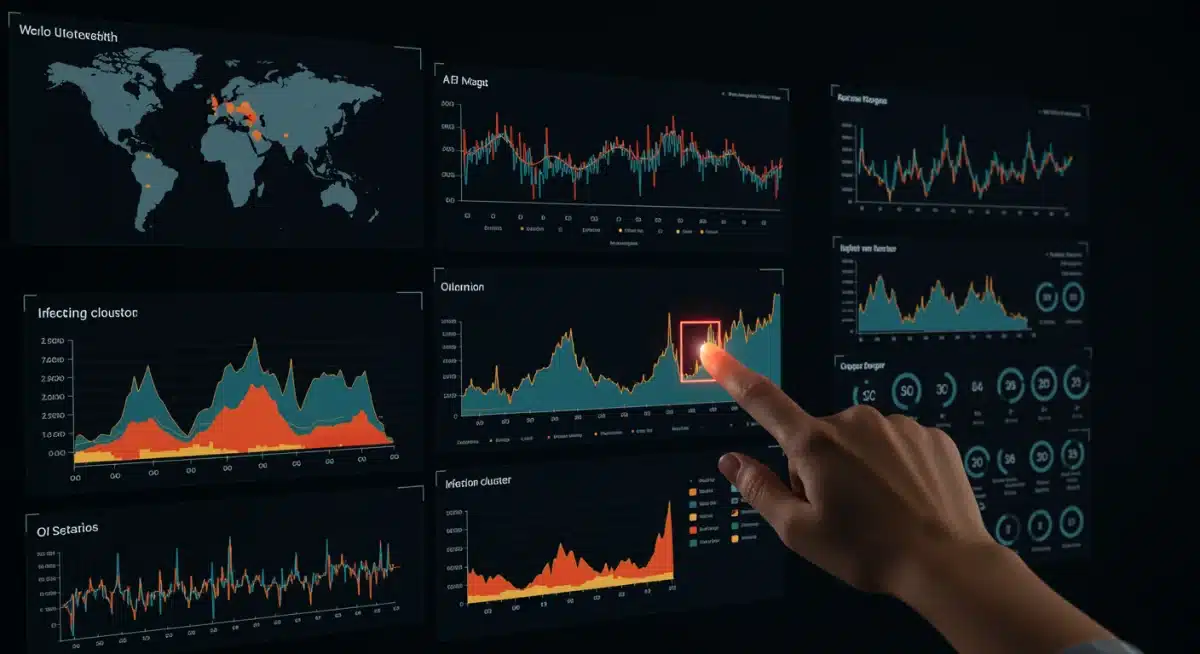
For AI predictions to be useful, they must be presented clearly and concisely. Dashboards should visualize key metrics, trends, and predicted outbreak hotspots, allowing public health officials to quickly grasp the situation.
- Intuitive interfaces: Easy to navigate, even for users without extensive technical backgrounds.
- Customizable alerts: Threshold-based notifications for emerging threats, delivered via email, SMS, or dedicated applications.
- Geospatial mapping: Visualizing outbreak data on maps to identify geographic clusters and spread patterns.
- Scenario modeling: Tools that allow officials to explore potential outcomes of different intervention strategies.
The design of these interfaces should be a collaborative effort between AI developers and public health practitioners to ensure they meet real-world needs and integrate effectively into daily operations.
Establishing real-time data feeds and continuous monitoring
The predictive power of AI is maximized when it operates on the freshest data available. This necessitates establishing real-time data feeds from all integrated sources, ensuring that the models are constantly updating their predictions.
Continuous monitoring implies that the AI system is always running, vigilant for new signals that might indicate an emerging threat. This proactive stance contrasts sharply with traditional, often retrospective, surveillance methods. It’s about creating a living, breathing system that evolves with the public health landscape.
Furthermore, mechanisms for feedback and recalibration are essential. As new data becomes available and outbreaks unfold, the AI models should be continuously re-evaluated and retrained to improve their accuracy. This adaptive learning loop is crucial for maintaining the system’s effectiveness over time.
By effectively integrating AI into public health workflows and enabling real-time deployment, we move closer to the goal of cutting response times. This operational phase bridges the gap between technological innovation and practical public health impact, making AI a truly transformative force.
Phase 4: fostering collaboration and ethical considerations
Successful implementation of AI for predictive outbreak monitoring extends beyond technical prowess; it fundamentally relies on robust collaboration and an unwavering commitment to ethical principles. This phase addresses the human and societal dimensions crucial for broad acceptance and sustained impact.
Building trust among stakeholders, ensuring data privacy, and fostering inter-agency cooperation are as vital as the algorithms themselves. A technically brilliant system that lacks public trust or ethical oversight will ultimately fail to achieve its potential.
Inter-agency cooperation and knowledge sharing
Effective outbreak monitoring often requires data and expertise from diverse entities, including local health departments, national agencies, international organizations, and even private tech companies. Establishing clear channels for communication and data sharing is paramount.
- Joint task forces: Bringing together experts from different fields to guide AI development and deployment.
- Standardized protocols: Agreements on data formats, sharing mechanisms, and reporting procedures.
- Training programs: Educating public health personnel on how to interpret and utilize AI-generated insights.
- Secure data exchange platforms: Technologies that facilitate safe and compliant sharing of sensitive health information.
These collaborative efforts not only enrich the data available to AI models but also build a shared understanding and commitment to the system’s goals.
Addressing data privacy, bias, and transparency
The use of AI in public health raises significant ethical questions that must be proactively addressed. Protecting individual privacy, ensuring fairness in predictions, and maintaining transparency in how AI models operate are non-negotiable.
Anonymization and de-identification techniques are crucial for safeguarding patient data. Policies must be in place to govern data access and usage, ensuring that information is only used for its intended public health purpose. Regular audits should be conducted to detect and mitigate algorithmic biases that could disproportionately affect certain populations.
Transparency involves explaining how AI models arrive at their predictions, even if the underlying algorithms are complex. This helps build trust among both public health officials and the general public, fostering acceptance of AI as a valuable tool rather than an opaque black box. Regular ethical reviews and public engagement are essential components of this ongoing process.
In summary, while the technical aspects of AI are critical, the human elements of collaboration and ethics form the bedrock of a truly successful and sustainable predictive outbreak monitoring system. By prioritizing these aspects, we ensure that AI serves the public good responsibly and effectively.
Phase 5: continuous improvement and scaling strategies
The journey of implementing AI for predictive outbreak monitoring doesn’t end with initial deployment; it’s an ongoing process of refinement, adaptation, and expansion. This phase focuses on ensuring the system remains effective, relevant, and capable of addressing future public health challenges.
Continuous improvement involves learning from real-world performance, updating models, and integrating new data sources. Scaling strategies prepare the system for broader application, both geographically and in terms of the types of outbreaks it can monitor.
Performance monitoring and model recalibration
Once deployed, the AI system’s performance must be continuously monitored against its stated objectives, particularly the goal of a 20% reduction in response time. Key performance indicators (KPIs) should be established to track accuracy, timeliness of alerts, and the impact on public health interventions.
- Real-time feedback loops: Mechanisms for health officials to provide input on the accuracy and utility of AI predictions.
- Automated performance metrics: Systems that continuously calculate model accuracy, precision, and recall.
- Scheduled model retraining: Regular updates to AI models using new data to maintain and improve predictive power.
- Anomaly detection for model drift: Tools to identify when a model’s performance begins to degrade due to changes in data patterns or environmental factors.
This iterative process ensures that the AI system remains sharp and responsive to evolving disease dynamics. Without constant vigilance and recalibration, even the best models can become outdated.
Scaling the solution for broader impact
After successful pilot programs and localized deployments, the next step is to scale the AI solution for broader impact. This might involve expanding its reach to cover larger geographic areas, integrating it with national public health systems, or adapting it to monitor a wider range of infectious diseases.
Scaling requires careful planning to ensure infrastructure can handle increased data loads and computational demands. It also involves developing modular components that can be easily adapted to different contexts and regulatory environments.
Furthermore, knowledge transfer and capacity building are crucial for successful scaling. Training additional personnel in new regions on how to use and maintain the AI system ensures its sustainability. The ultimate aim is to create a widely adopted, resilient system that provides comprehensive predictive capabilities across diverse public health landscapes.
By embracing continuous improvement and strategic scaling, AI for predictive outbreak monitoring can evolve into a powerful, enduring asset for global public health, helping to achieve and surpass the ambitious goal of significantly reducing response times to emerging threats.
Measuring impact and achieving the 20% reduction target
The ultimate success of implementing AI for predictive outbreak monitoring hinges on its measurable impact, specifically the ability to cut response times by 20% by mid-2025. This phase focuses on defining metrics, establishing baselines, and continuously evaluating progress toward this ambitious goal.
Measuring impact is not just about reporting numbers; it’s about demonstrating tangible improvements in public health outcomes. This requires a clear understanding of what constitutes ‘response time’ and how AI interventions directly influence it.
Defining and tracking response time metrics
To accurately measure a 20% reduction, a precise definition of ‘response time’ is essential. This typically involves the duration from the first signal of a potential outbreak to the implementation of initial public health interventions (e.g., alert dissemination, resource mobilization, initial investigations).
- Baseline establishment: Documenting average response times using traditional methods prior to AI implementation.
- Key milestones: Tracking specific points in the response chain, such as time from signal detection to official alert, or from alert to first field team deployment.
- Data collection: Implementing robust systems to collect data on these new, AI-informed response times.
- Comparative analysis: Regularly comparing AI-driven response times against the established baseline and traditional methods.
These metrics provide the quantitative evidence needed to assess the AI system’s effectiveness and identify areas for further optimization.
Attributing AI’s contribution to reduced response times
While a reduction in overall response time is the goal, it’s important to understand how much of that reduction can be directly attributed to the AI system. This requires careful analysis and, where possible, controlled comparisons.
AI contributes by providing earlier warnings, more precise risk assessments, and faster identification of affected populations. This allows public health officials to mobilize resources and deploy interventions much sooner than would be possible with manual methods. For instance, if an AI system detects an emerging cluster three days before traditional syndromic surveillance would, those three days are a direct gain attributable to AI.
Furthermore, AI can optimize resource allocation by pinpointing areas of highest risk, ensuring that limited resources are deployed most effectively. This efficiency indirectly contributes to faster, more targeted responses.
Achieving the 20% reduction target by mid-2025 requires not only the technical implementation of AI but also a strategic focus on measurement and attribution. By clearly defining success metrics and continuously evaluating performance, organizations can ensure that their investment in AI translates into tangible, life-saving improvements in public health response capabilities.
| Key Step | Brief Description |
|---|---|
| Data Infrastructure | Consolidate and secure diverse data sources for AI analysis, ensuring quality and accessibility. |
| AI Model Development | Select, train, and rigorously validate AI algorithms using historical data for accurate predictions. |
| Workflow Integration | Integrate AI insights into public health operations through user-friendly dashboards and real-time alerts. |
| Ethical Oversight | Ensure data privacy, address biases, and maintain transparency in AI deployment and use. |
Frequently asked questions about AI in outbreak monitoring
Crucial data types include clinical records, laboratory results, syndromic surveillance, social media trends, environmental factors, and anonymized mobility data. A diverse set of high-quality data sources enhances the AI model’s predictive accuracy and comprehensive understanding of potential outbreaks.
AI reduces response time by providing early detection of potential outbreaks through real-time analysis of vast datasets. It identifies subtle patterns and anomalies faster than human-led methods, enabling public health officials to issue alerts, mobilize resources, and implement interventions much sooner.
Key ethical considerations include ensuring data privacy through anonymization, addressing algorithmic biases to prevent health inequities, and maintaining transparency in how AI models generate predictions. Robust governance and public trust are essential for successful and responsible AI deployment.
Accuracy is ensured through rigorous training and validation with historical data, continuous performance monitoring, and regular recalibration. Establishing real-time feedback loops and conducting automated performance metric tracking are vital for maintaining and improving the models’ predictive power over time.
Collaboration is critical, involving inter-agency cooperation among health departments, government bodies, and private tech companies. It facilitates data sharing, standardizes protocols, and builds shared expertise, ensuring a comprehensive and coordinated approach to leveraging AI for public health.
Conclusion
The journey toward implementing AI for predictive outbreak monitoring to cut response time by 20% by mid-2025 is a multifaceted endeavor, requiring strategic vision, technical expertise, and an unwavering commitment to public health. By meticulously addressing data infrastructure, model development, workflow integration, ethical considerations, and continuous improvement, organizations can transform their ability to anticipate and respond to infectious disease threats. The proactive power of AI offers not just efficiency gains but a fundamental shift towards a more resilient and prepared global health system, ultimately safeguarding communities and saving lives.