AI in Supply Chains 2026: Reduce Logistics Delays by 25%

Artificial intelligence will be crucial in transforming supply chains by 2026, providing practical solutions to drastically cut logistics delays and improve operational efficiency across industries.
In an increasingly interconnected and demanding global economy, the efficiency of supply chains is paramount. By 2026, the integration of artificial intelligence (AI) is not just an advantage, but a necessity for businesses aiming to stay competitive and responsive. This guide explores how to achieve a significant reduction in logistics delays, specifically targeting a 25% improvement, through strategic AI implementation. Optimizing supply chains with AI in 2026 offers a transformative pathway to operational excellence and enhanced customer satisfaction.
Understanding the Current Supply Chain Landscape
The traditional supply chain, often characterized by manual processes and siloed data, faces numerous challenges. From unforeseen disruptions like natural disasters and geopolitical events to everyday complexities such as fluctuating demand and transportation bottlenecks, the system is constantly under pressure. These challenges often lead to significant delays, increased costs, and ultimately, dissatisfied customers. Recognizing these pain points is the first step toward embracing AI as a solution.
Before diving into AI solutions, it’s essential to conduct a thorough audit of existing processes. This involves mapping out the entire supply chain, identifying every touchpoint, and pinpointing areas where delays most frequently occur. Understanding the root causes of these inefficiencies, whether they stem from poor forecasting, inadequate inventory management, or communication breakdowns, provides a clear roadmap for AI intervention.
The evolution of supply chain challenges
Historically, supply chain managers relied on historical data and basic statistical models. While effective to a degree, these methods often fell short when faced with unprecedented global events or rapid market shifts. The sheer volume of data generated today, from sensor readings on shipping containers to real-time traffic updates, overwhelms traditional analytical approaches, making human-driven optimization increasingly difficult.
- Global market volatility and economic uncertainties.
- Increasing customer expectations for speed and transparency.
- Complex regulatory environments and compliance issues.
The conclusion here is that the intricate nature of modern supply chains demands a more sophisticated approach. AI offers the computational power and analytical capabilities to process vast datasets, identify subtle patterns, and provide actionable insights that human analysis alone cannot.
Setting the Foundation: Data Collection and Infrastructure
The success of any AI initiative hinges entirely on the quality and accessibility of data. For supply chain optimization, this means gathering comprehensive data from every stage: procurement, manufacturing, warehousing, transportation, and last-mile delivery. This data must be accurate, consistent, and available in real-time or near real-time to feed AI algorithms effectively. Establishing a robust data infrastructure is therefore a critical prerequisite.
Investing in technologies such as IoT sensors, RFID tags, and advanced enterprise resource planning (ERP) systems is vital. These tools facilitate the automated collection of granular data, ranging from temperature and humidity in storage facilities to the exact location of goods in transit. Without this rich data foundation, AI models lack the fuel needed for accurate predictions and optimizations.
Building a unified data platform
Fragmented data sources are a common hurdle. To overcome this, organizations must aim to create a unified data platform or data lake. This central repository integrates data from disparate systems, providing a holistic view of the supply chain. Data normalization and cleansing processes are crucial to ensure consistency and eliminate errors, making the data suitable for AI consumption.
- Implement IoT devices for real-time tracking.
- Integrate ERP, WMS, and TMS systems.
- Establish data governance policies for quality and security.
In conclusion, a well-structured data foundation is not merely a technical requirement but a strategic asset. It empowers AI systems to draw accurate conclusions and make informed decisions, directly contributing to reducing logistics delays and enhancing overall efficiency.
Leveraging AI for Predictive Analytics and Demand Forecasting
One of AI’s most powerful applications in supply chain management is its ability to perform highly accurate predictive analytics, especially in demand forecasting. Traditional forecasting methods often struggle with volatility, leading to either overstocking (and associated holding costs) or understocking (and lost sales). AI, with its capacity to analyze vast and varied datasets, can significantly improve these predictions.
Machine learning algorithms can identify complex patterns in historical sales data, promotional activities, economic indicators, social media trends, and even weather patterns. By continuously learning from new data, these models adapt and refine their forecasts, providing a much clearer picture of future demand. This precision enables businesses to optimize inventory levels, plan production schedules more effectively, and proactively manage their logistics.
Advanced forecasting models
Beyond simple regression, AI employs sophisticated techniques like neural networks and ensemble models to predict demand. These models can uncover subtle correlations and non-linear relationships that human analysts or simpler statistical tools might miss. The result is a more resilient supply chain, less prone to the shocks of unexpected demand surges or drops.
- Utilize deep learning for pattern recognition in large datasets.
- Incorporate external factors like economic trends and news sentiment.
- Implement continuous learning loops to refine models over time.
The practical application of AI in predictive demand forecasting translates directly into fewer stockouts, reduced waste, and more efficient resource allocation. This directly contributes to the goal of optimizing supply chains with AI in 2026 by minimizing the delays caused by misaligned inventory and production.
AI-Powered Route Optimization and Fleet Management
Transportation is a major component of logistics, and often a significant source of delays and costs. AI offers revolutionary solutions for route optimization and fleet management, moving beyond static route planning to dynamic, real-time adjustments. This capability is crucial for reducing transit times, fuel consumption, and operational expenses.
AI algorithms can analyze real-time traffic conditions, weather forecasts, road closures, delivery schedules, and vehicle capacities to determine the most efficient routes. This isn’t just about finding the shortest path, but the optimal one considering a multitude of variables. For example, an AI system can instantly re-route a delivery truck to avoid unexpected congestion, ensuring on-time arrival.
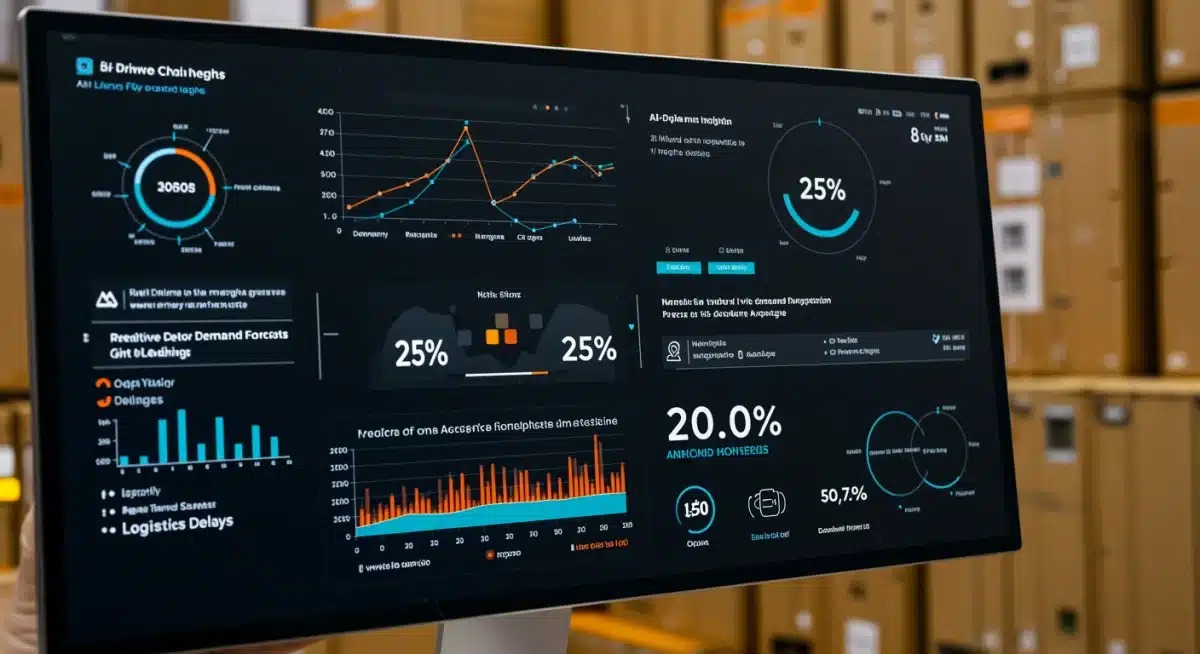
Dynamic routing and real-time adjustments
Modern fleet management systems integrated with AI provide dispatchers with predictive insights and automated decision-making tools. They can anticipate potential delays before they occur and suggest alternative strategies. This proactive approach minimizes disruptions and keeps goods moving efficiently through the network.
- Integrate GPS data with AI for real-time traffic analysis.
- Optimize vehicle loading and sequencing for maximum efficiency.
- Implement predictive maintenance for fleet vehicles to prevent breakdowns.
In summary, AI-powered route optimization and fleet management transform logistics from a reactive process into a highly proactive and agile operation. By continuously adapting to changing conditions, AI ensures that goods reach their destinations faster and more reliably, directly contributing to a 25% reduction in logistics delays.
Enhancing Warehouse Operations with AI and Robotics
Warehouses are central hubs in the supply chain, and their efficiency directly impacts overall logistics performance. AI, when combined with robotics and automation, can dramatically improve warehouse operations, from inventory placement and retrieval to order fulfillment. This integration leads to faster processing times, reduced errors, and optimized space utilization.
AI-driven warehouse management systems (WMS) can analyze product characteristics, demand patterns, and order profiles to determine the most optimal storage locations. This minimizes travel time for human or robotic pickers. Robotic process automation (RPA) handles repetitive tasks like picking, packing, and sorting, freeing up human workers for more complex, value-added activities.
Smart inventory management
Beyond simple placement, AI can manage inventory with unprecedented accuracy. Predictive algorithms can identify slow-moving items versus fast-moving items, suggesting optimal reorder points and quantities. Computer vision systems can monitor inventory levels in real-time, reducing the need for manual counts and significantly cutting down on discrepancies.
- Deploy autonomous mobile robots (AMRs) for material handling.
- Implement AI-powered vision systems for quality control and inventory tracking.
- Optimize warehouse layout based on AI analysis of workflow and product movement.
The conclusion for warehouse operations is clear: AI and robotics create a highly efficient, error-resistant environment. By streamlining internal logistics and inventory management, these technologies play a vital role in optimizing supply chains with AI in 2026 and achieving significant delay reductions across the entire network.
Implementing AI: A Step-by-Step Guide for 2026
Successfully integrating AI into your supply chain requires a structured approach. It’s not a one-time project but an ongoing process of adoption, learning, and refinement. Companies looking to achieve a 25% reduction in logistics delays by 2026 should follow a clear roadmap, starting with pilot programs and scaling gradually.
Begin with a clear definition of the problem you aim to solve and identify a specific area within your supply chain that could benefit most from AI. This could be demand forecasting for a particular product line or route optimization for a specific region. A phased approach allows for testing, learning, and demonstrating tangible ROI, building internal support for broader implementation.
Strategic AI adoption roadmap
Engaging with AI solution providers or building internal AI capabilities are both viable options. For many organizations, a hybrid approach combining off-the-shelf solutions with custom development makes the most sense. Continuous training for employees on new AI tools and processes is also crucial for successful adoption.
- Define clear objectives and KPIs for AI projects.
- Start with small-scale pilot programs to validate concepts.
- Invest in data scientists and AI engineers or partner with experts.
In conclusion, the journey to optimizing supply chains with AI in 2026 is strategic and iterative. By meticulously planning, executing, and refining AI initiatives, businesses can systematically dismantle bottlenecks and achieve significant improvements in logistics efficiency and reliability.
Measuring Impact and Continuous Improvement
Achieving a 25% reduction in logistics delays is an ambitious but attainable goal with AI. However, simply implementing AI tools is not enough; continuous monitoring and measurement of their impact are critical. Establishing clear Key Performance Indicators (KPIs) from the outset allows businesses to track progress, identify areas for further optimization, and demonstrate the value of AI investments.
KPIs should include metrics such as on-time delivery rates, lead times, inventory turnover, transportation costs, and customer satisfaction scores. AI systems themselves can be configured to report on these metrics, providing real-time dashboards and alerts. This data-driven feedback loop is essential for refining AI models and processes, ensuring that the benefits are sustained and enhanced over time.
Iterative optimization with AI
AI is not a static solution; it thrives on continuous learning. As new data streams in and market conditions evolve, AI models can be retrained and updated to maintain their predictive accuracy and optimization capabilities. This iterative process ensures that the supply chain remains agile and responsive to future challenges, continuously pushing towards greater efficiency.
- Establish a robust framework for tracking logistics KPIs.
- Utilize AI tools for performance monitoring and anomaly detection.
- Foster a culture of continuous improvement and adaptation within the organization.
Ultimately, measuring impact and committing to continuous improvement are what transform AI from a technology investment into a strategic advantage. By doing so, businesses can not only meet but exceed their goals for reducing logistics delays, solidifying their competitive position through optimizing supply chains with AI in 2026.
| Key Area | AI Impact |
|---|---|
| Demand Forecasting | Significantly improves accuracy, reducing overstocking and stockouts. |
| Route Optimization | Enables real-time, dynamic adjustments to minimize transit delays. |
| Warehouse Operations | Automates tasks and optimizes inventory placement for faster fulfillment. |
| Risk Management | Identifies potential disruptions proactively, allowing for contingency planning. |
Frequently Asked Questions About AI in Supply Chains
AI reduces delays by enhancing predictive analytics for demand and supply, optimizing transportation routes in real-time, automating warehouse operations, and providing early warnings for potential disruptions. These capabilities lead to more efficient planning and execution across the entire supply chain.
Crucial data includes historical sales, inventory levels, transportation metrics, real-time traffic and weather, economic indicators, and supplier performance. The more comprehensive and accurate the data, the better AI can analyze patterns and make informed predictions and recommendations for optimization.
Yes, a 25% reduction is realistic with strategic AI implementation. Companies adopting AI for demand forecasting, route optimization, and automated warehouse management have already demonstrated significant improvements, making this target achievable for those who invest in robust AI solutions.
Start by assessing your current supply chain bottlenecks, establishing a strong data infrastructure, and defining clear objectives. Begin with a pilot project in a specific area, then scale up. Investing in relevant technologies and training your team are also vital initial steps.
AI offers SMBs a competitive edge by democratizing advanced optimization tools previously exclusive to large enterprises. Cloud-based AI solutions make it affordable to access predictive analytics and route optimization, enabling SMBs to improve efficiency and compete effectively in the market.
Conclusion
The journey towards optimizing supply chains with AI in 2026 is not merely about adopting new technology; it’s about fundamentally rethinking how goods move from origin to destination. By embracing AI-driven predictive analytics, dynamic route optimization, and intelligent warehouse management, businesses can achieve significant reductions in logistics delays, enhance operational efficiency, and build more resilient supply chains. The 25% delay reduction target is an achievable benchmark that reflects the transformative power of AI, positioning companies for sustained success in a rapidly evolving global marketplace. The future of logistics is intelligent, proactive, and meticulously optimized by AI, promising a new era of efficiency and reliability.