AI Governance Frameworks: Essential for US Organizations by 2026
In the rapidly evolving landscape of artificial intelligence, the imperative for robust AI Governance Frameworks has never been more critical, especially for U.S. organizations. As AI systems become increasingly sophisticated and integrated into every facet of business and society, the need to ensure their ethical, transparent, and accountable deployment is paramount. The projected timeline of mid-2026 highlights the urgency, as regulatory bodies and public expectations continue to accelerate. This comprehensive guide delves into the essential frameworks that U.S. organizations must adopt to navigate this complex terrain, build trustworthy AI, and remain competitive and compliant.
The promise of AI is immense, offering unprecedented opportunities for innovation, efficiency, and growth. However, this potential is accompanied by significant risks, including algorithmic bias, privacy violations, security vulnerabilities, and job displacement. Without clear and enforceable AI Governance Frameworks, organizations risk not only legal and financial penalties but also severe reputational damage and a loss of public trust. The U.S. government, through initiatives like the National Institute of Standards and Technology (NIST) AI Risk Management Framework, has already laid foundational groundwork, signaling a clear direction for responsible AI development and deployment.
This article will explore seven pivotal AI Governance Frameworks that U.S. organizations should prioritize for implementation by mid-2026. These frameworks are not merely theoretical constructs; they are actionable blueprints designed to guide organizations in establishing a resilient and ethical AI ecosystem. From ensuring data privacy and security to promoting fairness and transparency, each framework addresses a unique yet interconnected aspect of responsible AI. By understanding and adopting these guidelines, organizations can proactively mitigate risks, foster innovation, and ultimately build AI systems that benefit humanity.
Understanding the Urgency: Why Mid-2026 is the Deadline for AI Governance Frameworks
The timeline of mid-2026 is not arbitrary; it reflects a confluence of factors driving the urgent need for robust AI Governance Frameworks. Firstly, the pace of AI development is accelerating exponentially. New models and applications are emerging almost daily, often outpacing the ability of existing legal and ethical guidelines to keep up. This rapid advancement necessitates a proactive approach to governance rather than a reactive one.
Secondly, regulatory pressures are intensifying. While the U.S. has historically favored a sector-specific approach to regulation, there is a growing consensus that a more comprehensive framework for AI is needed. The NIST AI Risk Management Framework (AI RMF) is a prime example of this shift, providing a voluntary yet highly influential set of guidelines that are increasingly seen as a de facto standard. Beyond NIST, various federal agencies are exploring or implementing AI-specific regulations within their domains, from healthcare to finance. States are also beginning to enact their own AI-related legislation, creating a complex patchwork that organizations must navigate.
Thirdly, public and consumer expectations are rising. As AI becomes more ubiquitous, individuals are becoming more aware of its potential impact on their lives, from privacy concerns to issues of fairness and accountability. Organizations that fail to demonstrate a commitment to ethical AI risk losing the trust of their customers, employees, and stakeholders. A strong AI Governance Frameworks can serve as a testament to an organization’s dedication to responsible innovation.
Finally, the competitive landscape demands it. Organizations that can confidently deploy trustworthy AI will gain a significant competitive advantage. This includes attracting top talent, securing investment, and fostering deeper partnerships. Conversely, those that lag in establishing strong AI Governance Frameworks may find themselves at a disadvantage, struggling with compliance issues, ethical dilemmas, and a diminished capacity to innovate responsibly.
The mid-2026 deadline, therefore, represents a critical window for U.S. organizations to establish foundational AI Governance Frameworks. It’s an opportunity to move beyond ad-hoc solutions and embed responsible AI practices deeply within their organizational culture and operations. The following sections will detail the specific frameworks that can help achieve this.
Framework 1: The NIST AI Risk Management Framework (AI RMF)
At the forefront of U.S. AI governance is the National Institute of Standards and Technology (NIST) AI Risk Management Framework (AI RMF). Published in January 2023, the AI RMF is a voluntary framework designed to help organizations manage the risks of artificial intelligence. It emphasizes a flexible, outcomes-based approach that can be adapted to various sectors and AI applications. For any U.S. organization serious about AI Governance Frameworks, the NIST AI RMF is an indispensable starting point.
Core Principles of NIST AI RMF:
- Govern: Establish an AI risk management culture, policies, and procedures. This involves defining roles and responsibilities, setting clear objectives, and integrating AI risk management into broader enterprise risk management strategies.
- Map: Identify and characterize AI risks. This includes understanding the context of AI use, identifying potential harms (e.g., bias, privacy, security), and assessing the severity and likelihood of these harms.
- Measure: Evaluate, analyze, and track AI risks. This involves developing metrics and tools to assess the effectiveness of risk mitigation strategies, monitoring AI system performance, and conducting regular audits.
- Manage: Prioritize, respond to, and recover from AI risks. This includes implementing controls, developing incident response plans, and continuously improving AI risk management processes based on lessons learned.
The NIST AI RMF is particularly valuable because it provides a common language and set of principles for discussing and addressing AI risks across different stakeholders. It encourages a multi-disciplinary approach, bringing together technical experts, legal teams, ethicists, and business leaders. Implementing this framework helps organizations not only identify and mitigate risks but also build confidence in their AI systems, fostering greater adoption and trust.
Organizations should consider the NIST AI RMF as the foundational pillar of their AI Governance Frameworks strategy. It provides a robust, adaptable structure that can be tailored to specific organizational needs while aligning with broader national guidance on responsible AI.
Framework 2: Data Governance for AI: Ensuring Quality, Privacy, and Security
AI systems are only as good as the data they are trained on. Therefore, a robust data governance framework is an absolutely critical component of any effective set of AI Governance Frameworks. This framework focuses on the entire lifecycle of data used in AI, from collection and storage to processing, usage, and eventual disposal. Without meticulous data governance, AI systems are susceptible to biases, inaccuracies, and significant privacy and security vulnerabilities.
Key Pillars of Data Governance for AI:
- Data Quality: Ensuring that data is accurate, complete, consistent, and timely. Poor data quality can lead to flawed AI models and biased outcomes. This involves implementing data validation rules, cleansing processes, and regular quality audits.
- Data Privacy: Adhering to relevant privacy regulations such as GDPR, CCPA, and emerging state-level privacy laws. This includes obtaining informed consent, anonymizing or pseudonymizing sensitive data, and implementing robust access controls.
- Data Security: Protecting data from unauthorized access, breaches, and cyber threats. This involves encryption, multi-factor authentication, secure storage solutions, and regular security assessments.
- Data Lineage and Provenance: Maintaining clear records of where data comes from, how it was collected, and how it has been transformed. This is crucial for auditing, debugging, and ensuring traceability of AI decisions.
- Data Ethics: Establishing ethical guidelines for data collection and usage, particularly concerning sensitive populations or potentially discriminatory attributes. This includes considerations around data minimization and purpose limitation.
Implementing a strong data governance framework requires collaboration between data scientists, IT security teams, legal counsel, and business units. It’s not a one-time task but an ongoing process that evolves with new data sources, AI applications, and regulatory changes. For U.S. organizations, prioritizing data governance ensures that their AI initiatives are built on a solid, ethical, and legally compliant foundation, making it a cornerstone of effective AI Governance Frameworks.
Framework 3: Ethical AI Principles and Guidelines
Beyond technical and regulatory compliance, the ethical dimension of AI is non-negotiable. Establishing clear Ethical AI Principles and Guidelines is a fundamental aspect of comprehensive AI Governance Frameworks. These principles serve as a moral compass, guiding the development, deployment, and use of AI systems to ensure they align with societal values and human well-being.
Common Ethical AI Principles:
- Fairness and Non-Discrimination: Ensuring AI systems treat all individuals and groups equitably, avoiding biases that could lead to discriminatory outcomes. This requires rigorous testing for bias and implementing bias mitigation strategies.
- Transparency and Explainability: Making AI systems understandable and their decisions interpretable. Users and stakeholders should be able to comprehend how an AI system arrived at a particular conclusion, especially in high-stakes applications.
- Accountability and Responsibility: Clearly defining who is responsible for the actions and outcomes of AI systems. This includes establishing mechanisms for redress and oversight when AI causes harm.
- Privacy and Security: Reinforcing the importance of protecting personal data and ensuring the security of AI systems against malicious attacks, as detailed in the data governance framework.
- Human Oversight and Control: Ensuring that humans retain ultimate control over AI systems, with mechanisms for intervention and override. AI should augment human capabilities, not replace human judgment entirely.
- Safety and Reliability: Designing AI systems to operate safely, consistently, and predictably, minimizing the risk of unintended consequences or failures.
Organizations should not merely adopt these principles; they must embed them into their AI development lifecycle. This involves training for AI developers and managers, regular ethical impact assessments, and establishing an internal ethics review board or committee. By prioritizing ethical considerations, U.S. organizations can build public trust, mitigate reputational risks, and foster responsible innovation within their AI Governance Frameworks.
Framework 4: AI Risk Assessment and Mitigation Strategies
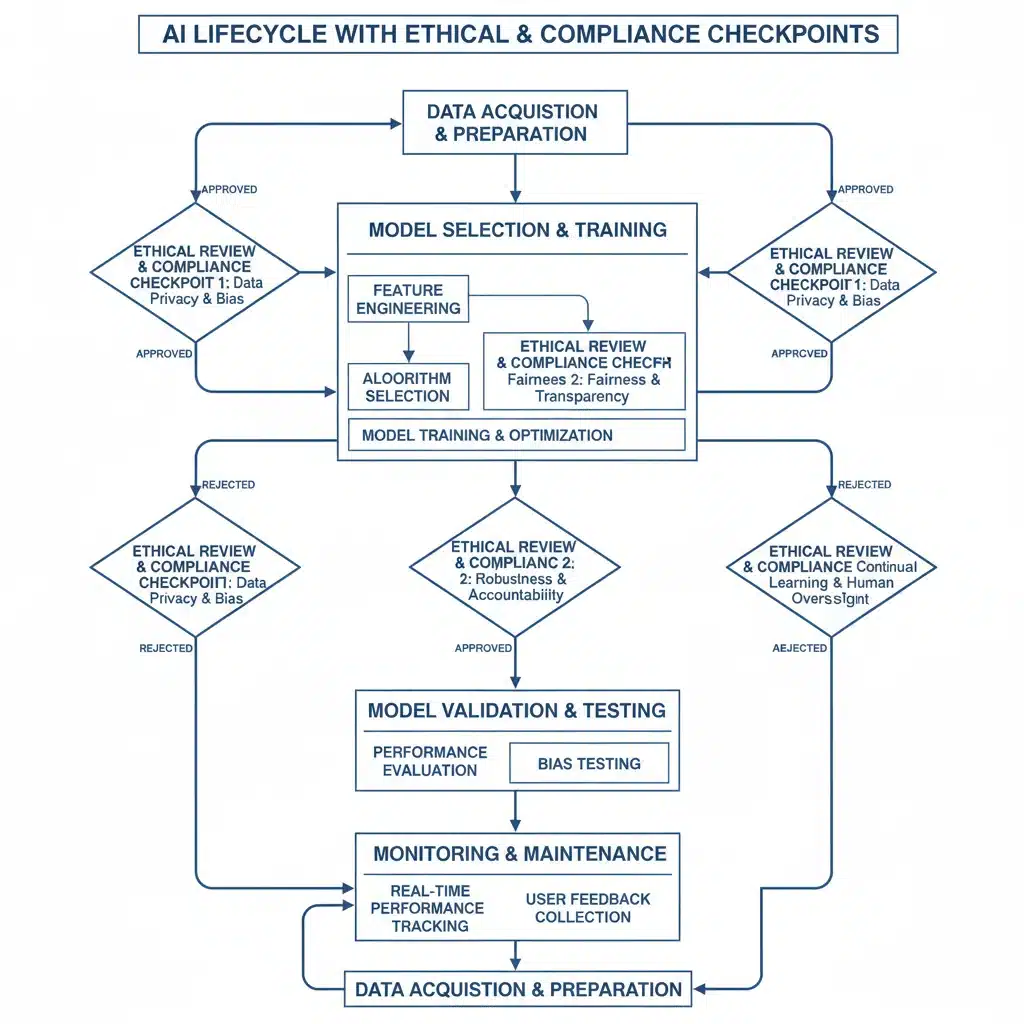
A proactive approach to identifying and addressing potential harms is central to effective AI Governance Frameworks. The AI Risk Assessment and Mitigation Strategies framework systematically identifies, evaluates, and controls risks associated with AI systems throughout their entire lifecycle. This goes hand-in-hand with the NIST AI RMF’s ‘Map’ and ‘Measure’ functions but focuses specifically on the practical implementation of risk management.
Key Components of AI Risk Assessment:
- Risk Identification: Cataloging potential harms, including technical failures, ethical breaches (e.g., bias, privacy violations), security vulnerabilities, and societal impacts (e.g., job displacement, misinformation). This requires brainstorming, expert consultation, and scenario planning.
- Risk Analysis and Evaluation: Assessing the likelihood and impact of identified risks. This often involves quantitative and qualitative methods to prioritize risks based on their potential severity and probability of occurrence.
- Mitigation Strategy Development: Designing and implementing controls to reduce or eliminate identified risks. This could include technical solutions (e.g., bias detection tools, explainable AI techniques), process changes (e.g., enhanced data validation, human-in-the-loop systems), or policy adjustments.
- Monitoring and Review: Continuously tracking the effectiveness of mitigation strategies and regularly reassessing risks as AI systems evolve and new information becomes available. This includes post-deployment monitoring and incident response planning.
- Documentation and Reporting: Maintaining thorough records of risk assessments, mitigation actions, and their outcomes. This is crucial for accountability, compliance, and demonstrating due diligence.
Implementing this framework requires a shift from viewing AI risks as purely technical problems to understanding them as complex, multi-faceted challenges that involve technical, ethical, legal, and social dimensions. For U.S. organizations, integrating robust AI risk assessment into their overall enterprise risk management strategy is a non-negotiable step in building resilient AI Governance Frameworks by mid-2026.
Framework 5: Transparency and Explainability (XAI) Principles
As AI systems become more complex, especially with the rise of deep learning models, their decision-making processes can often appear opaque. This ‘black box’ problem poses significant challenges for trust, accountability, and regulatory compliance. Therefore, embedding Transparency and Explainability (XAI) Principles is a crucial element of modern AI Governance Frameworks.
Elements of Transparency and Explainability:
- Model Interpretability: Designing AI models that are inherently understandable, where the logic behind their decisions can be easily followed. This might involve using simpler models or specific architectures that prioritize interpretability.
- Post-Hoc Explainability: Developing techniques to explain the decisions of complex, opaque AI models after they have been made. This includes methods like LIME (Local Interpretable Model-agnostic Explanations) and SHAP (SHapley Additive exPlanations) which provide insights into feature importance or local decision boundaries.
- Data Transparency: Providing clear information about the data used to train AI models, including its sources, characteristics, and any preprocessing steps. This helps users understand potential biases or limitations.
- Algorithmic Transparency: Documenting the algorithms and methodologies used in AI systems, including their design choices, underlying assumptions, and how they are intended to operate.
- User-Centric Explanations: Tailoring explanations to the needs and understanding of different stakeholders, whether they are end-users, regulators, or internal auditors. Explanations should be clear, concise, and relevant to the context.
- Decision Traceability: Ensuring that the lineage of an AI decision can be traced back through the model, data, and input parameters, allowing for auditing and troubleshooting.
The push for XAI is driven by both ethical considerations (e.g., the right to explanation) and practical needs (e.g., debugging, regulatory compliance, building user trust). For U.S. organizations, integrating XAI into their AI Governance Frameworks is not just good practice; it’s becoming a necessity for deploying trustworthy and accountable AI systems, particularly in sensitive domains like finance, healthcare, and law enforcement.
Framework 6: Human Oversight and Control Mechanisms
Even the most advanced AI systems are not infallible and should not operate autonomously without human intervention, especially in high-stakes environments. Therefore, establishing robust Human Oversight and Control Mechanisms is a vital component of responsible AI Governance Frameworks. This framework ensures that humans remain in the loop, providing a critical safety net and exercising judgment where AI alone cannot or should not.
Key Aspects of Human Oversight:
- Human-in-the-Loop (HITL): Designing AI systems where human input, review, or decision-making is integrated into the operational workflow. This can range from humans validating AI recommendations before execution to humans actively training and refining AI models.
- Human-on-the-Loop (HOTL): Allowing AI systems to operate more autonomously but with continuous human monitoring and the ability to intervene or override decisions when necessary. This is common in systems where real-time response is critical, but human judgment is still essential for exceptions.
- Human-out-of-the-Loop (HOTL – for review): AI systems operate fully autonomously, but human review occurs periodically to assess performance, identify issues, and ensure compliance. This is typically for less critical applications or where risks are well understood.
- Defined Intervention Protocols: Clearly outlining the conditions under which human intervention is required, who is authorized to intervene, and the procedures for doing so. This includes emergency stop functions and fallback options.
- Training and Competency: Ensuring that human operators and overseers are adequately trained to understand the AI systems they are managing, including their capabilities, limitations, and potential failure modes.
- Accountability Structures: Establishing clear lines of responsibility for human decisions made in conjunction with AI systems, as well as for the overall performance and impact of the AI.
The goal of this framework is not to hinder AI progress but to ensure that AI serves humanity responsibly. By embedding human oversight, U.S. organizations can build more resilient, ethical, and trustworthy AI systems, fulfilling a critical requirement within their broader AI Governance Frameworks by mid-2026.

Framework 7: Regulatory Compliance and Legal Preparedness
Navigating the complex and evolving legal and regulatory landscape is perhaps one of the most challenging aspects of AI deployment. The Regulatory Compliance and Legal Preparedness framework is essential for U.S. organizations to ensure their AI Governance Frameworks not only align with ethical principles but also adhere to current and anticipated laws. The patchwork of federal, state, and even international regulations concerning AI, data privacy, and consumer protection demands constant vigilance.
Key Elements of Regulatory Compliance:
- Staying Abreast of Legislation: Continuously monitoring new and proposed legislation related to AI, data privacy (e.g., CCPA, Virginia CDPA, Colorado CPA), consumer protection, and sector-specific regulations (e.g., HIPAA for healthcare AI, FINRA for financial AI).
- Legal Risk Assessment: Conducting thorough legal reviews of AI applications to identify potential non-compliance risks, including issues related to discrimination, unfair trade practices, intellectual property, and liability.
- Compliance by Design: Integrating legal and regulatory requirements into the very design and development process of AI systems, rather than attempting to retrofit compliance later. This includes privacy-by-design and security-by-design principles.
- Internal Policies and Procedures: Developing internal policies, codes of conduct, and standard operating procedures that reflect legal obligations and ensure consistent adherence across the organization.
- Contractual Safeguards: Ensuring that contracts with AI vendors, data providers, and partners include appropriate clauses regarding data use, intellectual property, liability, and compliance with AI governance standards.
- Audit and Reporting Mechanisms: Establishing internal audit processes to periodically verify compliance and prepare for potential external audits. This also includes defining clear reporting lines for compliance issues and breaches.
- Training and Awareness: Educating employees, especially those involved in AI development and deployment, about relevant laws, regulations, and the organization’s compliance policies.
Given the increasing scrutiny from government bodies and consumer advocacy groups, U.S. organizations cannot afford to overlook legal preparedness. Proactive engagement with legal counsel and compliance experts is critical. By embedding this framework into their overall AI Governance Frameworks, organizations can significantly reduce their legal exposure and build a reputation as responsible AI innovators by mid-2026.
Integrating and Implementing AI Governance Frameworks
Adopting these seven AI Governance Frameworks is not about implementing them in isolation; it’s about integrating them into a cohesive, holistic strategy that permeates the entire organization. The real challenge lies in translating these principles and guidelines into actionable practices and embedding them within the organizational culture. For U.S. organizations, the mid-2026 timeframe represents a critical window to establish these integrated systems.
Steps for Effective Integration:
- Establish a Dedicated AI Governance Committee: Form a cross-functional committee comprising representatives from legal, IT, data science, ethics, business units, and executive leadership. This committee will be responsible for overseeing the implementation and ongoing management of the AI Governance Frameworks.
- Conduct an AI Inventory and Risk Audit: Identify all existing and planned AI applications within the organization. For each, conduct a thorough risk assessment against the principles of the chosen frameworks, prioritizing areas of highest risk.
- Develop a Phased Implementation Roadmap: Break down the implementation into manageable phases. Start with foundational elements like data governance and ethical principles, then progressively integrate more complex aspects like XAI and human oversight.
- Invest in Training and Awareness: Provide comprehensive training to all employees involved in AI development, deployment, and management. Foster a culture of responsible AI where ethical considerations are part of everyday decision-making.
- Leverage Technology: Utilize tools and platforms that can automate aspects of AI governance, such as bias detection, model monitoring, data lineage tracking, and compliance reporting.
- Regular Review and Adaptation: The AI landscape is dynamic. Regularly review and update the AI Governance Frameworks to account for new technologies, emerging risks, and evolving regulatory requirements. This includes conducting periodic ethical impact assessments and compliance audits.
- Stakeholder Engagement: Engage with internal and external stakeholders, including employees, customers, industry peers, and regulators, to gather feedback and ensure the governance framework is responsive to diverse needs and concerns.
An integrated approach ensures that decisions made in one area (e.g., data privacy) are consistent with and support objectives in another (e.g., fairness and non-discrimination). This synergy is crucial for building truly trustworthy AI systems that are not only technologically advanced but also ethically sound and legally compliant. By taking these steps, U.S. organizations can confidently build robust AI Governance Frameworks that stand the test of time and innovation.
The Future of Trustworthy AI in the U.S.
The journey towards building trustworthy AI is an ongoing one, but the establishment of strong AI Governance Frameworks by mid-2026 marks a critical milestone for U.S. organizations. The insights and strategies outlined in this guide – encompassing the NIST AI RMF, robust data governance, ethical principles, risk assessment, transparency, human oversight, and regulatory preparedness – provide a comprehensive roadmap.
Organizations that embrace these frameworks will not only mitigate significant risks but also unlock new opportunities. Trustworthy AI fosters greater innovation, enhances customer loyalty, improves operational efficiency, and strengthens an organization’s reputation as a responsible leader in the digital age. It allows for the safe and ethical exploration of AI’s full potential, ensuring that its benefits are realized while its harms are minimized.
The U.S. is at a pivotal moment in shaping the future of AI. By proactively implementing these essential AI Governance Frameworks, organizations can contribute to a future where AI serves as a powerful force for good, driving progress and prosperity in a manner that is fair, transparent, and accountable to all. The time to act is now, to ensure that the promise of AI is matched by a commitment to responsible and ethical deployment.