AI Diagnostics & 2025 FDA: 90% Faster Approvals

AI-powered diagnostics are poised to achieve significantly faster FDA approval times, potentially up to 90% quicker, by navigating the evolving 2025 regulatory landscape with advanced data insights and streamlined validation processes.
The healthcare landscape is on the cusp of a profound transformation, driven by the convergence of artificial intelligence and advanced medical diagnostics. Understanding how AI FDA approval processes will adapt to these innovations, particularly with the 2025 regulations, is crucial for developers and patients alike.
Understanding the 2025 FDA Regulatory Landscape for AI
The U.S. Food and Drug Administration (FDA) is continuously evolving its regulatory framework to keep pace with rapid technological advancements, especially in the realm of artificial intelligence. The year 2025 marks a pivotal moment, as new guidelines are expected to solidify approaches for evaluating AI-powered medical devices and diagnostics. This proactive stance aims to foster innovation while ensuring patient safety and diagnostic efficacy.
Historically, the FDA has adapted its oversight to new technologies, from pharmaceuticals to complex medical devices. AI presents unique challenges due to its adaptive learning capabilities, often referred to as ‘black box’ issues, and the need for robust validation datasets. The forthcoming regulations are anticipated to provide clearer pathways for developers, emphasizing transparency, real-world performance monitoring, and predetermined change control plans.
Key Shifts in Regulatory Focus
The 2025 FDA regulations are expected to introduce several significant changes designed to accommodate the dynamic nature of AI. These shifts will likely focus on a ‘total product lifecycle’ approach, recognizing that AI algorithms can evolve post-market. This means a move away from static approvals towards continuous oversight and adaptive regulatory pathways.
- Predetermined Change Control Plans (PCCPs): Manufacturers will likely need to submit plans outlining how their AI algorithms will learn and adapt post-market, ensuring changes remain within safe and effective parameters.
- Real-World Evidence (RWE): Greater emphasis will be placed on real-world data for validation and ongoing performance monitoring, moving beyond traditional clinical trial data alone.
- Transparency and Explainability: While not fully mandated, the FDA encourages developers to provide insights into how AI algorithms arrive at their decisions, fostering trust and interpretability.
These regulatory adjustments are not merely bureaucratic hurdles but are designed to create a predictable and efficient framework for bringing safe and effective AI diagnostics to market. By understanding and anticipating these changes, developers can strategically align their product development and approval strategies.
In essence, the 2025 FDA framework aims to strike a balance: encouraging the transformative potential of AI in healthcare while meticulously safeguarding public health. This requires a nuanced understanding of both technological capabilities and regulatory expectations, paving the way for more efficient approvals.
The Transformative Power of AI in Diagnostic Development
Artificial intelligence is fundamentally reshaping how diagnostic tools are conceived, developed, and validated. From image analysis to genomic sequencing, AI algorithms can process vast amounts of data with unprecedented speed and accuracy, identifying patterns often imperceptible to the human eye. This capability is not just an incremental improvement; it represents a paradigm shift in diagnostic medicine.
AI’s impact spans several critical areas of diagnostic development. Machine learning models can be trained on extensive datasets of patient outcomes, medical images, and laboratory results to detect diseases earlier, predict treatment responses, and even personalize diagnostic pathways. This leads to more precise diagnoses, reduced false positives, and ultimately, better patient care.
Accelerating Data Analysis and Pattern Recognition
One of AI’s most significant contributions is its ability to rapidly analyze complex diagnostic data. Traditional methods often involve laborious manual review, which is prone to human error and time-consuming. AI algorithms can automate these processes, extracting meaningful insights from diverse data sources.
- Medical Imaging: AI can analyze X-rays, MRIs, CT scans, and pathology slides with incredible speed, identifying subtle anomalies indicative of disease, such as early-stage cancers or neurological disorders.
- Genomic Data: Processing vast genomic sequences to identify mutations or biomarkers associated with specific conditions becomes significantly faster and more accurate with AI, enabling personalized medicine.
- Electronic Health Records (EHRs): AI can sift through structured and unstructured EHR data to identify risk factors, predict disease progression, and support clinical decision-making.
This acceleration in data analysis directly translates into faster research cycles and more efficient development of diagnostic prototypes. By quickly validating hypotheses and refining algorithms, developers can shorten the initial stages of product creation, setting the stage for quicker regulatory submissions.
The power of AI in diagnostic development lies in its capacity to augment human expertise, not replace it. It frees up clinicians and researchers to focus on complex cases and strategic insights, while routine yet critical tasks are handled with algorithmic precision.
Streamlining Clinical Validation with AI-Powered Insights
Clinical validation is often the most time-consuming and resource-intensive phase in the approval process for medical diagnostics. It involves demonstrating the device’s accuracy, reliability, and clinical utility in real-world patient populations. AI can significantly streamline this phase by optimizing study design, identifying suitable patient cohorts, and analyzing trial data more efficiently.
By leveraging AI, developers can move beyond conventional validation methods, which often require extensive, multi-year trials. AI tools can help predict clinical outcomes, identify confounding factors, and even simulate trial scenarios, leading to more targeted and effective clinical studies. This not only reduces costs but also accelerates the generation of robust evidence required for regulatory approval.
Optimizing Trial Design and Patient Selection
AI’s predictive capabilities can revolutionize how clinical trials are designed and executed. Instead of broad, generalized studies, AI can enable more precise and efficient approaches.
- Patient Stratification: AI algorithms can analyze patient data to identify specific subgroups that are most likely to benefit from a diagnostic, ensuring more homogeneous and responsive trial cohorts.
- Endpoint Prediction: By analyzing historical data, AI can help predict potential clinical endpoints, allowing for more streamlined trial designs and potentially shorter observation periods.
- Data Synthesis: AI can integrate data from various sources, including real-world data and previous studies, to generate synthetic control arms or augment existing trial data, reducing the need for large, lengthy control groups.
This optimization leads to smaller, more focused trials that yield high-quality evidence faster. The ability to quickly identify and recruit the right patients, coupled with intelligent data analysis, means that the clinical validation phase can be condensed without compromising scientific rigor or patient safety.
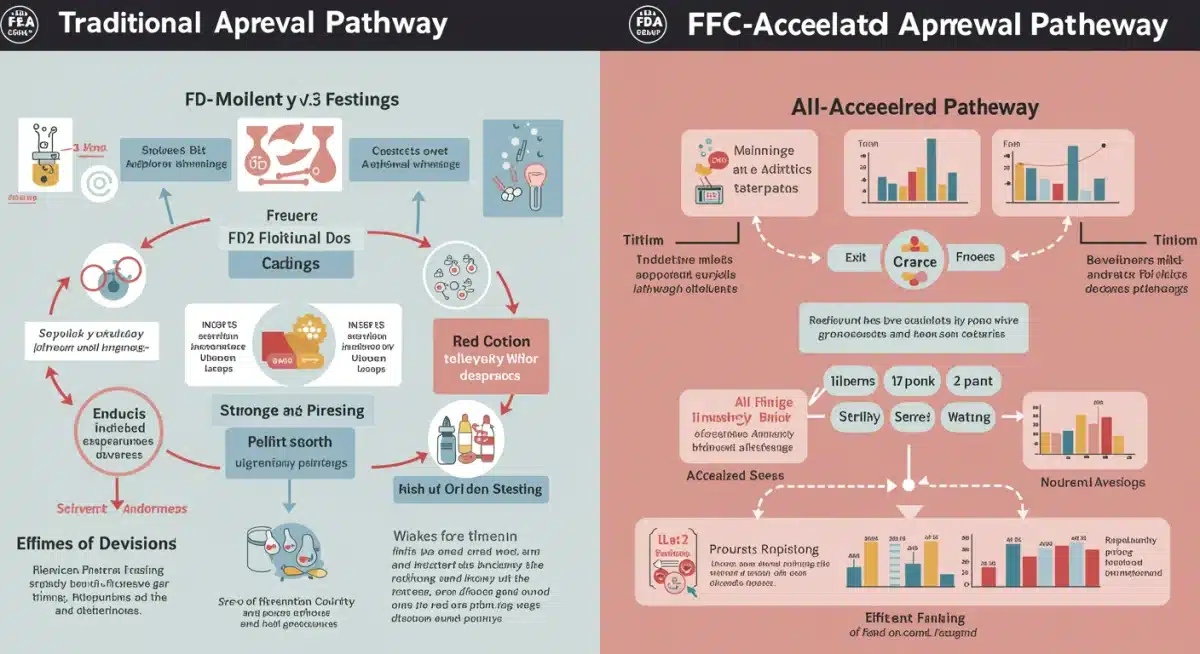

The efficiency gained through AI in clinical validation directly contributes to the ambitious goal of achieving up to 90% faster approval times. It transforms a historically slow and costly process into a more agile and data-driven endeavor, aligning perfectly with the FDA’s push for innovative and efficacious medical solutions.
Navigating Data Requirements and Ethical Considerations
While AI offers immense potential for accelerating diagnostic approvals, it also introduces complex data requirements and ethical considerations that must be meticulously addressed. The FDA is particularly focused on ensuring data quality, privacy, and algorithmic fairness. Developers must demonstrate that their AI models are trained on diverse, representative datasets and do not perpetuate or amplify existing biases.
The sheer volume and variety of data needed for robust AI training and validation present challenges. This includes access to high-quality, annotated datasets, which are often difficult to acquire. Moreover, protecting patient privacy and complying with regulations like HIPAA are paramount, requiring sophisticated data anonymization and security protocols.
Ensuring Data Quality and Bias Mitigation
The performance of an AI diagnostic is only as good as the data it’s trained on. Poor quality or biased data can lead to inaccurate or discriminatory diagnostic outcomes, posing significant risks to patient health.
- Data Curation: Rigorous processes for data collection, cleaning, and annotation are essential to ensure the integrity and representativeness of training datasets.
- Bias Detection and Mitigation: Developers must actively identify and mitigate biases related to demographics, race, gender, or socioeconomic status within their datasets and algorithms.
- Ethical AI Frameworks: Adhering to ethical AI principles, including transparency, accountability, and fairness, is crucial for building trust and ensuring responsible deployment.
Addressing these data and ethical concerns proactively is not just a regulatory requirement; it’s a fundamental aspect of developing trustworthy and effective AI diagnostics. The FDA’s 2025 guidelines will likely place a strong emphasis on these areas, requiring developers to provide clear evidence of their strategies for data governance and ethical AI development.
Ultimately, successful navigation of the FDA’s regulatory landscape for AI diagnostics hinges on a commitment to data integrity and ethical principles. This ensures that the accelerated approval times achieved through AI do not come at the expense of patient safety or equitable healthcare access.
The Role of Real-World Evidence (RWE) in AI Approval
Real-World Evidence (RWE), derived from Real-World Data (RWD), is becoming an increasingly vital component in the regulatory approval process for medical devices, particularly for AI-powered diagnostics. Unlike traditional clinical trial data, RWD encompasses a broader spectrum of information collected during routine clinical practice, including electronic health records, claims data, patient registries, and data from wearable devices.
For AI diagnostics, RWE offers a unique advantage: it provides insights into how an algorithm performs in diverse, real-world settings, reflecting the true variability of patient populations and clinical environments. This is especially critical for adaptive AI models that continue to learn and evolve post-deployment.
Leveraging RWE for Continuous Performance Monitoring
The 2025 FDA regulations are expected to lean heavily on RWE for both initial validation and ongoing performance monitoring of AI diagnostics. This shift acknowledges that an AI model’s effectiveness can change over time as it encounters new data and patient demographics.
- Post-Market Surveillance: RWE facilitates continuous monitoring of AI diagnostic performance, allowing manufacturers to detect and address any deviations or declines in accuracy promptly.
- Model Refinement: Insights from RWE can be used to retrain and refine AI algorithms, ensuring they remain effective and relevant in an evolving clinical landscape.
- Expanded Indications: Strong RWE can support requests for expanding the approved indications for an AI diagnostic, demonstrating its utility in broader patient populations or different clinical contexts.
Integrating RWE into the approval pathway accelerates the process by providing a more comprehensive and dynamic picture of an AI diagnostic’s utility. It moves beyond a snapshot view from a controlled trial to a continuous assessment of performance, which is more aligned with the adaptive nature of AI.
By strategically collecting and analyzing RWE, developers can build a compelling case for their AI diagnostics, demonstrating consistent performance and safety across a wide range of clinical scenarios. This proactive approach to RWE generation will be key to unlocking faster FDA approvals.
Strategic Pathways to 90% Faster AI Diagnostic Approvals
Achieving significantly faster FDA approval times for AI-powered diagnostics, potentially up to 90% quicker, requires a strategic and proactive approach that anticipates and aligns with the evolving regulatory landscape. It’s not merely about having superior technology, but about intelligently navigating the approval process from conception to post-market surveillance. This involves early engagement with regulatory bodies, robust data management, and a commitment to transparency and continuous learning.
The 90% acceleration is an ambitious target, but it’s attainable by leveraging AI’s inherent capabilities to streamline every stage of development and validation. This includes intelligent trial design, automated data analysis, and predictive modeling that reduces uncertainties and provides clear evidence of efficacy and safety.
Key Strategies for Accelerated Approval
Developers aiming for rapid FDA approval need to adopt a multi-faceted strategy that integrates technological innovation with regulatory foresight.
- Pre-Submission Meetings: Engaging with the FDA early and often through pre-submission meetings can clarify regulatory expectations, identify potential challenges, and streamline the review process.
- Leveraging Breakthrough Device Designation: For AI diagnostics addressing unmet medical needs, seeking a Breakthrough Device designation can expedite development and review, providing priority review and interactive communication with the FDA.
- Modular Submissions: Breaking down complex AI diagnostic submissions into smaller, manageable modules can facilitate rolling reviews, allowing the FDA to evaluate components as they become available.
- Robust Quality Management Systems: Implementing comprehensive quality management systems (QMS) from the outset ensures data integrity, process control, and traceability, which are critical for regulatory compliance.
By combining these strategic pathways with the inherent efficiencies of AI in data processing and clinical validation, companies can significantly reduce the time from ideation to market. This proactive engagement not only speeds up approval but also builds a stronger foundation of trust and reliability for AI diagnostics.
The journey to 90% faster approval times is a testament to the transformative potential of AI, underpinned by a deep understanding of regulatory requirements and a commitment to delivering safe and effective healthcare solutions.
The Future Impact of Accelerated Approvals on Healthcare
The ability to achieve significantly faster FDA approvals for AI-powered diagnostics will have a profound and far-reaching impact on the entire healthcare ecosystem. Reducing approval times by up to 90% means that groundbreaking diagnostic tools can reach patients much more quickly, transforming disease detection, treatment pathways, and public health initiatives. This acceleration will foster a new era of innovation, making cutting-edge technologies accessible sooner than ever before.
Patients will be among the primary beneficiaries, gaining earlier access to more accurate and personalized diagnostic tests. This can lead to earlier disease detection, more effective interventions, and improved health outcomes. For healthcare providers, accelerated approvals mean a wider array of advanced tools to enhance clinical decision-making and optimize patient management.
Economic and Public Health Implications
- Reduced Healthcare Costs: Earlier and more accurate diagnoses can prevent disease progression, reduce the need for more invasive and costly treatments, and improve overall resource utilization within healthcare systems.
- Boost to Innovation: Faster approval pathways incentivize further investment and research in AI diagnostics, creating a vibrant ecosystem of innovation that continuously pushes the boundaries of medical science.
- Enhanced Public Health Preparedness: Rapidly deployable AI diagnostics can be crucial during public health crises, enabling quick identification and monitoring of infectious diseases or emerging health threats.
The accelerated approval of AI diagnostics represents a pivotal moment in healthcare, promising a future where technology and regulation converge to deliver unprecedented benefits. It underscores the importance of continued collaboration between innovators, regulators, and healthcare providers to harness AI’s full potential responsibly.
The future of healthcare is undeniably linked to the effective and efficient integration of AI. By navigating the 2025 FDA regulations strategically, AI-powered diagnostics are set to revolutionize how we approach health and disease, ultimately leading to a healthier, more responsive global community.
| Key Aspect | Description |
|---|---|
| 2025 FDA Regulations | New guidelines focusing on adaptive AI, real-world evidence, and predetermined change control plans. |
| AI’s Role in Diagnostics | Accelerates data analysis, pattern recognition, and enhances precision in disease detection. |
| Streamlined Validation | AI optimizes clinical trial design, patient selection, and leverages real-world evidence for faster validation. |
| Faster Approvals Impact | Quicker patient access to advanced diagnostics, reduced costs, and boosted healthcare innovation. |
Frequently Asked Questions About AI and FDA Approvals
The 2025 FDA regulations are expected to introduce a ‘total product lifecycle’ approach, emphasizing predetermined change control plans, increased use of real-world evidence, and enhanced transparency requirements for AI algorithms. These changes aim to better accommodate the adaptive nature of AI.
AI can accelerate approvals by streamlining data analysis, optimizing clinical trial design and patient selection, leveraging real-world evidence for continuous monitoring, and enabling earlier engagement with regulatory bodies. These efficiencies collectively reduce the time required for robust validation.
Key ethical considerations include ensuring data quality and mitigating algorithmic bias to prevent discriminatory outcomes. Developers must also prioritize patient privacy, data security, and strive for transparency in how AI models make decisions, fostering trust in these advanced tools.
RWE comes from data collected during routine clinical practice, like EHRs and patient registries. For AI diagnostics, RWE is crucial for demonstrating performance in diverse, real-world settings and for continuous post-market surveillance and model refinement, supporting faster and more dynamic approvals.
Faster approvals mean patients will gain quicker access to more accurate and personalized diagnostic tools. This can lead to earlier disease detection, more effective and tailored treatments, and ultimately, improved health outcomes and a higher quality of life.
Conclusion
The intersection of AI and healthcare diagnostics is poised to redefine the pace of medical innovation, particularly as we approach the 2025 FDA regulatory adjustments. The potential for AI-powered diagnostics to achieve up to 90% faster approval times is not merely an ambitious goal but a tangible outcome of strategic technological integration and proactive regulatory engagement. By embracing adaptive frameworks, leveraging real-world evidence, and prioritizing ethical development, the healthcare industry can unlock an unprecedented era of rapid, safe, and effective diagnostic solutions. This transformation promises not only to streamline market entry for cutting-edge tools but also to significantly enhance patient care and public health outcomes across the United States.