AI Drug Discovery: 4 Key Computational Biology Advances in US
Recent U.S. research has significantly advanced AI drug discovery through four key computational biology breakthroughs, promising to revolutionize pharmaceutical development and accelerate the delivery of novel therapies to patients.
The landscape of pharmaceutical development is undergoing a profound transformation, spearheaded by artificial intelligence. In the last six months, U.S. research has witnessed remarkable strides in computational biology, particularly in areas that are directly accelerating AI drug discovery. These advancements are not merely incremental; they represent fundamental shifts in how we approach identifying, designing, and testing potential new medicines.
Revolutionizing Target Identification with Advanced AI
Target identification is the crucial first step in drug discovery, where researchers pinpoint specific molecules or pathways in the body that a drug can act upon to treat a disease. Traditionally, this process has been laborious, costly, and often fraught with uncertainty. However, recent computational biology advances, particularly in the U.S., are changing this paradigm, making target identification more precise and efficient than ever before.
The integration of AI, especially machine learning and deep learning algorithms, allows for the rapid analysis of vast biological datasets. These datasets include genomic sequences, proteomic profiles, and patient clinical data, providing an unprecedented view into disease mechanisms. AI can discern subtle patterns and correlations that human researchers might miss, leading to the identification of novel therapeutic targets.
Genomic Data Integration for Novel Targets
One significant advance involves AI’s ability to integrate and interpret complex genomic data. Researchers are now using deep learning models to analyze thousands of patient genomes, identifying genetic variations and their links to disease susceptibility and progression. This helps in pinpointing proteins or pathways that are causally linked to diseases.
- Variant-to-Function Mapping: AI models are increasingly adept at predicting the functional impact of genetic variants, translating raw genomic data into actionable biological insights.
- Network Biology Analysis: Graph neural networks are being employed to map intricate biological networks, revealing central nodes that represent promising drug targets.
- Multi-Omics Data Fusion: Combining genomics, transcriptomics, proteomics, and metabolomics data through AI offers a holistic view of disease biology, enhancing target specificity.
These computational methods are not just speeding up the process; they are uncovering entirely new avenues for therapeutic intervention, moving beyond well-trodden targets to explore previously unconsidered biological mechanisms. This shift promises a broader array of potential treatments for complex diseases.
Breakthroughs in Protein Folding and Structure Prediction
Understanding the three-dimensional structure of proteins is fundamental to drug design. Proteins are the workhorses of the cell, and their shape dictates their function. Predicting this shape, or ‘protein folding,’ from a linear sequence of amino acids has been one of biology’s grand challenges for decades. Recent computational milestones have dramatically altered this field.
The past six months have seen continued refinement and application of AI-powered protein structure prediction tools, most notably from U.S.-based research groups and collaborations. These tools are achieving near-experimental accuracy in predicting protein structures, even for highly complex proteins, significantly accelerating the structural biology bottleneck in drug discovery.
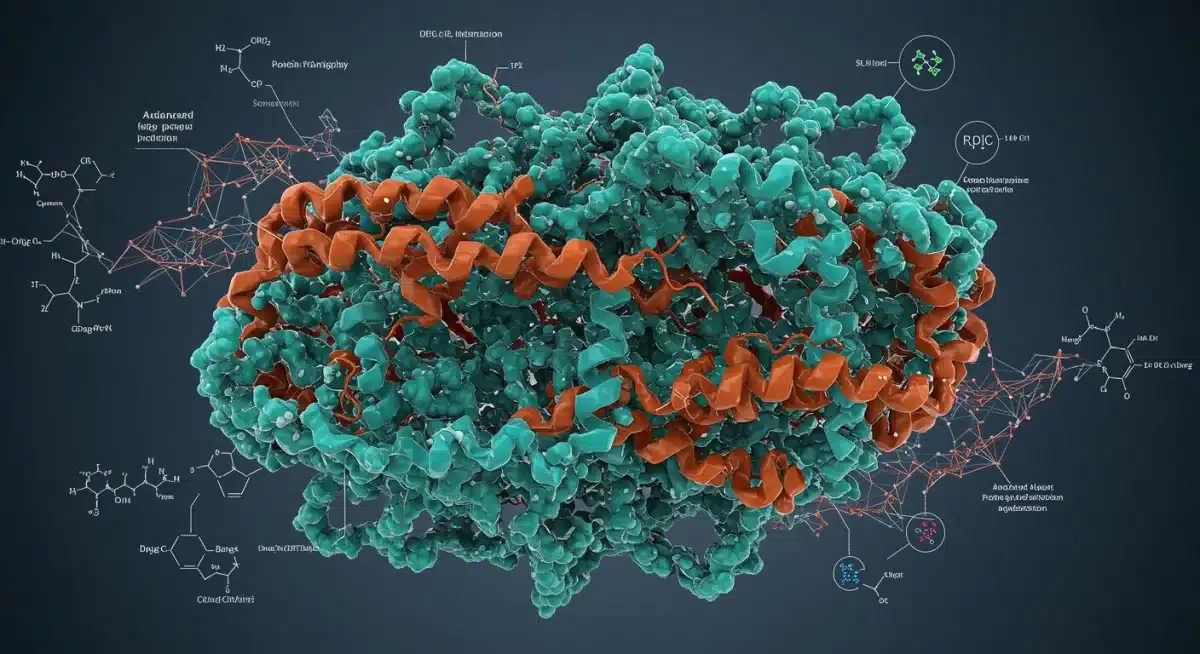
The implications for drug design are immense. Knowing a protein’s precise structure allows scientists to design molecules that fit perfectly into its active sites, like a key in a lock, thereby modulating its function. This precision minimizes off-target effects and improves drug efficacy.
AI-Enhanced Homology Modeling and De Novo Prediction
While traditional homology modeling relied on known similar structures, AI models now leverage vast databases of protein sequences and structures to predict novel folds. Furthermore, de novo prediction, which attempts to predict structure from sequence alone, has seen unprecedented success. This capability is crucial for novel proteins with no known structural relatives.
These advancements mean that researchers no longer need to spend years crystallizing proteins or using expensive cryo-EM techniques for every target. AI provides high-quality structural models quickly, enabling rapid virtual screening and lead optimization. This dramatically shortens the early stages of drug development, making the entire process more agile and cost-effective.
The ability to accurately predict protein structures is fundamentally changing how drug candidates are identified and refined. It allows for more rational drug design, moving away from purely empirical methods towards a more informed, AI-driven approach, which is vital for the future of pharmaceutical innovation.
Accelerating Lead Optimization with Generative AI
Once a potential drug target is identified and its structure understood, the next challenge is to find or design molecules that can effectively interact with it. This phase, known as lead optimization, involves synthesizing and testing countless compounds to improve their potency, selectivity, and pharmacokinetic properties. Generative AI is now playing a pivotal role in streamlining this complex process.
In the last half-year, U.S. research has showcased impressive applications of generative adversarial networks (GANs) and variational autoencoders (VAEs) in creating novel molecular structures. These AI algorithms can learn the chemical rules and properties of known drugs and then generate entirely new molecules with desired characteristics, often surpassing human intuition.
De Novo Molecular Design and Property Prediction
Generative models can design molecules from scratch that are optimized for specific binding affinities, solubility, and metabolic stability. This dramatically reduces the need for large-scale experimental screening, which is both time-consuming and resource-intensive. Instead of synthesizing thousands of compounds, researchers can focus on a smaller, highly curated set of AI-generated candidates.
- Targeted Molecule Generation: AI can be prompted to generate molecules with specific functional groups or scaffolds known to interact with a particular protein target.
- Multi-Objective Optimization: Generative AI can balance multiple properties simultaneously, designing compounds that are not only potent but also safe and bioavailable.
- Retro-Synthesis Planning: Some models can even suggest synthetic routes for the generated molecules, connecting computational design directly to experimental realization.
The ability of generative AI to rapidly explore vast chemical space and propose novel, synthetically accessible compounds is a game-changer for lead optimization. It allows drug developers to quickly iterate on designs, moving from concept to promising candidate much faster than traditional methods, thereby significantly compressing the drug discovery timeline.
Enhanced Clinical Trial Design and Patient Stratification
Beyond the laboratory, AI is also making substantial contributions to the later stages of drug development, specifically in clinical trial design and patient stratification. These areas are critical for ensuring that new drugs are safe and effective in human populations and that they reach the patients who will benefit most.
Recent U.S. research has focused on leveraging AI to analyze real-world data (RWD) and real-world evidence (RWE) from electronic health records, insurance claims, and genomic databases. This allows for more informed decisions about clinical trial populations, endpoints, and even the prediction of trial outcomes, leading to more efficient and successful studies.
Predictive Analytics for Trial Success
AI models can identify patient subgroups that are more likely to respond positively to a particular treatment, allowing for more targeted and personalized clinical trials. This reduces the number of participants needed, shortens trial duration, and increases the probability of demonstrating a drug’s efficacy.
Furthermore, AI can predict potential adverse events by analyzing historical patient data, helping researchers design safer trials and monitor patients more effectively. This proactive approach minimizes risks and improves patient safety throughout the clinical development process.
By optimizing clinical trial design and patient selection, AI is not only making drug development more efficient but also more ethical, ensuring that new therapies are tested in the most appropriate populations. This ultimately accelerates the availability of life-saving drugs to those who need them most.
The Role of High-Performance Computing and Data Infrastructure
The incredible progress in AI drug discovery would not be possible without the underlying advancements in high-performance computing (HPC) and robust data infrastructure. U.S. research institutions and tech companies have been at the forefront of developing and deploying the computational power necessary to fuel these AI algorithms.
The sheer volume and complexity of biological data—genomic sequences, protein structures, chemical libraries, and clinical records—demand massive computational resources for storage, processing, and analysis. Modern HPC clusters, often powered by specialized GPUs, are essential for training deep learning models that can handle such data at scale.
Cloud Computing and AI Platforms
Cloud-based AI platforms have become indispensable, providing researchers with on-demand access to scalable computing power without the need for extensive in-house infrastructure. This democratization of AI tools allows smaller labs and startups to contribute significantly to drug discovery.
- Distributed Computing: Large-scale simulations and model training are often spread across hundreds or thousands of processing units, drastically cutting down computation time.
- Data Lakes and Warehouses: Secure and accessible data storage solutions are critical for managing the petabytes of biological and chemical information required for AI training.
- Specialized AI Accelerators: Beyond general-purpose GPUs, custom AI chips are emerging, offering even greater efficiency for specific deep learning tasks relevant to drug discovery.
The continuous innovation in HPC and data infrastructure ensures that AI drug discovery continues to push boundaries. As algorithms become more sophisticated, the underlying hardware and data management systems must evolve in tandem, creating a powerful synergy that drives pharmaceutical innovation forward at an unprecedented pace.
Ethical Considerations and Future Outlook in AI Drug Discovery
While the excitement around AI in drug discovery is palpable, it is crucial to address the ethical considerations and regulatory challenges that accompany these rapid advancements. As AI models become more autonomous in designing molecules and informing clinical decisions, questions of accountability, bias, and data privacy come to the forefront.
U.S. researchers and policymakers are increasingly engaging in discussions to establish guidelines and frameworks that ensure responsible AI development and deployment. Balancing innovation with ethical oversight is paramount to maintaining public trust and realizing the full potential of AI in healthcare.
Addressing Bias and Ensuring Transparency
AI models are only as unbiased as the data they are trained on. If genomic or clinical datasets are not diverse, the models may perpetuate existing health disparities. Efforts are underway to curate more representative datasets and develop AI algorithms that can identify and mitigate bias.
Furthermore, the ‘black box’ nature of some deep learning models poses challenges for regulatory approval. Researchers are exploring explainable AI (XAI) techniques to make AI-driven drug discovery processes more transparent and understandable, fostering greater confidence in AI-generated insights.
The future of AI drug discovery advances looks incredibly promising, with continuous innovation in computational biology. The integration of quantum computing, advanced robotics for automated synthesis, and even more sophisticated multimodal AI models are on the horizon. These developments promise to further compress drug development timelines, reduce costs, and ultimately deliver more effective and personalized medicines to patients worldwide, shaping a healthier future for all.
| Key Advance | Impact on Drug Discovery |
|---|---|
| AI Target Identification | More precise and efficient identification of disease-related molecular targets through genomic data analysis. |
| Protein Folding Prediction | Near-experimental accuracy in predicting 3D protein structures, vital for rational drug design. |
| Generative AI for Lead Optimization | Rapid design of novel molecules with optimized properties, reducing experimental screening. |
| AI in Clinical Trials | Enhanced patient stratification and trial design, leading to more efficient and successful studies. |
Frequently Asked Questions About AI Drug Discovery
The primary benefit of AI in drug discovery is significantly accelerating the process. By automating complex analyses and predicting molecular interactions, AI reduces the time and cost associated with identifying drug targets, designing compounds, and optimizing leads, bringing new therapies to patients faster.
Computational biology provides the foundational data and models necessary for AI algorithms. It involves using computational methods to analyze biological data, model molecular interactions, and simulate biological processes, all of which are crucial inputs for AI to learn from and make predictions in drug development.
Generative AI models are used for de novo molecular design. They can create entirely new chemical compounds with desired properties, such as specific binding affinities or solubilities, tailored to a particular drug target. This helps in exploring novel chemical spaces and optimizing lead compounds efficiently.
Yes, AI can significantly improve clinical trial success rates. By analyzing real-world data, AI helps stratify patients, identifying those most likely to respond to a drug. It also assists in optimizing trial designs and predicting potential adverse effects, leading to more targeted and efficient clinical studies.
Ethical challenges include ensuring data privacy, addressing potential biases in AI models trained on unrepresentative datasets, and establishing accountability for AI-driven decisions. Transparency in AI algorithms (explainable AI) is also a key concern for regulatory approval and public trust in new AI-developed therapies.
Conclusion
The rapid pace of AI drug discovery advances driven by computational biology in U.S. research is reshaping the pharmaceutical industry. From precise target identification and accurate protein structure prediction to the innovative design of new molecules and optimized clinical trials, AI is proving to be an indispensable tool. While ethical considerations and regulatory frameworks are still evolving, the trajectory is clear: AI will continue to be a powerful force in bringing safer, more effective, and more personalized medicines to patients globally, marking a new era in healthcare innovation.