Boost Your Q1 Sales: AI Predictive Analytics

Implementing AI-powered predictive analytics is a strategic imperative for businesses aiming to significantly boost Q1 2025 sales, offering unparalleled insights into market trends and customer behavior to achieve a projected 15% revenue increase.
As we approach Q1 2025, businesses are keenly focused on strategies to not only meet but exceed their sales targets. The quest to significantly boost Q1 2025 sales is more critical than ever, and a powerful solution lies in the strategic implementation of AI predictive analytics. This technology offers an unprecedented ability to foresee market shifts, understand customer preferences, and optimize sales strategies, potentially unlocking a 15% revenue increase and setting a new benchmark for success.
Understanding AI Predictive Analytics for Sales Growth
AI predictive analytics harnesses the power of artificial intelligence and machine learning to analyze historical data and forecast future outcomes. For sales teams, this means moving beyond guesswork to data-driven decision-making. By identifying patterns and trends that human analysts might miss, AI can predict which customers are most likely to buy, which products will perform best, and when the optimal time to engage is.
The core concept revolves around feeding vast datasets into sophisticated algorithms. These algorithms then learn from the data, recognizing correlations and cause-and-effect relationships. The output is not just a simple forecast, but a detailed probability assessment that can be used to fine-tune every aspect of the sales cycle, from lead generation to post-purchase engagement. This level of foresight allows businesses to proactively address challenges and capitalize on opportunities, ensuring a more resilient and growth-oriented sales operation.
The Role of Machine Learning in Sales Forecasting
Machine learning models are the engine behind effective predictive analytics. They continuously refine their understanding of sales dynamics as new data becomes available. This adaptive learning is crucial in volatile markets, where static models quickly become obsolete.
- Regression Models: Used to predict continuous values, such as future sales revenue or specific product demand.
- Classification Models: Help categorize outcomes, like identifying high-value leads or predicting customer churn risk.
- Time Series Analysis: Specialized algorithms that analyze data points collected over time to forecast future trends.
By integrating these advanced models, companies gain a clear picture of what lies ahead, enabling them to allocate resources more efficiently and target their efforts where they will have the greatest impact. This proactive approach is a significant departure from traditional reactive sales strategies.
Ultimately, AI predictive analytics transforms raw data into actionable intelligence. It empowers sales leaders with the foresight needed to confidently navigate market complexities, optimize their strategies, and drive significant revenue gains. The ability to predict customer behavior and market demand with high accuracy is no longer a luxury but a necessity for competitive advantage.
Key Components of an AI-Powered Predictive Sales Strategy
Implementing an AI-powered predictive sales strategy involves several critical components working in synergy. It’s not just about deploying a single tool, but rather creating an ecosystem where data, technology, and human expertise converge to drive superior sales performance. This holistic approach ensures that predictive insights are not only generated but also effectively acted upon across the organization.
A robust strategy begins with high-quality data. Without clean, comprehensive, and relevant data, even the most advanced AI models will produce unreliable results. Therefore, data collection, cleansing, and integration are foundational steps. This includes data from CRM systems, marketing automation platforms, website analytics, social media, and even external market data sources.
Data Collection and Integration
The foundation of any successful AI predictive analytics initiative is the quality and breadth of data. Companies must consolidate data from various sources to create a unified view of their customers and market. This often requires breaking down data silos and implementing robust data integration platforms.
- CRM Systems: Centralize customer interactions, purchase history, and lead information.
- Marketing Automation: Track campaign performance, customer engagement, and lead scoring.
- ERP Systems: Provide insights into inventory, order fulfillment, and financial performance.
- External Data: Incorporate market trends, economic indicators, and competitor analysis.
Seamless integration ensures that AI models have access to all relevant information, allowing them to draw more accurate conclusions and generate more precise predictions. This comprehensive data foundation is what allows AI to truly shine.
Choosing the Right AI Tools and Platforms
The market offers a wide array of AI tools and platforms, each with unique strengths. Selecting the right ones depends on specific business needs, existing infrastructure, and the scale of operations. It is crucial to choose solutions that are scalable, flexible, and integrate well with current systems.
Consider platforms that offer pre-built machine learning models for common sales use cases, as well as those that allow for custom model development. User-friendliness and strong visualization capabilities are also key, as these will enable sales teams to easily interpret and act on the insights provided. A strategic choice here can significantly impact the speed of implementation and the return on investment.
By carefully selecting and integrating these components, businesses can build a powerful AI-driven sales strategy that not only predicts future sales but also guides the actions needed to achieve those predictions. This systematic approach is essential for realizing the full potential of AI in boosting Q1 2025 sales and beyond.
Leveraging AI for Enhanced Customer Segmentation and Personalization
AI predictive analytics excels at dissecting vast customer datasets to uncover granular segments, far beyond what traditional methods can achieve. This advanced segmentation allows businesses to understand their customers on a much deeper level, identifying specific needs, preferences, and behaviors that drive purchasing decisions. Such detailed insights are the bedrock of highly effective personalization, a critical factor in boosting sales in Q1 2025.
Instead of broad demographic classifications, AI can create dynamic customer segments based on real-time interactions, past purchases, browsing history, and even sentiment analysis from customer feedback. This enables businesses to move from one-size-fits-all marketing to highly tailored engagements that resonate deeply with individual customers, fostering stronger relationships and increasing conversion rates.
Predicting Customer Lifetime Value (CLV)
One of the most powerful applications of AI in customer segmentation is the prediction of Customer Lifetime Value (CLV). AI models analyze historical transaction data, customer engagement metrics, and behavioral patterns to forecast the total revenue a customer is expected to generate over their relationship with the company. This allows businesses to prioritize their sales and marketing efforts towards high-value customers.
- Resource Allocation: Directing premium support and personalized offers to high-CLV segments.
- Retention Strategies: Developing targeted campaigns to prevent churn among valuable customers.
- Acquisition Focus: Identifying characteristics of high-CLV customers to refine lead generation efforts.
By understanding CLV, companies can optimize their customer acquisition costs and focus on building long-term, profitable relationships, which is essential for sustainable growth and a significant boost to Q1 2025 sales.
Personalized Marketing and Sales Outreach
AI-driven personalization goes beyond simply addressing a customer by their name. It involves delivering the right message, at the right time, through the right channel, with content that is highly relevant to their individual journey. Predictive analytics helps anticipate what a customer needs or wants before they even express it.
For instance, if AI predicts a customer is likely to purchase a specific product based on their browsing history, sales teams can proactively reach out with tailored recommendations or special offers. This level of personalization significantly enhances the customer experience, making them feel understood and valued, which in turn drives higher engagement and conversion rates. This targeted approach is a direct pathway to achieving that 15% revenue increase in Q1 2025.
In essence, AI helps transform generic interactions into meaningful, personalized dialogues, leading to increased customer satisfaction and, ultimately, a substantial uplift in sales performance. The ability to predict and cater to individual customer needs is a game-changer in today’s competitive market.
Optimizing Sales Operations with AI-Driven Insights
AI predictive analytics offers far more than just forecasting sales figures; it provides deep insights that can fundamentally optimize sales operations across the board. By identifying inefficiencies, streamlining workflows, and empowering sales teams with superior intelligence, AI helps businesses achieve a leaner, more effective sales process. This operational efficiency is critical for realizing the ambitious goal of a 15% revenue increase in Q1 2025.
From lead scoring to territory optimization, AI can automate mundane tasks and provide strategic guidance, freeing up sales professionals to focus on relationship building and closing deals. The continuous feedback loop of AI models means that sales strategies are constantly being refined, leading to incremental improvements that accumulate into significant gains over time.
Predictive Lead Scoring and Prioritization
One of the most immediate benefits of AI in sales operations is predictive lead scoring. Traditional lead scoring often relies on static rules that fail to capture the nuances of customer behavior. AI models, however, can dynamically assess leads based on a multitude of factors, including engagement history, demographic data, firmographic data, and even external market signals.
This allows sales teams to prioritize leads with the highest probability of conversion, ensuring that valuable time and resources are directed towards the most promising opportunities. The result is a more efficient sales funnel and a higher conversion rate, directly contributing to increased sales in Q1 2025.
Sales Territory Optimization and Resource Allocation
AI can also revolutionize how sales territories are defined and how resources are allocated within those territories. By analyzing historical sales data, geographic information, market potential, and salesperson performance, AI algorithms can suggest optimal territory boundaries and recommend the best allocation of sales personnel.
- Balanced Workloads: Ensuring sales reps have equitable and manageable territories.
- Market Potential: Aligning territories with areas of high growth potential.
- Performance Improvement: Identifying areas where additional training or support might be needed.
This optimization ensures that every sales representative is positioned for maximum success, minimizing travel time, maximizing customer contact, and ultimately driving higher sales volumes. The strategic deployment of resources guided by AI insights is a powerful lever for boosting overall sales performance.
By integrating AI into sales operations, businesses can move beyond reactive management to proactive strategic planning. This leads to not only improved efficiency and reduced costs but also a significant uplift in sales effectiveness, paving the way for substantial revenue growth in Q1 2025.
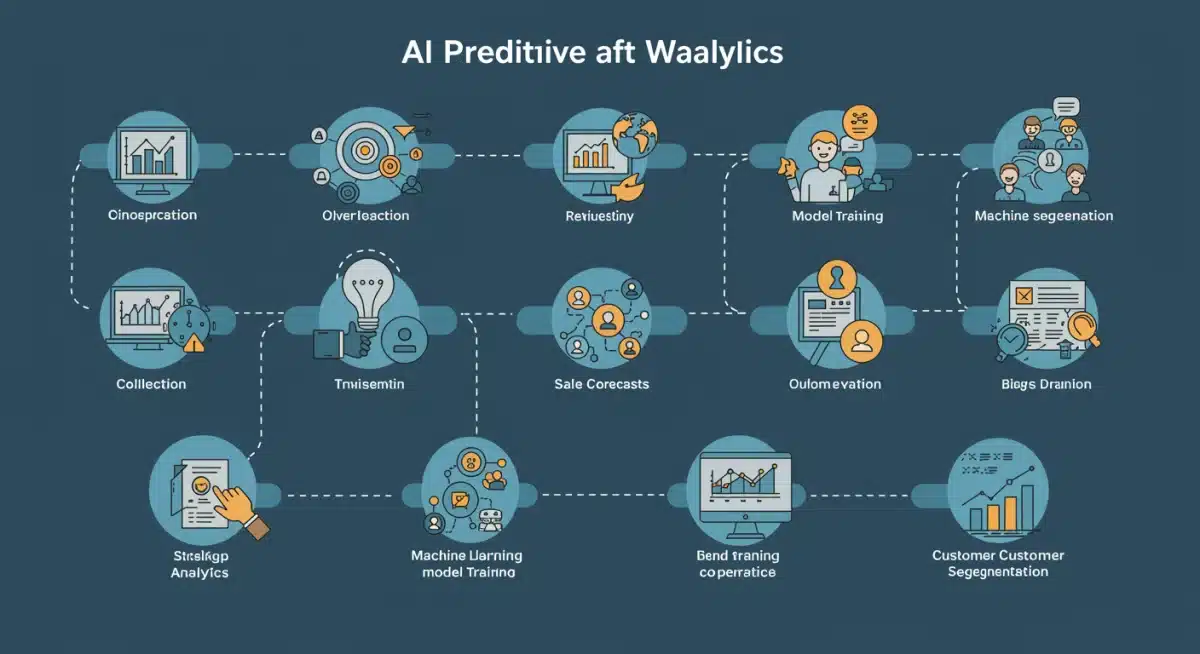
Implementing AI Predictive Analytics: A Step-by-Step Guide
Successfully implementing AI predictive analytics requires a structured approach, moving from initial assessment to ongoing optimization. It’s not a one-time project but a continuous journey of refinement and adaptation. A clear roadmap ensures that businesses can effectively integrate AI into their existing sales infrastructure and start seeing tangible results, such as the targeted 15% revenue increase in Q1 2025.
The process begins with a thorough understanding of current business challenges and aligning AI initiatives with overarching strategic goals. Without clear objectives, AI implementation can become a costly exercise with unclear returns. Therefore, defining what success looks like from the outset is paramount.
Phase 1: Data Preparation and Cleansing
Before any AI model can be trained, the data must be prepared. This involves collecting data from all relevant sources, cleaning it to remove inconsistencies and errors, and transforming it into a format suitable for analysis. This phase is often the most time-consuming but is critical for the accuracy of predictions.
- Data Audit: Identify all available data sources and assess their quality.
- Data Cleansing: Remove duplicates, correct errors, and handle missing values.
- Data Transformation: Convert data into a standardized format for AI model input.
Investing sufficient time and resources in this phase will significantly improve the reliability and effectiveness of the predictive models, laying a solid foundation for boosting Q1 2025 sales and beyond.
Phase 2: Model Development and Training
Once the data is clean and prepared, AI engineers and data scientists can begin developing and training the predictive models. This involves selecting appropriate algorithms, configuring parameters, and training the models on the historical data. Iterative testing and validation are crucial to ensure the models are accurate and robust.
This phase also includes defining the metrics by which the model’s performance will be evaluated. It’s not enough for a model to simply make predictions; those predictions must be demonstrably accurate and provide actionable insights that sales teams can leverage. Collaboration between data science and sales teams is vital here to ensure the models address real-world business problems.
Phase 3: Deployment, Monitoring, and Optimization
After successful training and validation, the AI models are deployed into the operational sales environment. However, deployment is not the end. Continuous monitoring of model performance is essential to ensure they remain accurate and relevant as market conditions and customer behaviors evolve. Regular recalibration and optimization are required to maintain peak performance.
This phase also involves integrating the AI insights into existing sales tools, such as CRM systems, to make them easily accessible to sales teams. User training and change management are crucial to ensure adoption and maximize the benefits of the new AI capabilities. By following these steps, businesses can effectively implement AI predictive analytics and realize a significant boost to their Q1 2025 sales.
Measuring the Impact: Achieving a 15% Revenue Increase
The ultimate goal of implementing AI predictive analytics is to achieve measurable business outcomes, particularly a significant boost in sales. The target of a 15% revenue increase in Q1 2025 is ambitious but entirely attainable with a well-executed AI strategy. Measuring this impact requires clear metrics and a systematic approach to tracking performance against established benchmarks.
It’s vital to establish baseline sales performance before AI implementation to accurately attribute any subsequent growth to the new predictive capabilities. This involves analyzing historical sales data, market conditions, and any other factors that might influence revenue, ensuring a fair comparison.
Key Performance Indicators (KPIs) for Success
To accurately measure the impact of AI predictive analytics, businesses must define and track specific Key Performance Indicators (KPIs). These KPIs provide quantifiable evidence of the strategy’s effectiveness and help identify areas for further optimization.
- Conversion Rate: Track the percentage of leads that convert into paying customers.
- Average Deal Size: Monitor the average revenue generated per transaction.
- Sales Cycle Length: Measure the time it takes from lead generation to deal closure.
- Customer Churn Rate: Assess the rate at which customers discontinue their relationship.
- Return on Investment (ROI): Calculate the financial benefits relative to the investment in AI.
Regularly reviewing these KPIs allows businesses to assess the direct impact of AI on their sales performance and make data-driven adjustments to their strategies. A positive trend across these indicators signals a successful AI implementation.
Attributing Revenue Growth to AI
Attributing a specific percentage of revenue growth, such as a 15% increase, directly to AI predictive analytics requires careful analysis. This often involves A/B testing or controlled experiments where a portion of the sales team or customer base operates with AI-driven insights, while another operates under traditional methods.
By comparing the performance of these groups, businesses can quantify the incremental value generated by AI. Furthermore, detailed reporting on how AI recommendations led to specific sales successes (e.g., a personalized offer suggested by AI leading to a large order) provides qualitative evidence. Transparent reporting and continuous communication between data science and sales teams are crucial to ensure that the value of AI is clearly understood and leveraged throughout the organization. This meticulous measurement ensures that the projected 15% revenue increase in Q1 2025 is not just a target but a verifiable achievement.
Future Trends and Sustaining AI-Driven Sales Growth
The landscape of AI predictive analytics is constantly evolving, with new advancements emerging at a rapid pace. To sustain AI-driven sales growth beyond Q1 2025, businesses must stay abreast of these future trends and continually adapt their strategies. This forward-looking approach ensures that competitive advantage is maintained and that sales performance continues to improve over the long term.
Embracing innovation and being willing to experiment with new technologies will be key. The businesses that remain agile and responsive to technological shifts will be the ones that continue to lead their markets, consistently driving higher sales and deeper customer engagement.
Generative AI and Conversational Sales
Generative AI, especially large language models (LLMs), is poised to revolutionize sales. These technologies can create highly personalized sales content, from email drafts to product descriptions, and even simulate human-like conversations. This opens up new possibilities for automating parts of the sales process while maintaining a personalized touch.
- Automated Content Creation: Generating tailored sales emails, presentations, and social media posts.
- AI Sales Assistants: Providing instant support to sales reps by answering complex customer queries.
- Personalized Chatbots: Engaging customers with intelligent, context-aware conversations on websites and social platforms.
The integration of generative AI with predictive analytics will enable sales teams to scale personalization efforts dramatically, reaching more customers with relevant messages and ultimately driving higher conversion rates. This fusion will be instrumental in sustaining and accelerating sales growth.
Ethical AI and Data Privacy in Sales
As AI becomes more integrated into sales, ethical considerations and data privacy will become even more critical. Customers are increasingly aware of how their data is used, and regulations like GDPR and CCPA are setting stricter standards. Businesses must ensure their AI predictive analytics practices are transparent, fair, and compliant with all relevant laws.
Building customer trust by openly communicating data usage policies and demonstrating a commitment to ethical AI will be paramount. This includes avoiding biased algorithms, ensuring data security, and giving customers control over their personal information. A strong ethical foundation not only mitigates risks but also enhances brand reputation, which is a significant factor in long-term sales success. Prioritizing ethical AI will be essential for building enduring customer relationships and ensuring sustainable sales growth in an increasingly data-conscious world.
| Key Aspect | Brief Description |
|---|---|
| AI Predictive Analytics | Uses AI and machine learning to forecast future sales and customer behavior based on historical data. |
| Enhanced Personalization | AI enables granular customer segmentation and tailored marketing, significantly boosting engagement. |
| Operational Optimization | AI refines lead scoring, territory planning, and resource allocation for increased sales efficiency. |
| Measuring Impact | KPIs and A/B testing are crucial to attribute revenue growth and ensure a 15% increase is met. |
Frequently Asked Questions About AI Predictive Sales
AI predictive analytics in sales uses artificial intelligence and machine learning algorithms to analyze historical sales data and customer behaviors to forecast future sales trends, identify high-potential leads, and personalize customer interactions, leading to more effective sales strategies and increased revenue.
By providing accurate sales forecasts, optimizing lead prioritization, enabling hyper-personalized marketing campaigns, and streamlining sales operations, AI predictive analytics allows businesses to make data-driven decisions that directly translate into higher conversion rates and a significant increase in sales for Q1 2025.
Effective AI predictive sales require comprehensive data from various sources, including CRM systems (customer interactions, purchase history), marketing automation platforms (campaign engagement), ERP systems (inventory, order fulfillment), and external market data. Quality data cleansing and integration are crucial.
Key challenges include ensuring data quality and integration, selecting the right AI tools, overcoming resistance to change within sales teams, and continuously monitoring and optimizing AI models. Addressing these requires a clear strategy, cross-functional collaboration, and ongoing investment.
ROI is measured by tracking key performance indicators such as conversion rates, average deal size, sales cycle length, and customer churn rate. A/B testing and controlled experiments help attribute specific revenue increases directly to AI initiatives, providing clear evidence of financial benefits.
Conclusion
The pursuit of a 15% revenue increase in Q1 2025 is an ambitious yet achievable goal for businesses willing to embrace the transformative power of AI predictive analytics. By meticulously preparing data, deploying sophisticated machine learning models, and continuously optimizing strategies, companies can unlock unparalleled insights into market dynamics and customer behavior. This strategic shift from reactive sales tactics to proactive, data-driven decision-making not only enhances operational efficiency but also fosters deeper customer relationships through hyper-personalization. As AI continues to evolve, integrating these advanced capabilities will be paramount for sustaining growth, maintaining a competitive edge, and confidently navigating the future of sales.