AI Ethics: Key Compliance Updates for US Businesses

US businesses must prepare for significant 2025 AI ethics compliance updates, particularly regarding algorithmic transparency, data governance, and accountability frameworks, to navigate the evolving regulatory environment effectively.
As we accelerate into 2025, the imperative for US businesses to understand and adapt to the evolving landscape of 2025 AI ethics compliance has never been more critical. Artificial intelligence, while offering unprecedented opportunities, also introduces complex ethical dilemmas and regulatory challenges that demand immediate attention.
Understanding the Evolving Regulatory Framework
The regulatory environment surrounding AI in the United States is rapidly maturing, moving beyond abstract discussions to concrete legislative and policy initiatives. Businesses operating with AI must recognize that a fragmented, state-by-state approach is slowly giving way to more coordinated efforts, though complete federal harmonization remains a challenge. Understanding these nuances is paramount for effective compliance strategies.
Several key governmental bodies, including the National Institute of Standards and Technology (NIST), the Federal Trade Commission (FTC), and various state legislatures, are actively shaping the conversation and introducing guidelines. These efforts aim to balance innovation with protection, ensuring that AI development and deployment adhere to principles of fairness, accountability, and transparency. The focus is increasingly on the practical implications of AI systems across various sectors.
NIST AI Risk Management Framework Adoption
The NIST AI Risk Management Framework (AI RMF) continues to serve as a foundational, voluntary guideline for organizations to manage risks associated with AI. In 2025, its adoption is expected to become a de facto standard, influencing future regulations and industry best practices. Businesses are encouraged to integrate the AI RMF into their existing risk management processes.
- Govern: Establish clear policies, procedures, and oversight structures for AI risks.
- Map: Identify and characterize AI risks across the system lifecycle.
- Measure: Analyze, evaluate, and track AI risks and their impacts.
- Manage: Prioritize, respond to, and recover from AI risks.
The framework provides a structured approach to identifying, assessing, and mitigating AI-related risks, from bias and discrimination to privacy infringements and security vulnerabilities. Its increasing prominence means that even without direct mandates, adherence will likely become a benchmark for demonstrating responsible AI practices to stakeholders and potential regulators.
Update 1: Enhanced Algorithmic Transparency and Explainability
One of the most significant compliance updates anticipated for 2025 revolves around enhanced algorithmic transparency and explainability. As AI systems become more sophisticated and pervasive, the demand for understanding their decision-making processes grows. This isn’t just a technical challenge; it’s a fundamental shift in how businesses must approach AI development and deployment.
New regulations are emerging that require organizations to provide clear, comprehensible explanations for how their AI models arrive at specific conclusions, especially in contexts that impact individuals significantly, such as credit scoring, employment decisions, or healthcare diagnoses. This moves beyond simply stating that an AI was used; it mandates a deeper insight into the underlying logic and data influences.
The Right to Explanation in Practice
The concept of a ‘right to explanation’ is gaining traction, mirroring principles seen in international data protection laws. For US businesses, this means developing mechanisms to articulate AI decisions in an understandable way to affected individuals. This could involve technical documentation, user-friendly interfaces, or even dedicated human review processes.
- Impact Assessments: Conduct regular algorithmic impact assessments to identify potential biases and unfair outcomes.
- Model Documentation: Maintain comprehensive records of AI model development, training data, and performance metrics.
- User Communication: Design clear communication strategies for explaining AI-driven decisions to end-users.
Achieving true transparency requires a multidisciplinary approach, combining data science, legal expertise, and user experience design. Businesses ignoring this trend risk not only non-compliance but also significant reputational damage and erosion of public trust.
Update 2: Stricter Data Governance and Privacy Protections
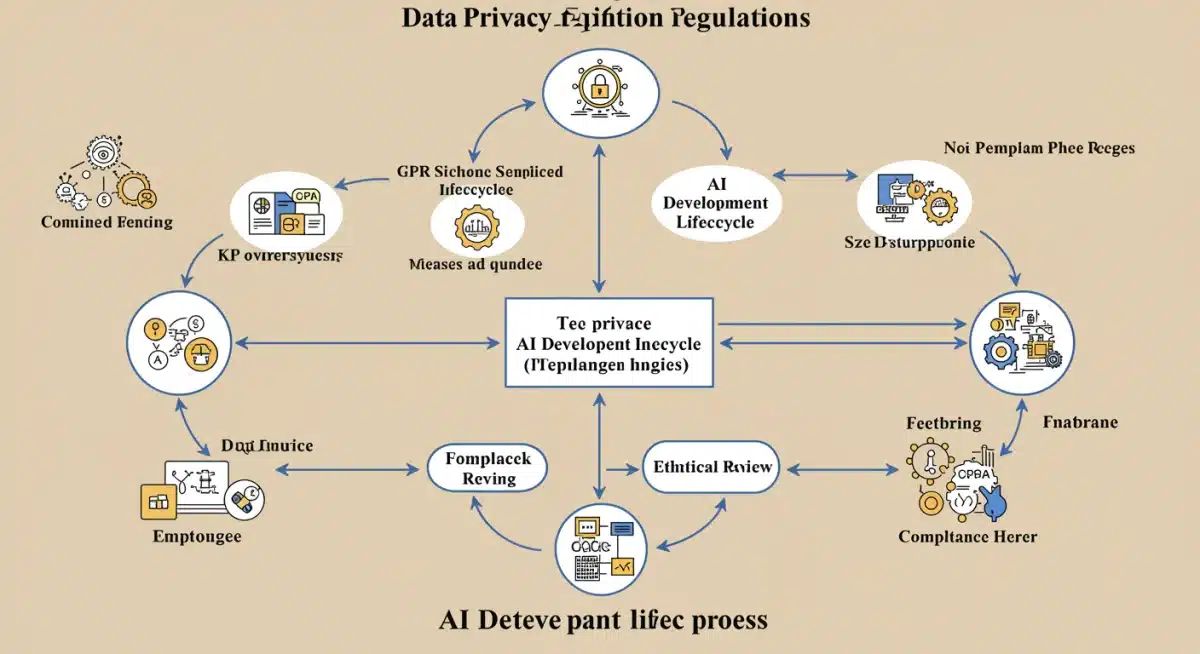
Data is the lifeblood of AI, and consequently, the governance of that data and the privacy protections afforded to individuals are under intense scrutiny. The second major compliance update for 2025 focuses on stricter data governance frameworks and expanded privacy protections, building on existing state-level regulations like the California Consumer Privacy Act (CCPA) and its successors.
Businesses must anticipate a more rigorous approach to how data is collected, stored, processed, and used by AI systems. This includes explicit consent mechanisms, stronger data anonymization requirements, and enhanced data security protocols. The goal is to prevent misuse, breaches, and the perpetuation of biases through flawed or unfairly acquired data.
Data Minimization and Purpose Limitation
Key principles like data minimization (collecting only necessary data) and purpose limitation (using data only for specified, legitimate purposes) will become more forcefully enforced. This requires a fundamental shift in data handling practices, moving away from broad data collection towards a more targeted and ethically conscious approach.
Furthermore, the interoperability between various data privacy laws, both within the US and internationally, will present a complex compliance challenge. Businesses operating across state lines or globally will need robust, adaptable data governance strategies that can satisfy multiple regulatory demands simultaneously. Investing in privacy-preserving AI techniques will be crucial.
Ensuring compliance in this area demands a holistic view of data lifecycle management within AI systems. From initial data acquisition to model deployment and ongoing maintenance, every stage must be scrutinized for adherence to privacy principles and regulatory requirements. Proactive audits and internal controls will be indispensable.
Update 3: Enhanced AI Accountability Frameworks
The third critical compliance update for 2025 concerns the establishment of enhanced AI accountability frameworks. As AI systems take on more critical roles, determining responsibility when things go wrong becomes increasingly vital. This update aims to clarify who is accountable for AI-driven errors, biases, or harms, pushing businesses to implement robust internal governance structures.
Expect regulations that mandate clear lines of responsibility, both within organizations and across the AI supply chain. This means identifying specific individuals or teams accountable for the ethical development, deployment, and oversight of AI systems. The era of blaming the ‘black box’ will rapidly diminish as legal and ethical expectations mature.
Establishing Internal AI Governance Committees
Many businesses are already forming dedicated AI ethics committees or appointing AI ethics officers to oversee their AI initiatives. These internal bodies play a crucial role in developing internal policies, conducting ethical reviews, and ensuring ongoing compliance with evolving regulations. Their findings and recommendations will be central to demonstrating accountability.
- Risk Assessments: Implement continuous risk assessments for AI systems, focusing on potential societal impacts.
- Human Oversight: Ensure appropriate human oversight mechanisms are in place, especially for high-stakes AI applications.
- Remediation Protocols: Develop clear protocols for addressing and remediating AI-induced harms or errors.
Accountability extends beyond internal processes to the broader ecosystem. Businesses will need to scrutinize their AI vendors and partners, ensuring that their systems also meet stringent ethical and compliance standards. Contractual agreements will increasingly include clauses related to AI ethics and liability, reflecting a shared responsibility across the AI value chain.
Preparing Your Business for 2025 AI Compliance
Navigating the complex landscape of 2025 AI ethics compliance requires a proactive and strategic approach. Businesses cannot afford to wait for regulations to be fully codified before taking action; early preparation is key to minimizing risks and leveraging AI responsibly. This involves a multi-faceted strategy that integrates ethical considerations into every stage of the AI lifecycle.
One fundamental step is to conduct a comprehensive audit of all existing and planned AI deployments within your organization. This audit should identify potential areas of non-compliance, assess ethical risks, and map out the data flows involved. Understanding your current AI footprint is the first step towards building a resilient compliance framework.
Cross-Functional Collaboration is Key
Effective AI ethics compliance isn’t solely the domain of legal or IT departments. It requires robust collaboration across various functions, including engineering, product development, legal, compliance, and even human resources. Creating cross-functional teams dedicated to AI ethics can foster a more holistic and integrated approach.
Furthermore, continuous education and training for employees at all levels are essential. From developers building AI models to executives making strategic decisions, everyone needs a foundational understanding of AI ethics, bias, privacy, and accountability. This cultivates a culture of responsible AI development and deployment throughout the organization.
Engaging with industry groups and participating in policy discussions can also provide valuable insights and influence future regulatory directions. Staying informed about emerging best practices and anticipated legislative changes will position your business as a leader in responsible AI, rather than a laggard reacting to mandates.
The Strategic Advantage of Proactive AI Ethics
While compliance might often be viewed as a burden, embracing AI ethics proactively offers significant strategic advantages for US businesses in 2025 and beyond. Beyond simply avoiding penalties, a strong commitment to ethical AI can enhance brand reputation, build customer trust, and even drive innovation. Consumers and partners are increasingly seeking out organizations that demonstrate responsible technology practices.
Businesses that can clearly articulate their ethical AI policies and demonstrate compliance with emerging standards will gain a competitive edge. This can translate into greater market acceptance for AI-powered products and services, reduced legal risks, and improved talent acquisition, as ethical considerations become a key factor for top professionals.
Building Trust Through Responsible AI
Trust is a critical currency in the digital age. By prioritizing AI ethics, businesses can cultivate deeper trust with their customers, employees, and the wider public. This trust is not easily earned but can be a powerful differentiator in a crowded marketplace, fostering loyalty and positive brand perception.
Moreover, embedding ethical considerations early in the AI development process can lead to more robust, fair, and effective AI systems. Addressing potential biases or privacy concerns at the design stage is far more efficient and less costly than attempting to remediate them after deployment. This iterative approach to ethical AI development supports long-term sustainable innovation.
Ultimately, proactive engagement with 2025 AI ethics compliance is not just about adhering to rules; it’s about shaping a future where AI serves humanity responsibly. Businesses that lead in this space will not only thrive but also contribute positively to the societal integration of artificial intelligence.
| Key Compliance Update | Brief Description |
|---|---|
| Algorithmic Transparency | Mandates clearer explanations for AI decisions, especially in high-impact scenarios like employment or credit. |
| Data Governance & Privacy | Requires stricter handling of data used by AI, including consent, anonymization, and security. |
| AI Accountability Frameworks | Establishes clear lines of responsibility for AI-driven outcomes, necessitating internal governance. |
Frequently Asked Questions About 2025 AI Ethics Compliance
The NIST AI RMF is a voluntary framework providing guidance for organizations to manage risks associated with AI. In 2025, it’s becoming a de facto standard, influencing future regulations and best practices, making its adoption crucial for demonstrating responsible AI governance.
Enhanced transparency will require businesses to provide clear, comprehensible explanations for AI decisions, especially in high-stakes contexts like credit or employment. This means developing mechanisms to articulate AI logic and data influences to affected individuals.
Key principles include data minimization, ensuring only necessary data is collected, and purpose limitation, meaning data is used only for specified, legitimate purposes. Stricter consent, anonymization, and security protocols will also be enforced.
As AI systems become more impactful, clarifying responsibility for errors or biases is vital. New frameworks mandate clear lines of accountability within organizations and across the AI supply chain, moving away from attributing failures solely to the ‘black box’.
Proactive AI ethics enhances brand reputation, builds customer trust, and can drive innovation. It offers a competitive edge, reduces legal risks, and attracts top talent, ultimately fostering greater market acceptance for AI-powered products and services.
Conclusion
The journey through the 2025 AI ethics landscape presents both challenges and opportunities for US businesses. By proactively addressing the three key compliance updates—enhanced algorithmic transparency, stricter data governance, and robust accountability frameworks—organizations can not only mitigate risks but also build a foundation of trust and innovation. Embracing these ethical imperatives is not merely about regulatory adherence; it’s about shaping a responsible future for artificial intelligence that benefits everyone.