Quantum AI Leap: 5 Neural Net Breakthroughs by 2026
The convergence of quantum computing and artificial intelligence is no longer a distant dream, but a rapidly approaching reality. By 2026, we anticipate significant strides in how neural networks are optimized, largely thanks to the power of quantum mechanics. This article delves into quantum AI neural networks, predicting five major breakthroughs that will redefine the landscape of AI research and development.
The Quantum Computing Foundation for AI
Quantum computing promises to unlock computational capabilities far beyond what classical computers can achieve. Its ability to process vast amounts of data simultaneously, leveraging principles like superposition and entanglement, makes it an ideal candidate for tackling the complex optimization problems inherent in neural networks. This foundational shift is crucial for understanding the forthcoming breakthroughs.
The current limitations of classical AI, particularly in training deep learning models, often stem from the sheer computational cost and time required. Quantum computing offers a potential pathway to circumvent these hurdles, enabling faster training times and the exploration of more intricate model architectures.
Quantum Supremacy and its AI Implications
While the term “quantum supremacy” often refers to a quantum computer solving a problem that a classical computer cannot in a feasible timeframe, its implications for AI are profound. Achieving this milestone in relevant AI tasks signifies a tangible advantage for quantum approaches.
- Exponential Speedup: Quantum algorithms can offer exponential speedups for certain computational problems, directly impacting neural network training.
- Complex Pattern Recognition: Enhanced ability to identify subtle and complex patterns in large datasets, crucial for advanced AI applications.
- Resource Efficiency: Potentially less energy consumption for specific, highly complex calculations compared to classical supercomputers.
The integration of quantum principles into AI is not merely about faster computation; it’s about fundamentally altering how AI learns and processes information. This paradigm shift will pave the way for intelligent systems that are more efficient, robust, and capable of solving problems currently beyond our reach.
Breakthrough 1: Quantum-Enhanced Gradient Descent
Gradient descent is the cornerstone of most neural network training, but it often struggles with local minima and slow convergence in high-dimensional spaces. By 2026, we expect to see practical implementations of quantum-enhanced gradient descent algorithms that leverage quantum parallelism to navigate these complex optimization landscapes more efficiently.
This breakthrough will involve using quantum algorithms to explore multiple optimization paths simultaneously, dramatically reducing the time and computational resources needed to train sophisticated neural networks. The ability to escape local minima more effectively will lead to more robust and higher-performing AI models across various applications.
How Quantum Mechanics Improves Optimization
Quantum mechanics introduces concepts like superposition, allowing a quantum bit (qubit) to exist in multiple states at once. This property can be harnessed in optimization algorithms to evaluate numerous potential solutions concurrently. When applied to gradient descent, this means the algorithm can effectively “see” a broader landscape of the loss function.
- Faster Convergence: Quantum algorithms can find optimal parameters much quicker than classical methods.
- Global Minima Discovery: Increased likelihood of finding the true global minimum, leading to more accurate models.
- Reduced Training Epochs: Less iterations needed to achieve desired performance, saving significant computational time.
The development of specialized quantum accelerators and hybrid quantum-classical architectures will be key to realizing this breakthrough. These systems will offload the most computationally intensive parts of gradient calculation to quantum processors, while classical computers handle the conventional data flow.
Breakthrough 2: Quantum Neural Network Architecture Optimization
Designing optimal neural network architectures is a labor-intensive and often heuristic process. By 2026, quantum computing will significantly accelerate and automate this process, allowing for the discovery of novel and highly efficient network structures that are currently infeasible to find with classical methods. This includes optimizing the number of layers, neurons per layer, and inter-layer connections.
The ability to rapidly explore a vast design space will lead to the creation of bespoke neural networks perfectly tailored for specific tasks, leading to unprecedented performance gains in areas like image recognition, natural language processing, and drug discovery.
Automating Architecture Search with Quantum Annealing
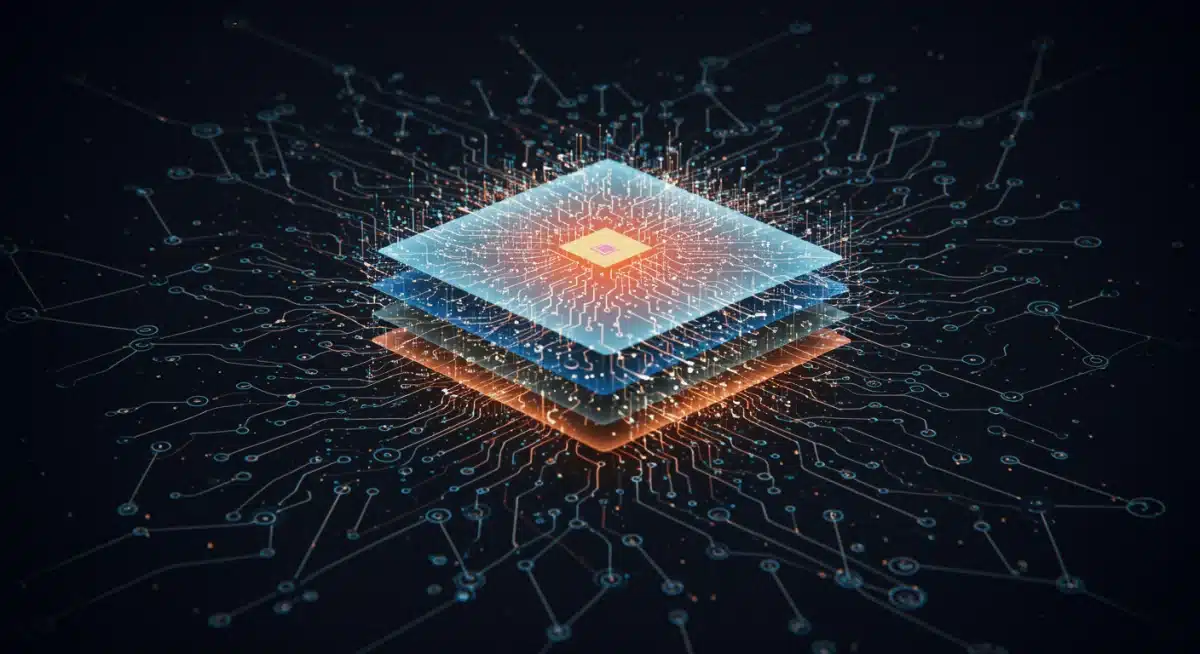
Quantum annealing, a specific type of quantum computation, is particularly well-suited for optimization problems. It can be employed to automatically search for optimal neural network architectures by encoding the design choices as a minimization problem. This approach can explore a much larger combinatorial space than classical neural architecture search (NAS) methods.
- Novel Network Designs: Discovery of architectures beyond human intuition, leading to superior performance.
- Hyperparameter Tuning: Simultaneous optimization of network structure and key hyperparameters.
- Reduced Design Cycle: Significantly decrease the time from concept to deployment for new AI models.
This breakthrough will democratize advanced AI development by making sophisticated network design accessible to a wider range of researchers and developers. It will move beyond empirical trial-and-error to a more systematic and quantum-accelerated approach.
Breakthrough 3: Quantum-Enhanced Feature Learning and Representation
Feature engineering and learning are critical for AI performance, transforming raw data into meaningful representations that neural networks can effectively process. By 2026, quantum computing will enable more powerful and nuanced feature learning, allowing neural networks to extract deeper, more abstract, and often hidden patterns from complex datasets. This will be achieved through quantum algorithms that can explore high-dimensional data spaces in ways classical algorithms cannot.
This capability will be particularly transformative in fields dealing with unstructured data, such as genomics, materials science, and financial modeling, where subtle correlations often hold significant predictive power.
Quantum Kernel Methods for Data Transformation
Quantum kernel methods leverage quantum states to map data points into a high-dimensional Hilbert space, where they may become linearly separable. This quantum-enhanced mapping can reveal intricate relationships within data that are invisible in classical spaces.
- Improved Data Separability: Better distinction between classes in complex datasets.
- Dimensionality Reduction: More effective compression of data while preserving essential information.
- Noise Robustness: Greater resilience to noisy or incomplete data inputs.
The development of robust quantum feature maps will empower neural networks to build richer and more discriminative representations of the input data, leading to a substantial boost in their learning capabilities and generalization.
Breakthrough 4: Quantum Machine Learning for Explainable AI
One of the persistent challenges in AI is the “black box” problem, where complex neural networks make decisions without clear, human-understandable explanations. By 2026, quantum machine learning techniques will contribute to the development of more explainable AI models, particularly in understanding the decision-making processes within quantum-accelerated neural networks.
This breakthrough will not only enhance trust in AI systems but also provide researchers with unprecedented insights into how these advanced models operate, fostering further innovation and refinement.
Interpreting Quantum-Enhanced Decisions
While quantum processes themselves can be counter-intuitive, the unique properties of quantum algorithms can be leveraged to trace the influence of input features on the quantum state evolution, and subsequently, on the final prediction. This opens new avenues for probing the internal workings of AI models.
- Feature Importance Attribution: Clearer identification of which input features contribute most to a decision.
- Decision Path Visualization: New methods to visualize the flow of information and decision points within quantum-inspired models.
- Bias Detection: Enhanced ability to detect and mitigate biases embedded in training data or model architecture.
The pursuit of explainable AI is crucial for the ethical deployment of powerful quantum-enhanced systems. This breakthrough represents a significant step towards AI that is not only intelligent but also transparent and accountable.
Breakthrough 5: Quantum-Resilient Neural Network Security
As AI systems become more ubiquitous, their security against adversarial attacks becomes paramount. By 2026, quantum computing will play a dual role: both posing new security threats and offering solutions for quantum-resilient neural network security. This breakthrough focuses on developing neural networks that are inherently more robust against quantum-enabled adversarial attacks and data breaches.
This includes leveraging quantum cryptography and quantum-resistant algorithms to secure data integrity and model parameters, ensuring that the advanced AI systems of the future remain trustworthy and impervious to emerging threats.
Quantum Cryptography for AI Data Protection
Quantum cryptography, particularly Quantum Key Distribution (QKD), provides theoretically unbreakable encryption. Integrating QKD into AI data pipelines will secure sensitive training data and model weights from eavesdropping and tampering, even from future quantum adversaries.
- Immutable Data Integrity: Ensuring the authenticity and unaltered state of training datasets.
- Secure Model Deployment: Protecting deployed AI models from adversarial manipulation.
- Post-Quantum Cryptography Integration: Implementing algorithms resistant to attacks from large-scale quantum computers.
The development of quantum-resilient neural networks is not just a defensive measure; it’s a proactive step to ensure the long-term viability and trustworthiness of AI in an increasingly quantum-enabled world. This will be a critical area of focus for researchers and security experts alike.
| Key Breakthrough | Brief Description |
|---|---|
| Quantum-Enhanced Gradient Descent | Faster, more efficient neural network training by escaping local minima. |
| Quantum Neural Network Architecture Optimization | Automated discovery of superior network designs for specific tasks. |
| Quantum-Enhanced Feature Learning | Extracting deeper, hidden patterns from complex datasets. |
| Quantum-Resilient Neural Network Security | Developing AI models robust against quantum-enabled cyber threats. |
Frequently Asked Questions about Quantum AI
Quantum AI merges quantum computing principles with artificial intelligence. It’s crucial because it promises to solve complex AI problems currently intractable for classical computers, leading to breakthroughs in optimization, data analysis, and learning capabilities.
By 2026, quantum computing will optimize neural networks through enhanced gradient descent for faster training, quantum-accelerated architecture search for better designs, and advanced feature learning for deeper data insights.
Yes, quantum machine learning techniques are expected to contribute to more explainable AI by 2026. They will provide new methods to understand decision-making processes within complex models, fostering trust and transparency.
Quantum AI presents both new security threats and solutions. By 2026, we anticipate breakthroughs in quantum-resilient neural network security, protecting AI systems from quantum-enabled adversarial attacks and data breaches using advanced cryptography.
No, quantum AI is not a complete replacement. It’s more accurately seen as a powerful augmentation. Hybrid quantum-classical approaches will likely dominate, leveraging the strengths of both computational paradigms to solve specific, highly complex problems.
Conclusion
The journey towards a quantum-powered AI future is accelerating, with 2026 poised to be a pivotal year for neural network optimization. The predicted breakthroughs in quantum-enhanced gradient descent, architecture optimization, feature learning, explainable AI, and robust security underscore a profound shift in AI capabilities. These advancements will not only push the boundaries of what AI can achieve but also lay the groundwork for more intelligent, efficient, and trustworthy systems across every sector. The synergy between quantum computing and artificial intelligence is set to redefine our technological landscape, empowering us with unprecedented tools to navigate an increasingly complex world.