Federated Learning: Revolutionizing US AI Research by 2026

The landscape of artificial intelligence is continuously evolving, with new paradigms emerging that promise to redefine how we develop and deploy intelligent systems. Among these, federated learning stands out as a particularly transformative approach, poised to have a profound impact on U.S. AI research by 2026. This innovative machine learning technique enables the training of algorithms on decentralized datasets without the need to centralize raw data, thereby addressing critical concerns around data privacy, security, and regulatory compliance. As we move closer to the mid-2020s, the implications of federated learning for various sectors, from healthcare to finance and beyond, are becoming increasingly clear, promising a new era of collaborative yet private AI development.
The traditional method of AI development often involves collecting vast amounts of data into a central repository for training models. While effective, this approach presents significant hurdles, especially when dealing with sensitive information or when data is geographically dispersed and subject to varying legal frameworks. Federated learning offers an elegant solution to these challenges, allowing organizations and researchers to collaborate on building robust AI models without compromising the confidentiality of their proprietary or sensitive data. This shift is not merely a technical adjustment; it represents a fundamental rethinking of how AI can be developed ethically and efficiently in a data-rich but privacy-conscious world.
Our exploration will delve into the multifaceted federated learning impact on U.S. AI research, examining the opportunities it creates for collaborative development, the ways it enhances data privacy, and the regulatory and ethical considerations that accompany its adoption. We will also look at the current state of federated learning, its key applications, and the challenges that must be overcome for its widespread implementation. By 2026, federated learning is not just an academic concept; it will be an integral part of the U.S. AI ecosystem, driving innovation and shaping the future of intelligent technologies.
Understanding Federated Learning: A Paradigm Shift in AI
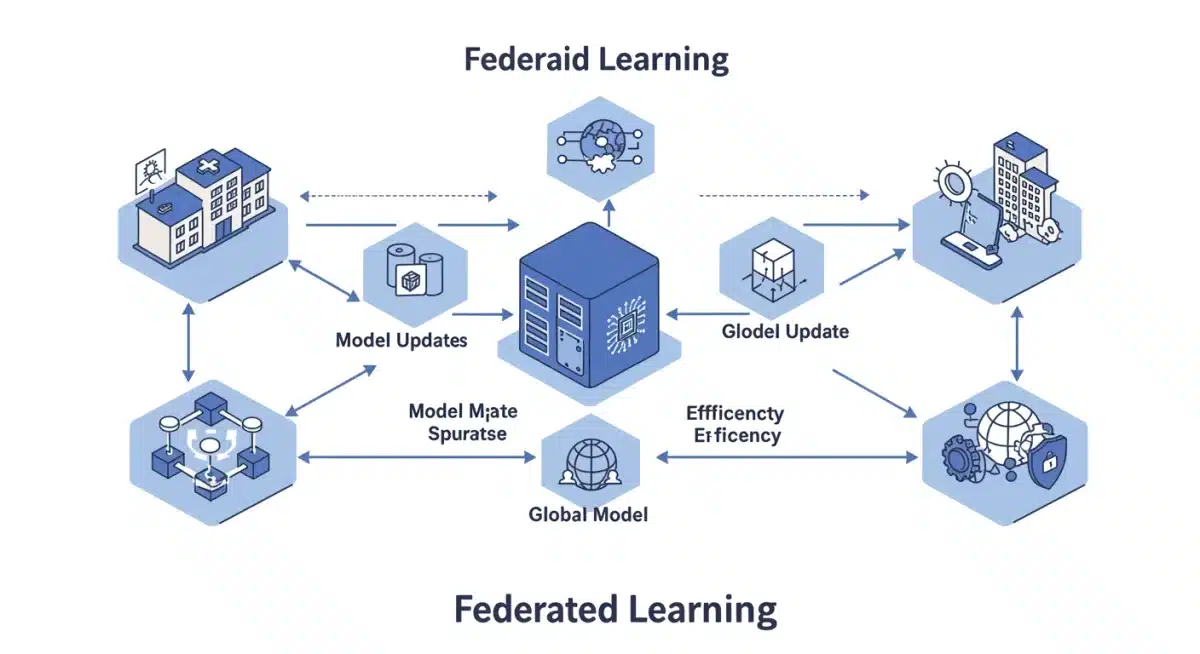
At its core, federated learning is a distributed machine learning approach that trains an algorithm across multiple decentralized edge devices or servers holding local data samples, without exchanging their data. Instead of moving data to a central location, federated learning brings the model to the data. Here’s a simplified breakdown of how it works:
- Initialization: A global model is initialized and distributed to participating devices or organizations.
- Local Training: Each participant trains the model locally using their own private dataset. This training generates a set of model updates (e.g., changes to weights and biases).
- Secure Aggregation: Instead of sending their raw data, participants send only these model updates (or gradients) back to a central server.
- Global Model Update: The central server securely aggregates these updates from all participants to create an improved global model. Advanced cryptographic techniques like secure multi-party computation or differential privacy can be employed during aggregation to further enhance privacy.
- Iteration: The updated global model is then sent back to the participants for another round of local training, and the process iterates until the model reaches a desired level of performance.
This iterative process ensures that sensitive data never leaves its original location, significantly mitigating privacy risks and compliance challenges. The federated learning impact extends beyond privacy, fostering collaboration among entities that might otherwise be unable to share data due to competitive concerns, regulatory constraints, or logistical difficulties. This makes it an ideal solution for industries dealing with highly sensitive information, such as healthcare, finance, and defense.
Key Principles and Advantages
The primary advantages of federated learning are multifaceted:
- Enhanced Data Privacy and Security: By keeping raw data localized, federated learning inherently protects sensitive information, reducing the risk of data breaches and ensuring compliance with regulations like GDPR, HIPAA, and CCPA.
- Decentralized Learning: It enables AI models to learn from a wider variety of real-world data sources, including edge devices, without the need for massive data transfers, which can be bandwidth-intensive and slow.
- Collaborative AI Development: Organizations can collectively build more robust and generalizable AI models by leveraging diverse datasets, even if direct data sharing is impossible. This fosters innovation and accelerates research.
- Reduced Communication Costs: In scenarios where edge devices generate vast amounts of data, sending only model updates rather than raw data can significantly reduce network bandwidth usage.
- Robustness to Data Heterogeneity: Federated learning algorithms are designed to handle data that may not be identically distributed across participants (Non-IID data), which is common in real-world scenarios.
These principles lay the groundwork for a transformative federated learning impact on how AI is conceived, developed, and deployed across the United States. Its ability to reconcile the demand for data with the imperative for privacy positions it as a cornerstone technology for future AI innovation.
The Impact of Federated Learning on U.S. AI Research by 2026
By 2026, federated learning is projected to be a critical enabler for various advanced AI applications in the U.S., driving innovation across several key sectors. Its ability to facilitate collaborative research while upholding stringent privacy standards will unlock new possibilities that were previously unattainable.
Healthcare and Medical Research
The healthcare sector is arguably one of the most promising areas for federated learning impact. Medical data is highly sensitive, subject to strict regulations (HIPAA), and often siloed within individual hospitals, clinics, or research institutions. Federated learning allows these entities to collaboratively train AI models for disease diagnosis, drug discovery, personalized medicine, and epidemiological studies without sharing patient-specific records. This means:
- Improved Diagnostic Accuracy: AI models trained on a wider, more diverse patient population across multiple hospitals can achieve higher accuracy in detecting diseases like cancer or rare conditions.
- Accelerated Drug Discovery: Pharmaceutical companies and research labs can combine their proprietary data to identify potential drug candidates more efficiently, without revealing trade secrets.
- Personalized Treatment Plans: Models can learn from aggregated patient data to recommend more effective, personalized treatment strategies.
- Public Health Surveillance: Analyzing health trends across various regions while maintaining individual privacy can enhance public health responses to outbreaks and chronic diseases.
The U.S. healthcare system, with its fragmented data landscape, stands to gain immensely from this technology, fostering a new era of collaborative medical AI research.
Financial Services and Fraud Detection
In the financial industry, data privacy and security are paramount. Banks, credit card companies, and other financial institutions possess vast amounts of sensitive customer transaction data. Federated learning can dramatically enhance fraud detection and risk assessment capabilities:
- Enhanced Fraud Detection: Financial institutions can collaboratively train AI models to detect new fraud patterns by learning from a collective pool of anonymized threat intelligence, without exposing customer transaction details to competitors.
- Improved Credit Scoring: Models can be trained on diverse financial histories from multiple institutions to create more accurate and fair credit scoring systems.
- Anti-Money Laundering (AML): Federated learning can help identify complex money laundering schemes by aggregating insights from various banks while protecting customer identities.
The federated learning impact here is about creating a safer, more secure financial ecosystem through shared intelligence that respects individual privacy.
Autonomous Vehicles and Smart Cities
The development of autonomous vehicles relies heavily on vast amounts of real-world driving data. This data often includes sensitive information about locations, vehicle occupants, and environmental conditions. Similarly, smart city initiatives collect data from countless sensors and devices.
- Safer Autonomous Driving: Car manufacturers can train AI models on diverse driving scenarios collected by different vehicles and fleets, improving perception, prediction, and control algorithms without centralizing sensitive location or user data.
- Optimized Traffic Management: Smart city systems can use federated learning to analyze traffic patterns from various sensors and personal devices, optimizing traffic flow and reducing congestion, all while preserving individual privacy.
- Predictive Maintenance: Vehicles and infrastructure can collaboratively train models to predict maintenance needs, enhancing safety and efficiency.
By 2026, federated learning will be instrumental in building more intelligent and privacy-respecting autonomous systems and urban environments.
Defense and National Security
The U.S. defense sector can leverage federated learning for intelligence analysis, cybersecurity, and predictive maintenance of critical infrastructure. Sharing sensitive military intelligence or classified data across different agencies or allied nations is inherently complex. Federated learning provides a framework to:
- Enhance Threat Detection: Agencies can train AI models to identify cyber threats or adversarial activities by pooling insights from various data sources without exposing raw classified information.
- Improve Situational Awareness: Collaborative learning from diverse sensor networks can enhance real-time situational awareness for military operations.
- Secure AI Development: Developing AI models on sensitive operational data while keeping that data secure within its original domain.
The federated learning impact on national security is about augmenting capabilities through shared learning while maintaining the highest levels of data compartmentalization and secrecy.

Addressing Data Privacy and Confidentiality
The paramount concern that federated learning addresses is data privacy. In an era of increasing data breaches and heightened awareness around digital rights, the ability to train powerful AI models without compromising individual or organizational privacy is a game-changer. The U.S. regulatory landscape, with its patchwork of state and federal privacy laws, makes data centralization a risky and often legally complex endeavor. Federated learning offers a robust solution by design.
Compliance with Regulations
For U.S. organizations, compliance with regulations like HIPAA (for healthcare), GLBA (for financial services), and emerging state-level privacy laws like CCPA (California Consumer Privacy Act) is critical. Federated learning inherently supports compliance by:
- Minimizing Data Movement: Raw data never leaves its secure domain, significantly reducing the attack surface and the risk of unauthorized access during transit or storage in a central repository.
- Preserving Anonymity: While individual model updates might still carry some information about the local data, advanced privacy-enhancing technologies (PETs) can be integrated to further anonymize these updates.
- Facilitating Auditing: The decentralized nature can simplify auditing processes, as data remains under the control of its original owner.
By 2026, the adoption of federated learning will be driven not just by its technical merits but also by its strong alignment with privacy-first regulatory frameworks, making it an indispensable tool for responsible AI development in the U.S.
Privacy-Enhancing Technologies (PETs)
While federated learning provides a strong baseline for privacy, it can be further enhanced by integrating other PETs:
- Differential Privacy: This technique adds a controlled amount of random noise to the model updates before they are sent to the central server, making it statistically impossible to infer information about any single individual’s data from the aggregated model.
- Secure Multi-Party Computation (SMC): SMC allows multiple parties to jointly compute a function over their inputs while keeping those inputs private. In federated learning, this can be used to aggregate model updates securely, ensuring that the central server itself never sees the individual updates.
- Homomorphic Encryption: This advanced cryptographic method allows computations to be performed on encrypted data without decrypting it first. While computationally intensive, it offers the highest level of privacy protection for federated learning model aggregation.
The continuous advancements in these PETs will significantly amplify the federated learning impact on data privacy, making it an even more secure and trustworthy approach for sensitive AI applications.
Collaborative Development Opportunities
Beyond privacy, federated learning is a powerful catalyst for collaborative AI development. In the U.S., where research and innovation are often driven by diverse institutions – from universities and government labs to corporations and startups – the ability to pool intelligence without pooling data is revolutionary.
Breaking Down Data Silos
One of the biggest impediments to rapid AI advancement has been the existence of data silos. Organizations often possess unique and valuable datasets, but competitive pressures, legal restrictions, or technical complexities prevent them from sharing this data. Federated learning directly addresses this by allowing:
- Inter-institutional Research: Universities can collaborate on grand challenges like climate modeling or disease prediction, combining their data resources without infringing on individual research group autonomy or data ownership.
- Industry Consortia: Competitors within an industry (e.g., automotive manufacturers, financial service providers) can come together to solve common problems like fraud detection or supply chain optimization, leveraging collective data intelligence while maintaining business secrecy.
- Public-Private Partnerships: Government agencies and private companies can collaborate on projects of national importance, such as disaster response or infrastructure monitoring, by sharing insights derived from their data.
This capability to break down data silos without breaking data privacy rules is a significant aspect of the federated learning impact, fostering a more collaborative and innovative AI ecosystem. By 2026, we can expect to see a proliferation of such partnerships, leading to more robust and generalizable AI solutions.
Democratizing AI Access and Development
Federated learning can also democratize access to advanced AI capabilities. Smaller organizations or research groups that lack the resources to collect and store massive datasets can still contribute to and benefit from large-scale AI models by participating in federated learning initiatives. This levels the playing field, allowing a broader range of entities to engage in cutting-edge AI research and development.
Furthermore, it enables AI models to be trained on data from edge devices (e.g., smartphones, IoT sensors) directly, leading to more personalized and contextually relevant AI experiences for users, without their personal data ever leaving their device. This shift empowers individuals and smaller entities to contribute to the global AI knowledge base while retaining full control over their data.
Challenges and Considerations for Widespread Adoption
Despite its immense potential, the widespread adoption of federated learning in U.S. AI research by 2026 faces several challenges that need to be addressed.
Technical Hurdles
- Heterogeneity of Data (Non-IID Data): Real-world data is often not identically and independently distributed across clients. This data heterogeneity can degrade model performance and convergence rates in federated learning. Developing robust algorithms that perform well on Non-IID data remains an active area of research.
- Communication Overhead: While federated learning reduces raw data transfer, communicating model updates can still be a bottleneck, especially with a large number of participants or complex models. Efficient communication strategies, including compression techniques and selective client participation, are crucial.
- System Heterogeneity: Clients in a federated learning system can have vastly different computational capabilities, network connectivity, and power constraints (e.g., smartphones vs. powerful servers). Developing algorithms that can adapt to this system heterogeneity without compromising efficiency or fairness is challenging.
- Security and Adversarial Attacks: While privacy-preserving by design, federated learning is not immune to sophisticated adversarial attacks, such as poisoning attacks (malicious clients sending corrupted updates) or inference attacks (attempting to deduce information about local data from aggregated models). Robust defense mechanisms are essential.
Regulatory and Ethical Frameworks
As federated learning gains traction, clear regulatory and ethical guidelines are needed, particularly in the U.S. context, where privacy laws can vary by state and sector.
- Establishing Best Practices: Developing industry-wide best practices for implementing federated learning, including standards for data governance, model aggregation, and privacy-enhancing techniques.
- Legal Clarity: Ensuring legal clarity around data ownership, liability, and accountability in federated learning environments, especially when multiple organizations are involved.
- Ethical AI Development: Addressing potential biases in models trained on diverse but potentially imbalanced datasets and ensuring fairness and transparency in federated AI systems.
The federated learning impact will be maximized only if these technical, regulatory, and ethical challenges are systematically addressed through ongoing research, policy development, and collaborative efforts.
The Future Landscape: Federated Learning by 2026
Looking ahead to 2026, the role of federated learning in U.S. AI research will be significantly more prominent than it is today. We can anticipate several key trends and advancements:
Increased Adoption in Critical Infrastructure
Federated learning will become a standard component in the AI strategies of critical infrastructure sectors, including energy grids, telecommunications, and transportation networks. Its ability to process data at the edge, coupled with its privacy-preserving features, makes it ideal for managing vast, distributed systems where data sensitivity and real-time processing are crucial.
Standardization and Interoperability
As the technology matures, there will be a greater push for standardization in federated learning protocols and frameworks. This will foster greater interoperability between different federated learning platforms and enable more seamless collaboration across diverse organizations. Open-source initiatives will play a critical role in driving this standardization, making the technology more accessible and easier to implement.
Advanced Privacy-Enhancing Techniques
Research into PETs will continue to advance, leading to more efficient and robust methods for ensuring data privacy in federated learning. Hybrid approaches combining differential privacy, secure multi-party computation, and homomorphic encryption will likely become more common, offering stronger guarantees against various types of attacks. The federated learning impact on privacy will only grow stronger with these innovations.
Integration with Edge AI and IoT
The synergy between federated learning, edge computing, and the Internet of Things (IoT) will be fully realized. Billions of IoT devices generate data at the edge of networks, and federated learning provides an efficient and private way to train AI models directly on these devices, reducing latency, conserving bandwidth, and enhancing data security. This will enable more intelligent and responsive IoT ecosystems, from smart homes to industrial automation.
New Business Models and Ecosystems
Federated learning will enable the emergence of new business models centered around data collaboration and shared AI intelligence. Companies might offer federated learning as a service, providing platforms and expertise for organizations to engage in privacy-preserving collaborative AI development. This will create new economic opportunities and foster specialized skill sets within the AI industry.
Talent Development and Education
The growing demand for federated learning expertise will necessitate significant investment in talent development and education. Universities and vocational programs will increasingly offer specialized courses in distributed AI, privacy-preserving machine learning, and secure computation, ensuring a skilled workforce to drive the adoption and advancement of federated learning technologies in the U.S.
Conclusion
By 2026, federated learning will have cemented its position as a cornerstone technology in U.S. AI research and development. Its unique ability to reconcile the seemingly conflicting demands of data utilization and privacy protection makes it indispensable for unlocking the full potential of AI in sensitive and highly regulated domains. From revolutionizing healthcare diagnostics to bolstering financial security and enabling safer autonomous systems, the federated learning impact will be felt across every major sector.
While challenges related to technical complexities, standardization, and regulatory frameworks remain, ongoing research and collaborative efforts are steadily paving the way for its widespread adoption. The future of AI in the United States is increasingly collaborative, privacy-aware, and decentralized, with federated learning at the forefront of this transformative shift. Organizations that embrace this paradigm early will be best positioned to leverage collective intelligence, accelerate innovation, and build more ethical, robust, and impactful AI solutions for the benefit of all.
The journey towards a fully federated AI ecosystem is well underway, and by 2026, we will witness its profound effects on how the U.S. leads the world in responsible and innovative AI research.