Mitigating Algorithmic Discrimination: US AI Developer Steps 2026

Mitigating algorithmic discrimination requires US AI developers to prioritize ethical frameworks, robust data governance, and continuous bias detection to meet evolving regulatory demands and foster equitable AI systems by 2026.
Mitigating algorithmic discrimination is not merely an ethical imperative but a rapidly approaching regulatory necessity for US AI developers in 2026. As artificial intelligence continues to permeate every facet of society, its potential to perpetuate and even amplify existing societal biases becomes a pressing concern. Addressing this challenge requires immediate, strategic action, ensuring that AI systems are developed responsibly and equitably for all.
understanding algorithmic discrimination: a growing concern
Algorithmic discrimination refers to the unfair or prejudicial treatment of individuals or groups through an algorithm’s decision-making process. This can manifest in various ways, from biased loan approvals to discriminatory hiring practices, or even unequal access to critical services. The urgency for US AI developers to address this issue stems from both ethical considerations and the impending regulatory landscape.
The core problem often lies in the data used to train these AI models. If historical data reflects societal biases, the AI system learns and perpetuates those biases, leading to unfair outcomes. Addressing this requires a multi-faceted approach, starting from the very inception of an AI project.
the roots of bias in AI systems
Bias in AI systems can originate from several sources, making its detection and mitigation complex. Understanding these origins is the first step towards building fairer algorithms.
- Data collection bias: Occurs when the data used to train the AI model does not accurately represent the target population, often leading to underrepresentation of minority groups.
- Algorithmic design bias: Can be introduced through the choices made in model architecture, feature selection, or optimization objectives, inadvertently favoring certain outcomes.
- Human bias in labeling: Human annotators, when labeling data, can unconsciously transfer their own biases into the dataset, which the AI then learns.
- Feedback loop bias: When an AI system’s outputs influence future data inputs, it can create a self-reinforcing cycle of discrimination, amplifying initial biases over time.
Recognizing these diverse sources of bias is crucial for developers to implement targeted mitigation strategies. A superficial understanding will only lead to superficial solutions, failing to address the systemic nature of algorithmic discrimination.
In conclusion, algorithmic discrimination is a pervasive issue rooted in various stages of AI development. For US AI developers, a deep understanding of its origins is paramount to effectively combatting its negative impacts and ensuring equitable AI systems by 2026.
proactive data governance and ethical sourcing
Effective data governance is the bedrock of mitigating algorithmic discrimination. It encompasses the entire lifecycle of data, from collection and storage to processing and eventual deletion. For US AI developers, establishing rigorous data governance policies is no longer optional but a critical component of responsible AI development.
Ethical data sourcing goes hand-in-hand with robust governance. This means actively seeking out diverse and representative datasets, and critically evaluating existing datasets for inherent biases before training any models. Transparency in data origins and collection methods is also key.
strategies for data fairness
Developers need actionable strategies to ensure data fairness. This involves more than just collecting a lot of data; it requires thoughtful consideration of what that data represents and how it is used.
- Diversity in data acquisition: Actively seek out data from underrepresented groups to ensure the training data reflects the true diversity of the population the AI will serve.
- Bias auditing of datasets: Implement automated and manual processes to audit datasets for demographic imbalances, missing data for specific groups, and proxy variables that might inadvertently encode protected characteristics.
- Synthetic data generation: Explore the use of synthetic data to augment underrepresented categories, helping to balance datasets without compromising privacy or introducing new biases.
- Data documentation and lineage: Maintain detailed records of data sources, collection methods, transformations, and any identified biases. This transparency is vital for accountability and future audits.
Beyond these technical considerations, ethical sourcing also involves understanding the consent processes for data collection and ensuring that data subjects are aware of how their information will be used, especially when AI is involved.
Ultimately, proactive data governance and ethical sourcing are fundamental pillars in the fight against algorithmic discrimination. Without a clean, representative, and ethically acquired dataset, even the most sophisticated algorithms are prone to bias, making these steps non-negotiable for US AI developers aiming for fairness by 2026.
implementing fairness metrics and bias detection tools
Once data is ethically sourced and governed, the next crucial step for US AI developers is to actively implement fairness metrics and employ sophisticated bias detection tools throughout the AI development pipeline. Simply hoping an algorithm will be fair is insufficient; proactive measurement and continuous monitoring are essential.
Fairness metrics provide quantifiable ways to assess whether an AI system is producing equitable outcomes across different demographic groups. Bias detection tools, on the other hand, help identify and diagnose the specific sources and types of bias present in data or models.
key fairness metrics and tools
A variety of metrics and tools are available to help developers quantify and address fairness. The choice of metric often depends on the specific application and the definition of fairness being pursued.
- Demographic parity: Ensures that the proportion of positive outcomes is roughly equal across different demographic groups, regardless of their individual characteristics.
- Equalized odds: Aims for equal true positive rates and equal false positive rates across different groups, often crucial in applications like medical diagnosis or criminal justice.
- Predictive equality: Focuses on ensuring that false positive rates are equal across groups, which can be important in scenarios where false positives have high costs.
- Open-source bias toolkits: Leveraging frameworks like IBM’s AI Fairness 360, Google’s What-if Tool, or Microsoft’s Fairlearn can significantly aid in identifying, visualizing, and mitigating biases.
These tools and metrics are not a one-size-fits-all solution. Developers must carefully select and apply them based on the context of their AI system and the potential societal impact. Regular evaluation using multiple metrics can provide a more comprehensive picture of fairness.
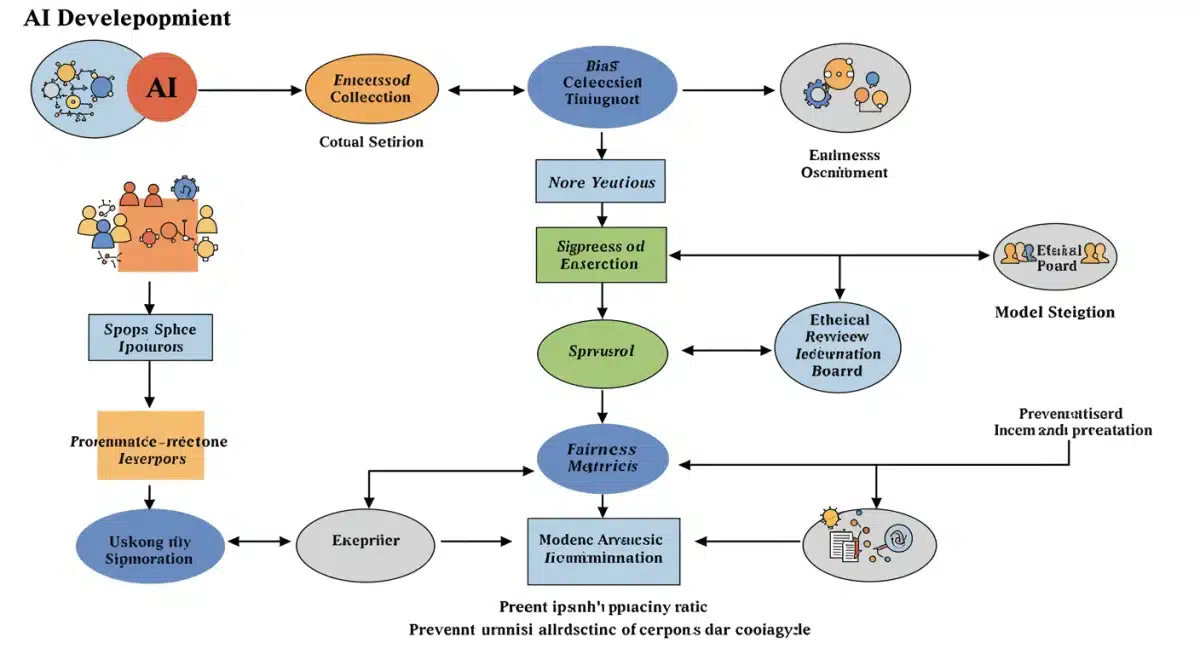
Integrating these tools and metrics into continuous integration/continuous deployment (CI/CD) pipelines can ensure that fairness is a constant consideration, not just an afterthought. This iterative approach allows for early detection and correction of biases, making the mitigation process more efficient.
In summary, implementing robust fairness metrics and leveraging advanced bias detection tools are indispensable steps for US AI developers. These practices enable the quantifiable assessment and proactive correction of algorithmic biases, moving closer to the goal of equitable AI systems by 2026.
ethical AI design and transparent model explainability
Beyond data and metrics, the very design of AI models must incorporate ethical considerations, and their decision-making processes need to be transparent. For US AI developers, adopting ethical AI design principles and prioritizing model explainability are crucial for building trust and accountability, especially with 2026 looming.
Ethical AI design involves making conscious choices about algorithms, features, and objectives that align with societal values and avoid discriminatory outcomes. Transparent model explainability, often referred to as XAI (Explainable AI), allows stakeholders to understand why an AI made a particular decision.
principles of ethical AI design
Building ethical AI systems requires a shift in mindset, integrating ethical considerations from conception to deployment.
- Human-centric design: Prioritize human well-being and societal benefit, ensuring AI systems augment human capabilities rather than diminish them or cause harm.
- Accountability and oversight: Design systems with clear lines of responsibility and mechanisms for human oversight, especially in high-stakes applications.
- Privacy by design: Embed privacy protections into the AI system’s architecture from the outset, minimizing data collection and ensuring secure processing.
- Robustness and reliability: Develop AI systems that are resilient to adversarial attacks and operate reliably under various conditions, preventing unexpected discriminatory behaviors.
Coupled with these design principles, explainability is vital. Complex ‘black box’ models, while powerful, often obscure the reasons behind their decisions, making it difficult to identify and correct biases. Techniques like LIME (Local Interpretable Model-agnostic Explanations) and SHAP (SHapley Additive exPlanations) can help shed light on model behavior.
By focusing on ethical design and ensuring model explainability, US AI developers can create systems that are not only effective but also trustworthy and fair. This dual approach is essential for navigating the complex ethical landscape of AI and preparing for future regulatory demands by 2026.
regulatory compliance and legal frameworks in 2026
The regulatory landscape for AI is evolving rapidly, and US AI developers must be acutely aware of impending compliance requirements by 2026. Ignoring these legal frameworks is not an option, as non-compliance can lead to significant penalties, reputational damage, and a loss of public trust. Proactive engagement with these regulations is paramount.
While a comprehensive federal AI law is still taking shape, several state-level initiatives and sector-specific guidelines are already influencing development. Developers need to anticipate future federal mandates and align their practices accordingly.
navigating the evolving legal terrain
Staying informed and adaptable is key to navigating the complex and dynamic regulatory environment surrounding AI.
- Understanding proposed federal guidelines: Monitor legislative developments and proposed frameworks from bodies like NIST (National Institute of Standards and Technology) regarding AI risk management and bias assessment.
- State-level AI laws: Be aware of state-specific laws, such as those in New York City concerning AI in hiring, which may set precedents for broader regulations.
- Sector-specific regulations: Adhere to industry-specific guidelines, for instance, those in healthcare or finance, which often have stricter requirements regarding data privacy and fairness.
- Internal compliance teams: Establish or empower internal teams dedicated to AI ethics and legal compliance to continuously monitor changes and ensure adherence.
Beyond explicit laws, developers should also consider the broader implications of existing civil rights legislation. AI systems, even if unintentionally, can violate anti-discrimination laws if their outputs have discriminatory effects on protected classes.
The imperative for US AI developers is to embrace a culture of continuous learning and adaptation regarding AI regulations. By actively engaging with emerging legal frameworks and striving for compliance, they can mitigate risks and demonstrate a commitment to responsible AI, well in advance of 2026.
fostering an ethical AI culture and continuous audits
Mitigating algorithmic discrimination is not just a technical challenge; it’s a cultural one. For US AI developers, fostering an ethical AI culture within their organizations is as crucial as implementing technical solutions. This involves creating an environment where ethical considerations are integrated into every stage of the AI lifecycle, from ideation to deployment and beyond.
Continuous auditing and monitoring are also vital to ensure that AI systems remain fair and unbiased over time. Algorithms are not static; they evolve, and so do the data they interact with, potentially introducing new biases or exacerbating existing ones.
building an ethical framework
Establishing an ethical AI culture requires clear policies, dedicated resources, and ongoing education.
- Cross-functional ethics committees: Form committees comprising ethicists, data scientists, legal experts, and end-users to provide diverse perspectives on AI projects and potential ethical pitfalls.
- Regular ethics training: Provide mandatory training for all AI development teams on ethical AI principles, bias awareness, and compliance requirements.
- Whistleblower protection: Create safe and anonymous channels for employees to report ethical concerns or potential biases within AI systems without fear of retaliation.
- Transparency and communication: Foster open dialogue about ethical challenges and solutions within the organization and with external stakeholders.
In addition to cultural shifts, continuous auditing practices are indispensable. This includes ongoing monitoring of model performance against fairness metrics, regular re-evaluation of training data, and periodic external audits by independent third parties to validate fairness and compliance.
The goal is to create a dynamic feedback loop where ethical considerations inform development, and continuous monitoring ensures sustained fairness. This holistic approach, combining cultural shifts with rigorous auditing, will empower US AI developers to effectively mitigate algorithmic discrimination and build truly responsible AI systems by 2026.
collaborative approaches and industry best practices
The challenge of mitigating algorithmic discrimination is too vast for any single organization or developer to tackle alone. Collaborative approaches and adherence to industry best practices are essential for US AI developers to make meaningful progress by 2026. Sharing knowledge, tools, and experiences can accelerate the development of fair and equitable AI.
This collaboration extends beyond individual companies to include academic institutions, government bodies, and non-profit organizations. Pooling resources and expertise can lead to more robust solutions and a more harmonized approach to ethical AI development.
leveraging collective intelligence
Engaging in collaborative initiatives and adopting recognized best practices can significantly enhance efforts to combat algorithmic discrimination.
- Participation in industry consortia: Join groups like the Partnership on AI or other industry-specific ethics working groups to contribute to and learn from collective efforts.
- Adoption of open standards: Utilize and contribute to open-source tools and frameworks for bias detection, fairness metrics, and explainable AI, fostering interoperability and shared progress.
- Academic-industry partnerships: Collaborate with universities and research institutions to conduct cutting-edge research on AI fairness, developing new methodologies and insights.
- Public-private dialogues: Engage in discussions with government agencies and policymakers to help shape effective and practical AI regulations that promote fairness without stifling innovation.
Beyond formal collaborations, simply sharing lessons learned and successful mitigation strategies through conferences, publications, and forums can be immensely valuable. This open exchange of information helps raise the collective bar for ethical AI development across the industry.
By embracing collaborative approaches and committing to industry best practices, US AI developers can collectively strengthen their efforts to mitigate algorithmic discrimination. This shared commitment is vital for building a future where AI serves all of humanity equitably and responsibly, especially as the 2026 deadline approaches.
| Key Point | Brief Description |
|---|---|
| Data Governance | Establish rigorous policies for ethical data sourcing, collection, and auditing to prevent bias from the start. |
| Fairness Metrics & Tools | Implement quantifiable metrics and open-source toolkits for continuous bias detection and measurement. |
| Ethical Design & Explainability | Prioritize human-centric AI design and ensure model transparency through explainable AI (XAI) techniques. |
| Regulatory Compliance | Stay informed and proactively comply with evolving federal and state-level AI ethics and anti-discrimination laws. |
Frequently Asked Questions About Algorithmic Discrimination Mitigation
It’s time-sensitive due to the rapid evolution of AI technology and the increasing societal impact of AI decisions. Emerging federal and state regulations are expected to mandate stricter ethical and fairness standards, making proactive compliance crucial to avoid significant legal and reputational consequences by 2026.
The primary source of algorithmic bias often stems from the data used to train AI models. If this data reflects historical or societal prejudices, or is unrepresentative of the target population, the AI system will learn and perpetuate those biases, leading to discriminatory outcomes in its predictions or decisions.
Developers can measure fairness using various metrics like demographic parity, equalized odds, and predictive equality. These metrics help quantify whether an AI system produces equitable outcomes across different demographic groups. Open-source toolkits like AI Fairness 360 can assist in applying and interpreting these measures effectively.
Explainable AI (XAI) is crucial because it helps demystify ‘black box’ AI models, allowing developers and stakeholders to understand the reasoning behind an AI’s decisions. This transparency is vital for identifying, diagnosing, and correcting biases that might otherwise remain hidden, thereby fostering trust and accountability in AI systems.
While a comprehensive federal AI law is still developing, US AI developers should monitor proposed federal guidelines from NIST and be aware of state-level laws, such as those in New York City regarding AI in hiring. Sector-specific regulations in healthcare and finance also impose strict fairness and privacy requirements that must be adhered to.
conclusion
The journey towards effectively mitigating algorithmic discrimination is a continuous and multifaceted endeavor for US AI developers. As the landscape of AI technology and its societal integration evolves, so too must the strategies employed to ensure fairness and equity. The impending regulatory shifts by 2026 underscore the critical need for immediate and proactive action. By prioritizing ethical data governance, implementing robust fairness metrics, embracing transparent AI design, fostering an ethical organizational culture, and engaging in collaborative industry best practices, developers can not only comply with future regulations but also build AI systems that genuinely serve humanity without prejudice. The commitment to responsible AI development today will define the ethical and equitable future of artificial intelligence.