LLM Hallucinations: New Strategies to Improve Factual Accuracy by 10% in 2025

Large Language Model (LLM) hallucinations, where AI generates false information, are a critical challenge impacting reliability, driving intensive research efforts to improve factual accuracy by 10% in 2025 through advanced validation and training methods.
The impact of Large Language Model hallucinations: new research strategies to improve factual accuracy by 10% in 2025 is a topic of paramount importance in the rapidly evolving landscape of artificial intelligence. These instances, where LLMs generate plausible but factually incorrect information, undermine trust and limit their widespread adoption across critical applications. Understanding the root causes and developing robust countermeasures is essential for the continued progress and reliability of AI.
Understanding LLM Hallucinations
Large Language Models, or LLMs, have demonstrated remarkable capabilities in generating human-like text, translating languages, and answering complex questions. However, a persistent and vexing issue is their propensity to ‘hallucinate,’ producing outputs that are confident in tone but factually baseless or nonsensical. This phenomenon is not a sign of malicious intent, but rather a byproduct of their training process and architectural design.
The core of an LLM’s operation involves predicting the next word in a sequence based on patterns learned from vast datasets. While this statistical pattern matching is incredibly powerful, it doesn’t inherently imbue the model with a true understanding of facts or causality. When faced with ambiguous prompts or insufficient training data for a specific query, the model might ‘invent’ information to complete the pattern, leading to a hallucination.
The Nature of Factual Errors
Hallucinations can manifest in various forms, ranging from subtle inaccuracies to outright fabrication. They can involve incorrect dates, names, statistics, or even entirely fictional events. The challenge lies in their often-convincing presentation, making them difficult for human users to detect without external verification. This makes the development of robust detection and mitigation strategies crucial.
- Confabulation: Generating information that is plausible but false, often filling in gaps with invented details.
- Contradiction: Producing statements that directly conflict with known facts or previous statements within the same output.
- Irrelevance: Providing information that is factually correct but completely unrelated to the user’s query.
Addressing these types of errors is not merely about refining a model’s vocabulary; it’s about instilling a deeper sense of factual grounding and contextual awareness. The research community is actively exploring diverse avenues, from architectural improvements to advanced training methodologies, to tackle this multifaceted problem. The goal is to move beyond mere linguistic fluency towards genuine factual integrity.
Current Challenges in Factual Accuracy
Despite significant advancements, achieving consistent factual accuracy in Large Language Models remains a formidable challenge. The sheer scale and complexity of these models, coupled with the inherent ambiguities of human language and knowledge, present multiple hurdles that researchers are striving to overcome. The absence of a definitive ‘ground truth’ for every possible query further complicates the evaluation process.
One primary challenge stems from the training data itself. While massive, these datasets can contain biases, inaccuracies, or outdated information. LLMs learn from this data, and any imperfections are inevitably reflected in their outputs. Furthermore, the models often prioritize fluency and coherence over strict factual adherence, sometimes generating convincing but incorrect prose.
Data Contamination and Bias
The internet, the primary source for LLM training data, is a vast repository of information, but it is also replete with misinformation and subjective content. Models trained on such data can inadvertently absorb and reproduce these inaccuracies. Identifying and filtering out erroneous or biased information at scale is an enormous undertaking.
- Outdated Information: Models trained on historical data may struggle with current events or rapidly changing facts.
- Propagated Misinformation: Erroneous claims frequently repeated online can be internalized by the model as fact.
- Source Attribution: LLMs typically do not cite sources for their generated content, making verification difficult for users.
Another significant challenge lies in the evaluation of factual accuracy. Manually fact-checking every generated output is impractical, and automated metrics often struggle to capture the nuances of factual correctness, especially in open-ended generations. Developing reliable and scalable evaluation frameworks is as critical as developing the models themselves. Without precise measurement, targeted improvements become difficult to track, hindering the ambitious goal of a 10% accuracy increase.
New Research Strategies: Data-Centric Approaches
To combat LLM hallucinations and enhance factual accuracy, a significant shift in research strategy is focusing on data-centric approaches. This involves not just increasing the quantity of training data, but meticulously curating, augmenting, and validating the quality and integrity of the information fed into these powerful models. The adage ‘garbage in, garbage out’ holds particularly true for LLMs, making data quality a cornerstone of future improvements.
One key method involves rigorous data curation. This goes beyond simple filtering and includes developing sophisticated pipelines to identify and rectify factual errors, remove biases, and ensure the timeliness of information. Researchers are exploring techniques like human-in-the-loop validation, where human experts review and annotate datasets for factual correctness, providing a strong signal for the models to learn from.
Enhanced Data Validation Techniques
Beyond initial curation, ongoing data validation is crucial. This includes cross-referencing information from multiple authoritative sources and employing automated fact-checking systems during the data preparation phase. Synthetic data generation is also being explored, creating highly controlled and factually accurate datasets to supplement real-world data, particularly for niche domains where reliable information might be scarce.
- External Knowledge Bases: Integrating structured knowledge graphs (e.g., Wikipedia, Wikidata) directly into the training or inference process to provide verifiable facts.
- Retrieval-Augmented Generation (RAG): Equipping LLMs with the ability to retrieve information from an external, trusted database before generating a response, grounding their answers in verifiable sources.
- Self-Correction Mechanisms: Training models to identify potential inaccuracies in their own outputs and then re-evaluate or reformulate their responses based on internal consistency checks or external validation.
These data-centric strategies aim to build a more robust foundation for LLM knowledge. By systematically improving the quality and reliability of the information LLMs learn from, researchers anticipate a direct and measurable improvement in factual accuracy, moving closer to the ambitious target of a 10% enhancement.
Architectural Innovations for Reliability
Beyond refining training data, significant efforts are being directed towards architectural innovations within LLMs themselves to improve their factual reliability. These advancements focus on designing models that are inherently less prone to hallucination, capable of better reasoning, and more transparent in their information processing. The goal is to embed factual integrity at a deeper structural level, rather than solely relying on external validation.
One promising area is the development of modular architectures. Instead of a single, monolithic model, future LLMs might consist of specialized modules: one for core language generation, another for factual retrieval, and perhaps a third for logical reasoning or consistency checking. This modularity could allow for more targeted interventions and better control over factual outputs.
Reasoning and Verification Modules
Integrating explicit reasoning and verification modules is a key architectural trend. These modules are designed to perform logical deductions, check for internal consistency, and cross-reference generated statements against a factual knowledge base or retrieved documents. This moves beyond mere statistical pattern matching to a more deliberate process of factual validation.
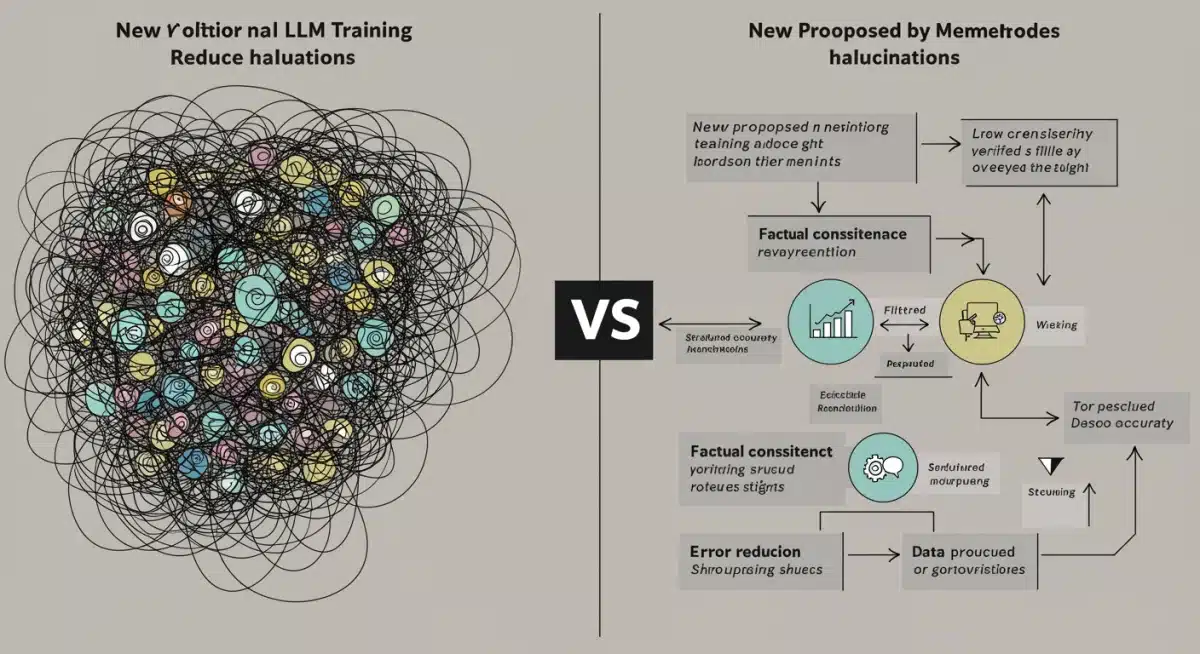

- Fact-Checking Layers: Adding dedicated layers within the neural network that evaluate the factual correctness of generated tokens or phrases before they are outputted.
- Uncertainty Quantification: Developing mechanisms for LLMs to express uncertainty or lack of knowledge when they are unsure about a fact, rather than generating a confident hallucination.
- Explainable AI (XAI) Integration: Designing models that can provide explanations or justifications for their factual claims, making it easier to trace information back to its source or identify potential errors.
These architectural shifts aim to create LLMs that are not only powerful generative tools but also reliable knowledge systems. By building in explicit mechanisms for factual verification and reasoning, researchers anticipate a substantial reduction in hallucinations and a measurable increase in overall factual accuracy, contributing significantly to the 2025 goal.
Advanced Training and Fine-tuning Techniques
Beyond data and architecture, advanced training and fine-tuning techniques are pivotal in the quest to reduce LLM hallucinations and enhance factual accuracy. These methods focus on refining the model’s learning process, encouraging it to prioritize truthfulness and consistency alongside linguistic fluency. The objective is to imbue LLMs with a more nuanced understanding of factual integrity during their development phase.
Reinforcement Learning from Human Feedback (RLHF) has shown considerable promise. By allowing human annotators to provide feedback not just on linguistic quality but specifically on factual correctness, models can learn to align their outputs more closely with human notions of truth. This iterative process helps steer the model away from generating plausible but incorrect statements.
Targeted Fine-tuning and Adversarial Training
Targeted fine-tuning on datasets specifically designed to expose and correct factual errors is another powerful approach. This involves creating datasets of known factual inaccuracies and training the model to identify and correct them. Adversarial training, where a ‘critic’ model attempts to identify hallucinations generated by the primary LLM, can also push the generative model to produce more factually robust outputs.
- Constraint-Based Training: Imposing explicit factual constraints or rules during training to guide the model towards factually accurate generations.
- Multi-Task Learning: Training LLMs on multiple related tasks simultaneously, including fact-checking or question-answering with a focus on evidence, to foster a broader understanding of factual knowledge.
- Domain Adaptation: Fine-tuning general LLMs on specific, highly curated domain-specific datasets to improve their factual accuracy within specialized fields where precision is paramount.
These sophisticated training paradigms move beyond brute-force data ingestion, focusing instead on teaching LLMs to reason about facts and self-correct. By combining these innovative training methods, researchers are optimistic about making substantial progress in improving factual accuracy, contributing significantly to the ambitious 10% target for 2025.
Measuring and Evaluating Factual Accuracy
Accurately measuring and evaluating the factual accuracy of LLMs is as critical as developing the strategies to improve it. Without robust and reliable metrics, it becomes challenging to track progress, compare different models, and ensure that research efforts are indeed leading to the desired 10% increase in accuracy. The complexity of LLM outputs necessitates sophisticated evaluation frameworks.
Traditional metrics like BLEU or ROUGE, while useful for linguistic quality, fall short in assessing factual correctness. New evaluation paradigms are emerging that focus specifically on factual consistency and verifiability. This often involves comparing generated statements against trusted knowledge bases or human-annotated ground truths, though scaling such methods remains a significant hurdle.
Developing Robust Evaluation Benchmarks
The creation of standardized, challenging benchmarks specifically designed to test factual accuracy is paramount. These benchmarks often include diverse factual questions, requiring models to retrieve, synthesize, and verify information across various domains. Human evaluation, while resource-intensive, remains a gold standard for nuanced factual assessment, often used to validate automated metrics.
- Fact-Checking Datasets: Curated datasets where each statement is labeled as factually correct or incorrect, allowing for automated evaluation of model outputs.
- Question Answering (QA) Benchmarks: Using QA datasets where answers require retrieving specific facts, enabling a direct measure of factual recall and precision.
- Adversarial Examples: Creating prompts specifically designed to elicit hallucinations, which helps stress-test models and identify their factual weaknesses.
The continuous development and refinement of these measurement and evaluation techniques are essential. They provide the necessary feedback loop for researchers to iterate on their models and training strategies. By establishing clear, quantifiable metrics for factual accuracy, the AI community can collectively work towards and objectively verify the ambitious goal of a 10% improvement by 2025, ensuring transparent progress in LLM reliability.
The Path Towards 10% Improvement by 2025
Achieving a 10% improvement in the factual accuracy of Large Language Models by 2025 is an ambitious yet attainable goal, driven by the convergence of innovative research strategies. This improvement is not expected to come from a single breakthrough but rather from a synergistic application of data-centric approaches, architectural enhancements, and advanced training methodologies. The collective efforts across the AI community are geared towards building more reliable and trustworthy LLM systems.
The focus moving forward will be on integrating these strategies into a cohesive framework. For instance, combining highly curated and validated datasets with modular architectures that include dedicated fact-checking components, all fine-tuned using reinforcement learning from human feedback, represents a powerful multi-pronged attack on hallucinations. This holistic approach ensures that factual integrity is considered at every stage of an LLM’s development and deployment.
Key Pillars for Success
Several key pillars will underpin the journey towards the 10% accuracy improvement. These include continued investment in high-quality data annotation, the development of more sophisticated reasoning capabilities within models, and the establishment of universally accepted evaluation benchmarks that can truly capture factual nuance. Collaboration between academic institutions and industry will accelerate progress.
- Cross-Disciplinary Research: Integrating insights from cognitive science, logic, and epistemology into AI research to better model human understanding of facts.
- Open-Source Collaboration: Sharing research findings, datasets, and models to foster rapid iteration and collective problem-solving within the AI community.
- Ethical AI Development: Prioritizing factual accuracy as a core ethical principle in LLM design, ensuring that these powerful tools serve humanity responsibly.
The journey to a 10% improvement in factual accuracy by 2025 is not just about technical advancements; it’s about fostering a paradigm shift in how we approach LLM development. By prioritizing truthfulness and reliability, the AI community can unlock the full potential of these models, making them indispensable and trusted tools across a vast array of applications, from scientific research to everyday information retrieval.
| Key Strategy | Brief Description |
|---|---|
| Data Curation & Validation | Meticulously cleaning, augmenting, and verifying training data to eliminate inaccuracies and biases. |
| Architectural Innovation | Developing modular LLM designs with explicit reasoning and fact-checking components. |
| Advanced Training Techniques | Utilizing RLHF, targeted fine-tuning, and adversarial methods to prioritize truthfulness. |
| Robust Evaluation | Creating standardized benchmarks and metrics to accurately measure and track factual accuracy improvements. |
Frequently Asked Questions About LLM Hallucinations
LLM hallucinations refer to instances where Large Language Models generate information that is plausible and grammatically correct but factually incorrect or entirely fabricated. This can include wrong names, dates, statistics, or fictional events, often presented with high confidence.
LLMs hallucinate primarily because they are trained to predict the next word based on statistical patterns in vast datasets, not to ‘understand’ facts. When faced with ambiguous inputs or insufficient data, they may ‘invent’ information to complete a coherent linguistic pattern, leading to factual errors.
Data quality is crucial. If LLMs are trained on datasets containing biases, inaccuracies, or outdated information, they will inevitably reflect these imperfections in their outputs. High-quality, curated, and validated data is fundamental to reducing hallucinations and improving factual correctness.
Architectural innovations, such as modular designs with dedicated fact-checking or reasoning components, aim to embed factual integrity directly into the LLM’s structure. These designs allow models to verify information internally or express uncertainty, making them inherently less prone to factual errors.
Yes, researchers believe a 10% improvement in factual accuracy by 2025 is realistic. This ambitious goal is driven by synergistic advancements in data curation, architectural design, advanced training techniques like RLHF, and more robust evaluation methodologies, all contributing to more reliable LLMs.
Conclusion
The pursuit of enhanced factual accuracy in Large Language Models is a critical endeavor that underpins the future reliability and trustworthiness of AI. The challenge of hallucinations, while complex, is being met with a multi-faceted research approach encompassing meticulous data curation, innovative architectural designs, and sophisticated training paradigms. The collective ambition to achieve a 10% improvement in factual accuracy by 2025 is a testament to the AI community’s commitment to developing more responsible and effective intelligent systems. As these strategies mature and are implemented, LLMs are poised to become not just powerful generative tools, but also robust and dependable sources of information, profoundly impacting various sectors and empowering users with greater confidence.