AI Bias Detection 2026: Practical Guide to Reducing Algorithmic Discrimination by 15%

AI Bias Detection 2026: A Practical Guide to Reducing Algorithmic Discrimination by 15%
The year is 2026, and Artificial Intelligence (AI) has permeated nearly every facet of our lives, from personalized recommendations to critical decision-making in healthcare, finance, and justice. While AI promises unprecedented efficiency and innovation, its rapid deployment has also brought into sharp focus a critical challenge: algorithmic bias. This isn’t a new problem, but in 2026, with AI systems becoming more autonomous and influential, the urgency to address and mitigate bias has reached an all-time high. The goal is no longer just to acknowledge bias, but to actively reduce algorithmic discrimination by a measurable margin, aiming for a 15% reduction across various applications. This comprehensive guide will delve into the practical strategies, tools, and best practices for effective AI bias detection and mitigation in the current landscape.
The Evolving Landscape of AI Bias in 2026
Algorithmic bias, at its core, refers to systematic and repeatable errors in a computer system that create unfair outcomes, such as privileging one arbitrary group over another. These biases can creep into AI systems through various stages of development, from biased training data to flawed model design, and even through the way models are deployed and interact with users. In 2026, the sources of bias are more complex than ever, often stemming from:
- Legacy Data: Historical human biases embedded in datasets reflecting past societal inequalities.
- Data Collection Gaps: Underrepresentation of certain demographic groups in training data, leading to models that perform poorly or unfairly for those groups.
- Feature Selection: Unintended proxies for sensitive attributes (e.g., zip code as a proxy for race or socioeconomic status).
- Algorithm Design: Design choices that inadvertently amplify existing biases or introduce new ones.
- Interaction Bias: AI systems learning and reinforcing biases through continuous interaction with biased user inputs or environments.
The consequences of unchecked AI bias are profound, ranging from financial exclusion and discriminatory hiring practices to misdiagnosis in healthcare and unfair judicial outcomes. Recognizing these risks, regulatory bodies and industry leaders are increasingly emphasizing the need for robust AI bias detection and mitigation frameworks. The ambition to reduce algorithmic discrimination by 15% by 2026 is not just an arbitrary number; it reflects a growing consensus on the need for quantifiable progress in ethical AI development.
Understanding the ‘Why’ Behind Bias Reduction
Beyond the ethical imperative, there are compelling practical and business reasons to prioritize AI bias detection and reduction:
- Regulatory Compliance: Governments worldwide are enacting stricter regulations regarding AI ethics and fairness. Non-compliance can lead to hefty fines, legal challenges, and reputational damage.
- Brand Reputation and Trust: Companies known for deploying biased AI risk losing customer trust and public goodwill. Ethical AI builds a positive brand image.
- Improved Model Performance: Biased models often generalize poorly to diverse populations, leading to suboptimal performance and inaccurate predictions for significant segments of users. Reducing bias often means improving overall model robustness.
- Market Expansion: Fair AI systems can cater to a broader, more diverse user base, opening new market opportunities and fostering inclusivity.
- Talent Attraction: Professionals in AI and data science are increasingly seeking roles in organizations committed to ethical AI development.
The 15% reduction target serves as a tangible benchmark, encouraging organizations to move beyond theoretical discussions to implement concrete, measurable strategies for addressing bias.
Key Strategies for Effective AI Bias Detection in 2026
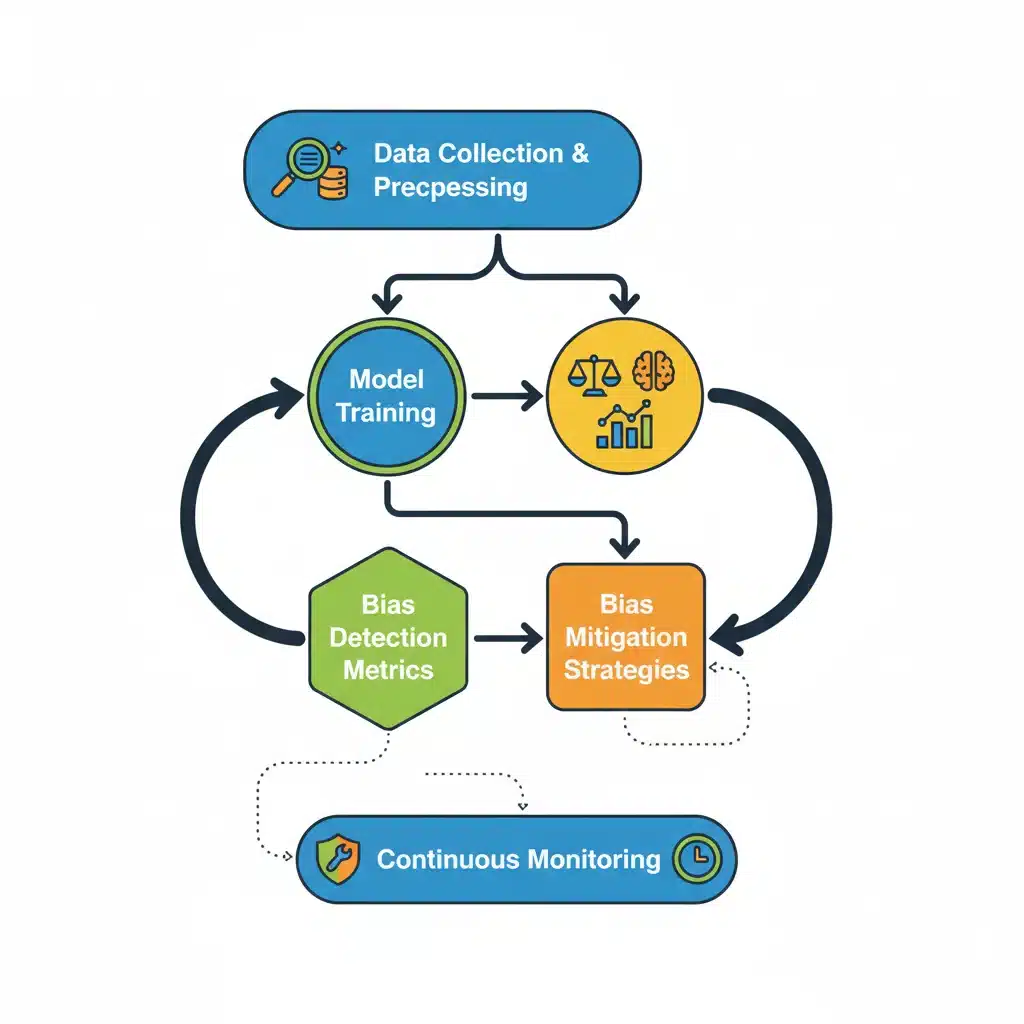
Effective AI bias detection requires a multi-faceted approach, integrating technical tools with organizational processes and ethical considerations. Here are the core strategies:
1. Comprehensive Data Auditing and Preprocessing
The journey to unbiased AI begins with unbiased data. In 2026, advanced data auditing techniques are crucial:
- Fairness Metrics for Data: Utilize metrics like statistical parity, disparate impact, and demographic parity to analyze training data for imbalances across sensitive attributes (e.g., gender, race, age, socioeconomic status).
- Data Annotation Audits: If human annotators are involved, audit their work for subjective biases. Implement diversity in annotation teams and clear, bias-aware guidelines.
- Synthetic Data Generation: In cases where real-world data is inherently biased or scarce for certain groups, carefully controlled synthetic data can help balance datasets, though this must be done with extreme caution to avoid introducing new biases.
- Bias Mitigation during Preprocessing: Techniques like re-sampling (oversampling underrepresented groups, undersampling overrepresented groups), re-weighting data points, and adversarial debiasing can be applied before model training.
2. Advanced Model-Agnostic Bias Detection Tools
Beyond data, the models themselves need scrutiny. 2026 sees a proliferation of sophisticated tools for AI bias detection:
- Explainable AI (XAI) for Bias Diagnosis: XAI techniques like SHAP (SHapley Additive exPlanations) and LIME (Local Interpretable Model-agnostic Explanations) are invaluable. They help understand which features contribute most to a model’s prediction for individual instances, revealing potential discriminatory decision paths. If a model consistently relies on a proxy for a sensitive attribute, XAI can expose it.
- Fairness Metrics for Models: Apply a range of fairness metrics post-training to evaluate model outputs. These include:
- Demographic Parity: Ensures that positive outcomes are equally distributed across different groups.
- Equalized Odds: Ensures that the true positive rates and false positive rates are equal across different groups.
- Predictive Parity: Requires that the positive predictive value (precision) is equal across groups.
- Sufficiency: Requires that the positive predictive value and negative predictive value are equal across groups.
- Counterfactual Fairness: A more advanced concept where a model is considered fair if its prediction for an individual remains the same, even if their sensitive attributes were changed (e.g., changing gender or race) while keeping other features fixed.
- Bias Auditing Frameworks: Utilize open-source libraries and commercial platforms (e.g., IBM’s AI Fairness 360, Google’s What-If Tool, Microsoft’s Fairlearn) that provide a suite of bias detection metrics and visualization tools.
3. Proactive Bias Mitigation during Model Development
AI bias detection is only half the battle; mitigation is where the real impact happens. Strategies include:
- In-processing Mitigation: Incorporate fairness constraints directly into the model training process. This can involve adversarial debiasing, where an adversarial network attempts to predict sensitive attributes from the model’s output, and the main model is trained to fool it, thereby removing sensitive information from its predictions.
- Regularization Techniques: Modify loss functions to include fairness-aware regularization terms that penalize disparate treatment or impact.
- Algorithmic Redesign: In some cases, the underlying algorithm itself may need redesigning to explicitly account for fairness. This might involve using different objective functions or architectural changes.
4. Post-Deployment Monitoring and Feedback Loops
Bias is not a static problem. Models can develop new biases over time due to concept drift or changes in user interaction patterns. Continuous monitoring is essential:
- Real-time Bias Monitoring: Implement dashboards and alerting systems that continuously track fairness metrics on live model predictions, identifying deviations from desired fairness thresholds.
- Human-in-the-Loop Feedback: Establish mechanisms for human experts to review AI decisions and provide feedback, especially in sensitive applications. This feedback can then be used to retrain and refine models.
- User Feedback Mechanisms: Allow end-users to report perceived biases or unfair outcomes, providing valuable real-world insights.
- A/B Testing for Fairness: When deploying new versions of models, conduct A/B tests to compare fairness metrics between the old and new versions across different demographic segments.
Tools and Technologies for AI Bias Detection in 2026
The ecosystem of tools for AI bias detection has matured significantly by 2026. Here’s a look at some prominent categories:
- Open-Source Libraries:
- AI Fairness 360 (IBM): A comprehensive open-source toolkit that provides a wide range of metrics for measuring fairness and algorithms for mitigating bias in datasets and machine learning models.
- Fairlearn (Microsoft): Focuses on assessing and improving fairness of AI systems, with capabilities to mitigate various types of unfairness.
- Aequitas (University of Chicago): An open-source toolkit for auditing bias in machine learning models, providing group-level metrics and visualizations.
- What-If Tool (Google): A visual, interactive tool to explore and debug ML models, helping users understand model behavior and identify potential fairness issues.
- Commercial Platforms and Services: Many cloud providers (AWS, Google Cloud, Azure) now offer integrated fairness toolkits within their ML platforms. Specialized startups also provide advanced bias detection and mitigation as a service, often leveraging differential privacy and federated learning for sensitive data.
- Explainable AI (XAI) Frameworks:
- SHAP: Provides game-theoretic explanations for model outputs, showing the contribution of each feature to a prediction.
- LIME: Explains individual predictions of any classifier in an interpretable and faithful manner.
- Data Anonymization and Privacy-Preserving Techniques: Differential privacy, homomorphic encryption, and federated learning are increasingly used to enable training on sensitive data without exposing individual information, reducing the risk of indirect bias through data leakage.
Measuring Progress: Achieving the 15% Reduction Target
The goal of reducing algorithmic discrimination by 15% necessitates clear, measurable metrics and a consistent reporting framework. Here’s how organizations are approaching this in 2026:
- Baseline Establishment: Before implementing mitigation strategies, organizations must establish a baseline of bias using a chosen set of fairness metrics across critical AI applications. This baseline provides the starting point for measuring improvement.
- Key Performance Indicators (KPIs) for Fairness: Define specific KPIs related to fairness, such as:
- Percentage reduction in disparate impact for sensitive groups.
- Improvement in equalized odds scores across different demographics.
- Reduction in the performance gap (e.g., accuracy, recall) between the majority and minority groups.
- Regular Audits and Reporting: Conduct periodic internal and external audits to assess progress against the 15% target. Publish transparency reports detailing bias detection efforts, methodologies, and measured reductions.
- Standardized Benchmarks: Collaborate with industry bodies and academic institutions to develop standardized benchmarks and datasets for evaluating fairness across different AI domains, allowing for more consistent measurement and comparison.
Achieving a 15% reduction isn’t a one-time fix; it’s an ongoing commitment to continuous improvement and refinement of AI systems.
Organizational Best Practices for Ethical AI Development
Technology alone cannot solve the problem of AI bias. Organizational culture and processes play a crucial role in fostering ethical AI development:
1. Diverse and Inclusive AI Teams
Homogeneous development teams are more likely to overlook biases that affect underrepresented groups. Promoting diversity in AI teams (gender, ethnicity, socioeconomic background, disability status, etc.) brings varied perspectives that can help identify and address potential biases early in the development cycle. This is a foundational element for effective AI bias detection.
2. Ethical AI Governance and Policies
Establish clear internal policies and guidelines for ethical AI development, deployment, and monitoring. This includes:
- AI Ethics Committees: Cross-functional committees comprising ethicists, legal experts, data scientists, and business leaders to review AI projects for ethical implications.
- Responsible AI Principles: Define and communicate core principles that guide all AI development, emphasizing fairness, accountability, transparency, and privacy.
- Bias Impact Assessments: Mandate pre-deployment assessments to identify and mitigate potential biases and their societal impacts.
3. Continuous Training and Education
Regular training on AI ethics, bias detection techniques, and responsible AI practices for all employees involved in AI development, from data scientists to product managers, is vital. This ensures a shared understanding and commitment to fairness.
4. Transparency and Explainability
Strive for transparency in AI systems by documenting data sources, model architectures, and decision-making processes. Prioritize explainable AI (XAI) to ensure that model predictions can be understood and audited, especially when sensitive decisions are made. This bolsters trust and facilitates external review for AI bias detection.
Challenges and Future Outlook for AI Bias Detection
Despite significant progress, challenges remain in the quest for truly unbiased AI:
- Defining Fairness: There is no single, universally agreed-upon definition of fairness. Different contexts and stakeholders may prioritize different fairness metrics, leading to trade-offs.
- Intersectionality: Addressing bias for intersecting social groups (e.g., Black women, elderly LGBTQ+ individuals) is complex, as biases can accumulate and interact in nuanced ways.
- Data Scarcity for Minority Groups: While synthetic data helps, genuine, representative data for very specific minority groups can still be hard to obtain, making robust bias detection and mitigation challenging.
- Dynamic Nature of Bias: As mentioned, biases can evolve, requiring continuous adaptation of detection and mitigation strategies.
- Scalability of Solutions: Implementing comprehensive bias detection and mitigation across thousands of AI models in large organizations remains a significant operational challenge.
Looking ahead, 2026 is just a stepping stone. The future of AI bias detection will likely see:
- Greater Standardization: More widely accepted industry standards and certifications for ethical AI.
- AI for AI Fairness: AI systems designed to detect and mitigate bias in other AI systems, operating with higher efficiency.
- Legally Mandated Audits: Regular, independent third-party audits for AI systems in high-stakes applications becoming a legal requirement.
- Proactive Design: Shifting from reactive bias mitigation to proactive, ‘fairness-by-design’ principles embedded from the initial conceptualization of AI projects.
Conclusion: A Commitment to Fairer AI
The journey to reducing algorithmic discrimination by 15% in 2026 is an ambitious yet achievable goal. It requires a concerted effort from data scientists, engineers, ethicists, policymakers, and organizations as a whole. By embracing comprehensive data auditing, leveraging advanced AI bias detection tools, implementing proactive mitigation strategies, and fostering a culture of ethical AI, we can build fairer, more robust, and ultimately more beneficial AI systems for everyone. The continuous evolution of AI demands a continuous commitment to its ethical development, ensuring that technology serves humanity equitably and justly. The work is ongoing, but the foundation laid in 2026 sets a powerful precedent for a future where AI truly empowers all.