AI Regulation 2026: US Tech Compliance & Innovation Guide

Navigating 2026’s AI Regulatory Landscape: A Guide for U.S. Tech Companies on Compliance and Innovation
The dawn of 2026 marks a pivotal moment for artificial intelligence (AI) in the United States. As AI technologies continue their exponential growth, so does the imperative for robust regulatory frameworks. For U.S. tech companies, understanding and proactively adapting to the evolving landscape of AI Regulation 2026 US is not merely a legal obligation but a strategic necessity for sustainable growth and competitive advantage. This comprehensive guide delves into the anticipated regulatory shifts, offering insights and actionable strategies to ensure compliance while fostering innovation in the dynamic AI sector.
The conversation around AI governance has intensified globally, with major economies like the European Union leading the charge with comprehensive legislation such as the AI Act. While the U.S. approach has historically been more fragmented, 2026 is expected to bring increased clarity and more consolidated efforts from federal and state governments. Companies operating within this space must prepare for a multi-faceted regulatory environment that touches upon data privacy, algorithmic transparency, bias mitigation, cybersecurity, and consumer protection.
The Current State of AI Regulation in the US: A Patchwork Pre-2026
Before we project into 2026, it’s crucial to understand the foundation upon which future regulations are being built. The U.S. has not yet adopted a single, overarching federal law specifically governing AI, unlike some of its international counterparts. Instead, the regulatory environment has been characterized by a ‘sector-specific’ and ‘principle-based’ approach, relying on existing laws and the guidance of various agencies. This patchwork includes:
- Executive Orders and Directives: The Biden administration has issued several executive orders, notably the ‘Executive Order on the Safe, Secure, and Trustworthy Development and Use of Artificial Intelligence’ (October 2023). This order laid the groundwork for federal agencies to develop standards, guidelines, and best practices for AI safety, security, and privacy. It also mandated reporting requirements for developers of powerful AI systems and addressed issues like AI-generated synthetic content and national security risks. These orders are not laws themselves but direct federal agencies to act, often paving the way for future legislation.
- National Institute of Standards and Technology (NIST) AI Risk Management Framework (RMF): Published in early 2023, the NIST AI RMF is a voluntary framework designed to help organizations manage the risks of AI. While not legally binding, it is increasingly seen as a de facto standard for responsible AI development and deployment, and its principles are likely to be incorporated into future mandatory regulations. It emphasizes governability, trustworthiness, and risk mitigation.
- Sector-Specific Regulations: Existing laws in areas like healthcare (HIPAA), finance (Gramm-Leach-Bliley Act), and consumer protection (FTC Act) are being interpreted and applied to AI. For example, the Federal Trade Commission (FTC) has been active in addressing deceptive AI practices and algorithmic bias under its existing authority to protect consumers. Similarly, the Equal Employment Opportunity Commission (EEOC) is scrutinizing AI tools used in hiring for potential discriminatory impacts.
- State-Level Initiatives: Several states have taken the lead in AI regulation. California, for instance, with its robust data privacy laws (CCPA/CPRA), is exploring how these apply to AI-driven data processing. Other states are considering legislation on specific AI applications, such as facial recognition or algorithmic decision-making in critical sectors. The varied state landscape adds another layer of complexity for companies operating nationwide.
- Data Privacy Laws: The general landscape of data privacy, including state laws like CCPA/CPRA, Virginia’s CDPA, and Colorado’s CPA, significantly impacts how AI systems collect, process, and use personal data. These laws often require explicit consent, provide data subject rights, and mandate data protection assessments, all of which are critical for AI developers.
This fragmented approach has created both flexibility and uncertainty. However, as AI becomes more pervasive, the pressure for more cohesive and enforceable regulations is mounting, setting the stage for significant changes in 2026.
Key Areas of Focus for 2026 AI Regulation US
Looking ahead to 2026, several key themes are expected to dominate the U.S. AI regulatory agenda. Tech companies should pay close attention to these areas:
1. Algorithmic Transparency and Explainability
One of the most persistent concerns with AI is the ‘black box’ problem – the difficulty in understanding how AI models arrive at their decisions. AI Regulation 2026 US is likely to push for greater algorithmic transparency and explainability, particularly in high-stakes applications such as credit scoring, employment, healthcare diagnostics, and criminal justice. This could involve:
- Disclosure Requirements: Companies might be required to disclose when AI is being used to make significant decisions affecting individuals.
- Explainability Mandates: Regulations may demand that AI systems provide clear, understandable explanations for their outputs, especially when those outputs lead to adverse impacts. This could involve technical requirements for interpretable AI models or documentation of decision-making processes.
- Impact Assessments: Mandatory algorithmic impact assessments (AIAs) could become standard, requiring companies to evaluate potential biases, risks, and societal impacts before deploying AI systems.
2. Bias Detection and Mitigation
Bias in AI, often stemming from biased training data or flawed algorithms, can perpetuate and even amplify societal inequalities. Addressing algorithmic bias is a top priority for regulators. Expected developments include:
- Anti-Discrimination Laws Applied to AI: Existing anti-discrimination laws (e.g., Civil Rights Act, ADA) will continue to be vigorously applied to AI systems in areas like hiring, lending, and housing. Regulators may issue specific guidance on how to ensure AI compliance.
- Bias Auditing Requirements: Companies may face requirements to regularly audit their AI systems for bias, using standardized metrics and independent third-party assessments.
- Fairness Metrics and Standards: Development and adoption of industry-specific fairness metrics and best practices for mitigating bias are likely to be encouraged or mandated.
3. Data Privacy and Security in AI
The insatiable need for data to train and operate AI models brings significant privacy and security challenges. AI Regulation 2026 US will undoubtedly reinforce and expand data protection principles:
- Enhanced Data Governance: Stricter requirements for data collection, storage, use, and deletion, especially for personal and sensitive data. This includes robust consent mechanisms and data minimization principles.
- AI-Specific Data Security: New standards for securing AI models and their training data against cyber threats, including adversarial attacks that can manipulate AI outputs.
- Privacy-Enhancing Technologies (PETs): Increased emphasis on the use of PETs like federated learning, differential privacy, and homomorphic encryption to protect data while enabling AI development.

4. AI Accountability and Liability
Determining accountability when AI systems cause harm is a complex legal challenge. 2026 is likely to see movements towards clearer frameworks for AI liability:
- Producer Responsibility: Regulations may assign clear responsibilities to developers, deployers, and operators of AI systems for ensuring their safety, reliability, and ethical performance.
- Risk-Based Approaches: A tiered approach to regulation, similar to the EU AI Act, where AI systems are categorized based on their risk level (e.g., unacceptable risk, high-risk, limited risk, minimal risk), with higher-risk systems facing more stringent requirements.
- Human Oversight Requirements: Mandates for meaningful human oversight in critical AI decision-making processes to ensure that humans retain ultimate control and accountability.
5. Intellectual Property and Copyright for AI-Generated Content
The rapid rise of generative AI has sparked intense debate over intellectual property rights. Who owns content created by AI? What about the data used to train these models? While complex, AI Regulation 2026 US could begin to address:
- Attribution and Licensing: Potential requirements for attributing AI-generated content or for licensing data used in training AI models.
- Copyright Protection: Clarification on whether AI-generated works are eligible for copyright protection and, if so, who holds those rights.
- Fair Use Doctrine: Reinterpretation or expansion of the fair use doctrine in the context of AI training data.
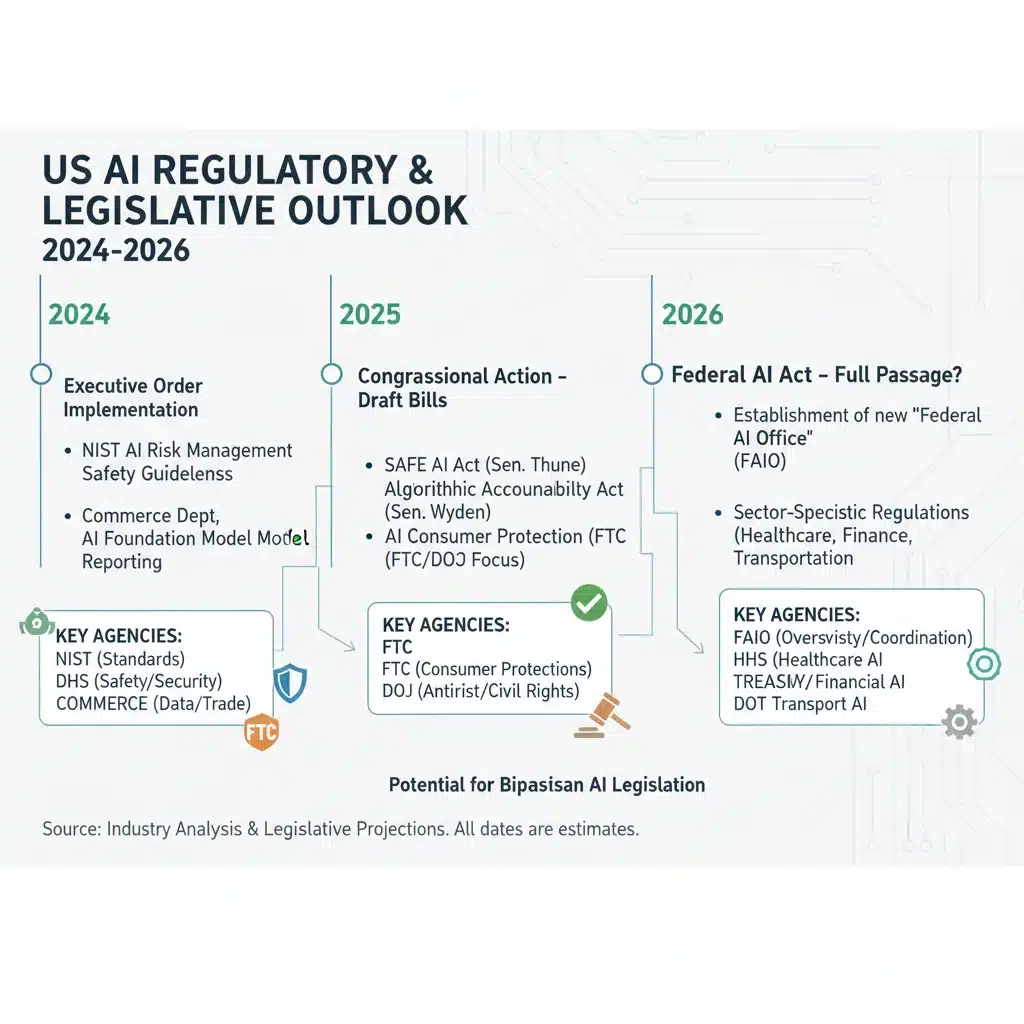
Anticipated Legislative and Agency Actions by 2026
While predicting exact legislative outcomes is difficult, we can anticipate several avenues through which AI Regulation 2026 US will materialize:
- Congressional Action: Despite political divides, bipartisan interest in AI regulation exists. Lawmakers are likely to continue drafting and debating comprehensive federal AI legislation. While a broad AI law akin to the EU AI Act might not pass by 2026, targeted legislation addressing specific AI risks (e.g., deepfakes, critical infrastructure AI) is more probable.
- Federal Agency Rulemaking: Agencies like the FTC, NIST, FDA, Department of Commerce, and Department of Labor will likely issue more specific rules, guidance, and enforcement actions based on existing authorities and new directives from Executive Orders. The FDA, for instance, is already developing frameworks for AI in medical devices, and this will continue to evolve.
- State-Level Harmonization Efforts: As more states enact their own AI-related laws, there might be efforts towards some level of harmonization or, conversely, increased fragmentation. Companies should monitor leading states like California, New York, and Colorado for their AI policy developments.
- International Collaboration and Standards: The U.S. will likely continue to engage in international dialogues and collaborations on AI governance, influencing and being influenced by global standards. This could lead to the adoption of internationally recognized best practices.
Strategies for U.S. Tech Companies: Compliance and Innovation in 2026
Navigating the complex terrain of AI Regulation 2026 US requires a proactive and strategic approach. Here are key strategies for U.S. tech companies:
1. Establish Robust AI Governance Frameworks
Implement internal policies and procedures for responsible AI development and deployment. This includes:
- Dedicated AI Ethics Committees: Form cross-functional teams comprising legal, technical, ethics, and business experts to oversee AI initiatives and ensure compliance.
- Internal Guidelines and Best Practices: Develop clear guidelines for data collection, model development, testing, deployment, and monitoring, aligned with principles like the NIST AI RMF.
- Regular Audits and Assessments: Conduct periodic internal and external audits of AI systems for bias, performance, security, and compliance with emerging regulations.
2. Prioritize Privacy by Design and Security by Design
Embed privacy and security considerations into the very architecture of AI systems from the outset, rather than as an afterthought:
- Data Minimization: Collect only the data necessary for the AI system’s purpose.
- Anonymization and Pseudonymization: Utilize techniques to protect personal data where possible.
- Robust Access Controls: Implement strict controls over who can access AI models and their training data.
- Threat Modeling: Proactively identify and mitigate potential security vulnerabilities specific to AI systems, including adversarial attacks.
3. Invest in Algorithmic Transparency and Explainability Tools
As regulatory pressure mounts, the ability to explain AI decisions will be paramount:
- Explainable AI (XAI) Techniques: Integrate XAI methods into your development lifecycle to make AI models more interpretable.
- Documentation and Record-Keeping: Maintain detailed records of AI model development, training data, performance metrics, and decision-making processes.
- User-Facing Explanations: Develop clear and concise explanations for end-users when AI systems make impactful decisions.
4. Proactively Address AI Bias
Building fair and equitable AI systems is not just a regulatory requirement but an ethical imperative:
- Diverse Data Sets: Ensure training data is diverse and representative to avoid perpetuating societal biases.
- Bias Detection Tools: Utilize and develop tools to detect and measure bias in AI models.
- Mitigation Strategies: Implement techniques to mitigate identified biases, such as re-weighting training data, adjusting algorithms, or post-processing model outputs.
- Human-in-the-Loop: Design AI systems that allow for human review and intervention, especially in critical decision-making contexts.
5. Stay Informed and Engage with Policymakers
The regulatory landscape is fluid, necessitating continuous monitoring and engagement:
- Monitor Legislative Developments: Keep abreast of proposed federal and state legislation, as well as new agency guidance.
- Participate in Industry Groups: Join industry associations and working groups focused on AI policy to share insights and influence regulatory discussions.
- Provide Feedback to Regulators: Engage during public comment periods for proposed rules to ensure your company’s perspective is heard.
6. Foster a Culture of Responsible AI Innovation
Compliance should not stifle innovation; rather, it should guide it towards more responsible and trustworthy AI. Companies that embed ethical considerations into their innovation process will build greater trust with consumers and regulators. This involves:
- Ethical by Design: Integrating ethical considerations from the initial conceptualization of an AI product.
- Cross-Disciplinary Collaboration: Encouraging collaboration between technical teams, ethicists, legal experts, and social scientists.
- Continuous Learning: Investing in training and education for employees on responsible AI practices and emerging regulations.
The Intersection of Compliance and Competitive Advantage
While AI Regulation 2026 US might seem like an added burden, it also presents a significant opportunity. Companies that proactively embrace responsible AI practices will gain a competitive advantage by:
- Building Trust: Consumers and business partners are increasingly concerned about AI’s ethical implications. Demonstrating a commitment to responsible AI builds trust and strengthens brand reputation.
- Mitigating Risks: Proactive compliance reduces the risk of costly legal battles, regulatory fines, and reputational damage.
- Attracting Talent: Top AI talent is often drawn to organizations committed to ethical and responsible development.
- Fostering Sustainable Innovation: By building AI responsibly, companies can create more robust, fair, and reliable products that have long-term societal benefit and market acceptance.
Challenges and Opportunities for U.S. Tech Companies
The journey towards comprehensive AI Regulation 2026 US is not without its challenges. The rapid pace of technological advancement often outstrips the speed of legislative processes. Furthermore, defining complex concepts like ‘harm,’ ‘bias,’ and ‘explainability’ in a legally enforceable way remains a significant hurdle. The balance between fostering innovation and ensuring public safety and ethical use is delicate.
However, these challenges also present opportunities. Companies that actively participate in shaping the regulatory dialogue can help create frameworks that are both effective and practical. Those that invest early in robust AI governance, privacy-enhancing technologies, and bias mitigation strategies will be well-positioned to lead the market, not just in technological prowess but also in trustworthiness and ethical leadership.
Conclusion
The year 2026 is poised to be transformative for AI Regulation 2026 US. For U.S. tech companies, the days of unregulated AI development are rapidly coming to an end. The shift towards a more structured and enforceable regulatory environment demands vigilance, adaptability, and a commitment to responsible innovation. By understanding the anticipated regulatory landscape, establishing robust internal governance, prioritizing privacy and ethics, and actively engaging with the policy-making process, companies can not only ensure compliance but also cement their position as leaders in the ethical and impactful development of artificial intelligence. The future of AI in the U.S. will be defined by how effectively tech companies navigate this complex interplay of innovation and regulation.